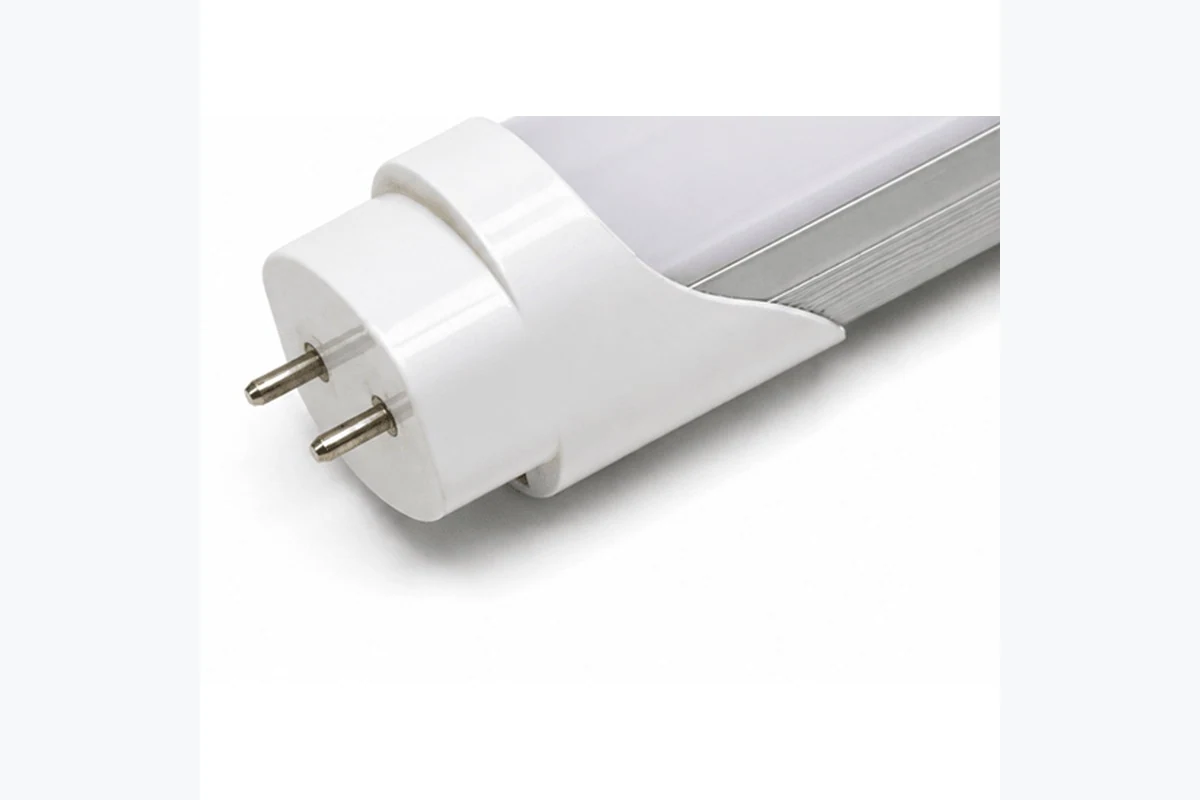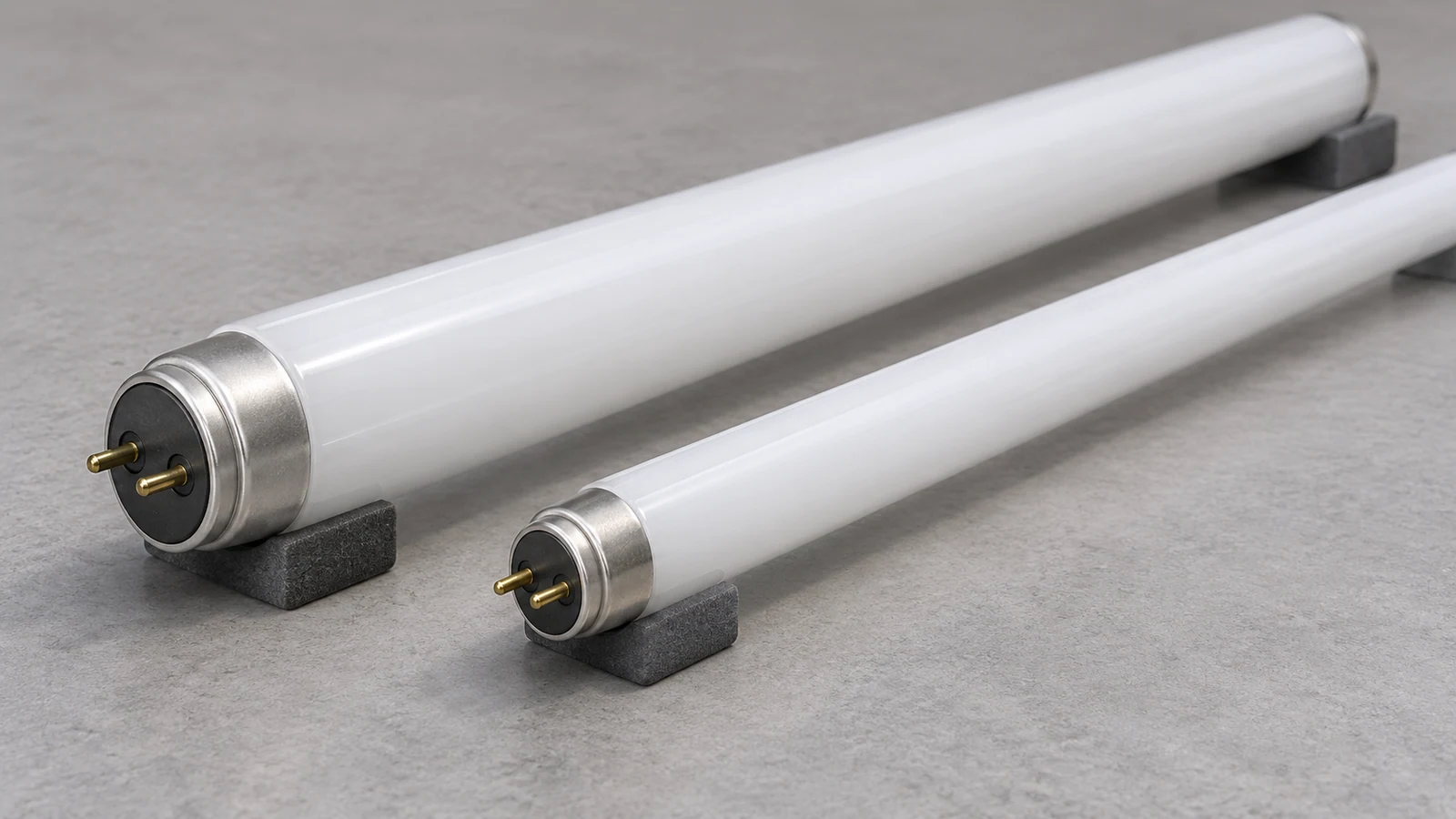
A maintenance order marked only “four-foot T8 replacement” leaves several decisions unfinished. The old lamp may be a medium bi-pin fluorescent tube, a high-output lamp with a different cap, or an LED installed during an earlier conversion. Each can look like an ordinary linear lamp from the floor.
For a facility team or distributor, the useful starting point is the identity of the installed lamp and fitting. Once that is clear, the T12 versus T8 comparison can help you select a replacement route and avoid putting unlike products into the same stock group.
How T12 and T8 describe the lamp
Nominal diameter and light-source technology
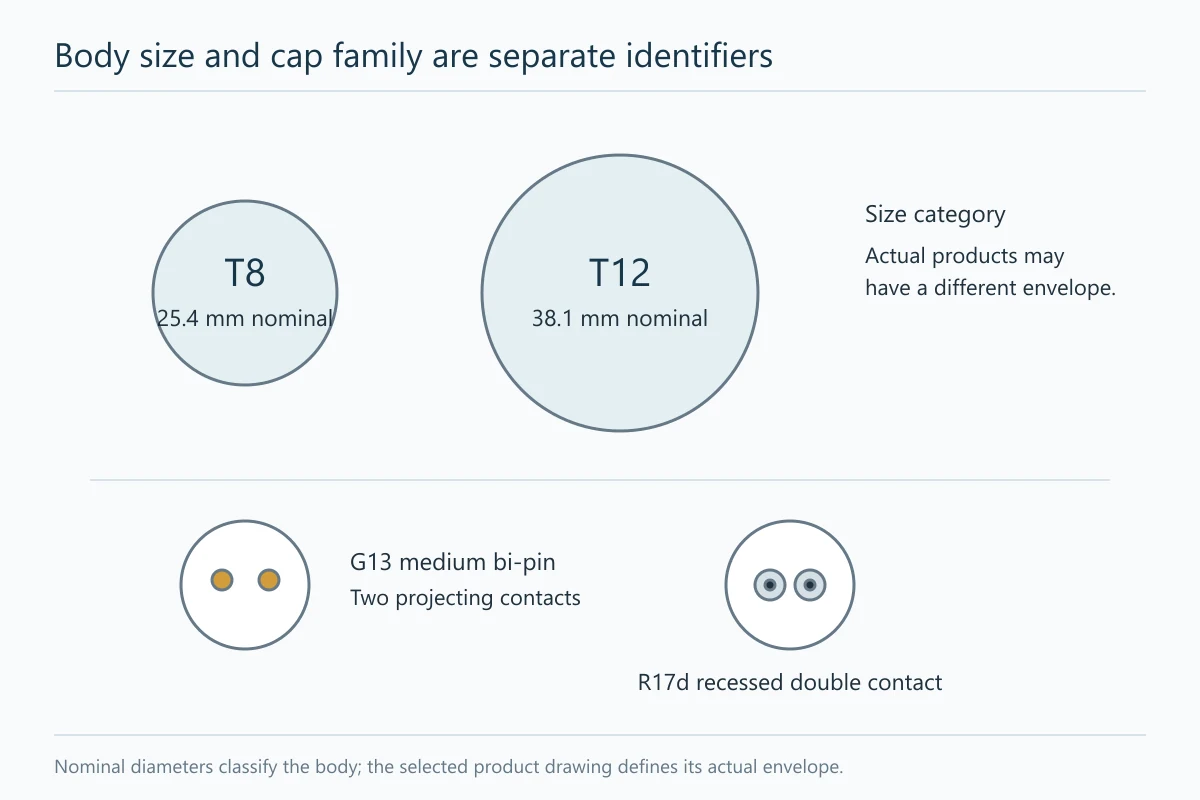
The number after T expresses a nominal tubular diameter in eighths of an inch. T8 therefore corresponds to one inch, or 25.4mm, and T12 to one and a half inches, or 38.1mm. The designation describes a size family. It does not identify the lamp’s length, cap or electrical arrangement.
Traditional T8 and T12 lamps are fluorescent light sources. An LED product can also use a tubular form and a T8 description. Its LEDs and driving electronics produce light differently from a fluorescent discharge lamp, even when the outside shape is intended for a familiar fitting.
That distinction changes the comparison. Replacing one fluorescent lamp with another requires the appropriate fluorescent lamp and operating gear. Choosing an LED alternative requires the intended LED arrangement as well as the mechanical fit. The tube-light types overview separates these classification systems if the existing inventory contains several technologies.
Diameter, base and length determine different parts of fit
Common medium bi-pin examples
Many familiar straight T8 and T12 fluorescent lamps use a G13 medium bi-pin cap. The two pins belong to the cap interface; the larger T12 body does not turn them into a different size merely because its glass is wider. Efficiency Maine’s dated Lighting Guide: Frequently Asked Lighting Questions describes the common four-foot, two-pin comparison in this specific context.
Compare actual dimensions separately. The lamp body, end caps and pins can have different length endpoints in a manufacturer’s drawing. A nominal four-foot description is useful for sorting an inventory, but the drawing determines which assembled measurement belongs between the fitting’s holders. The lamp also needs room to enter and leave those holders.
HO and specialty bases need their own identification
Some high-output linear families use recessed double-contact R17d caps. Current Lighting’s GEL267 R02 conversion guide, revised April 23, 2026, includes both T8 and T12 fluorescent HO examples with this cap. They are a useful reminder to read the actual cap and full marking rather than apply the common G13 example to every tube.
A similar diameter is no substitute for that identification. If a cap, reflector or fixed cover changes the insertion path, the replacement can require a different mechanical arrangement even before the electrical version is considered.
Allow for the difference between a nominal category and a manufactured envelope. VST’s published T8 entries include a D28 dimension, while the nominal T8 diameter calculation gives 25.4mm. The category name is therefore not the maximum outside dimension to put into a clearance drawing. Use the selected product’s actual body and end dimensions, and identify what the length arrows measure. That distinction prevents a familiar size label from becoming an incorrect mechanical assumption.
Fluorescent operation depends on the lamp-ballast pair
What the lamp marking identifies
A fluorescent lamp needs control gear suited to its electrical characteristics. Its complete marking can distinguish length, power family, color and an HO version that a casual T8 or T12 description omits. Those details matter when matching a replacement to the ballast’s stated lamp combinations.
It is tempting to use age as a shortcut: T12 means magnetic ballast and T8 means electronic. The installed equipment needs a closer look. The DOE/PNNL CALiPER Report 21.4, published in 2014, describes T12 systems with magnetic or electronic gear. The report is historical background, not a current compatibility list.
Ballast family and system input
The lamp wattage and the electrical input to the complete fitting describe different boundaries. Retained control gear consumes power too. Comparing a fluorescent lamp’s printed watts with an LED offer can leave that part of the system out of the calculation.
| Information | What it identifies | How it affects the choice |
|---|---|---|
| T8 or T12 | Nominal body-diameter family | Starts the physical identification, without choosing the supply arrangement |
| Full fluorescent lamp marking | The actual lamp family and version | Allows comparison with the gear’s stated lamp combinations |
| G13, R17d or another cap | The physical end interface | Determines which holder family and drawing must be considered |
| Ballast reference and configuration | The installed operating equipment | Separates a documented lamp combination from an assumed substitute |
LED replacement routes change what the fixture must support
Retaining compatible control gear
A ballast-compatible LED route can be attractive when the fitting is sound, the existing gear is identified and the selected lamp has applicable combination evidence. The benefit is preserving an operating arrangement that the product is intended to use. A generic “works with fluorescent fixtures” description does not identify that combination.
For a mixed building, one compatible fitting does not establish that every similar-looking room contains the same ballast. Group the equipment by the actual relevant references before purchasing one lamp for the whole site.
A reviewed conversion or a new luminaire
Other LED arrangements replace or remove the old control gear, while a complete luminaire replacement changes the fitting itself. A reviewed conversion may suit a usable housing whose existing gear is unsuitable for the selected LED route. A new fitting deserves consideration when the housing, optical assembly or service arrangement no longer meets the project need.
These are different work scopes. Any building-electrical alteration requires qualified personnel, the applicable product instructions and the site’s requirements. This comparison helps identify the route; it does not provide the connections for carrying it out. The ballast-compatible and ballast-bypass comparison develops the operating choices without treating all tubes as interchangeable.

Compare output, distribution and system watts
Light output at the lamp and fixture
There is no single lumen output attached to either diameter. Compare the exact lamp’s stated flux and optical version. A source with a different direction of emission can interact differently with a reflector or lens, so equal lamp lumens need not preserve the same distribution in the room.
For a desk area, the relevant result includes how light reaches the work surface. For a display, the vertical face may matter more. The existing fitting can redirect or obstruct part of the source output. This is why a bare-lamp comparison is only one part of deciding whether an LED replacement serves the original task.
Power measured at a consistent boundary
Use comparable whole-system inputs when estimating energy. A lamp-only wattage, a lamp-plus-ballast figure and a complete luminaire measurement should be labeled accordingly. Current product data takes precedence over old typical ranges. If the project is ready for an energy and installed-cost assessment, continue with the LED tube retrofit planning guide rather than assuming a saving from the T12 or T8 name.
Read a T12-to-LED replacement record
Find the matching lamp family in the source table
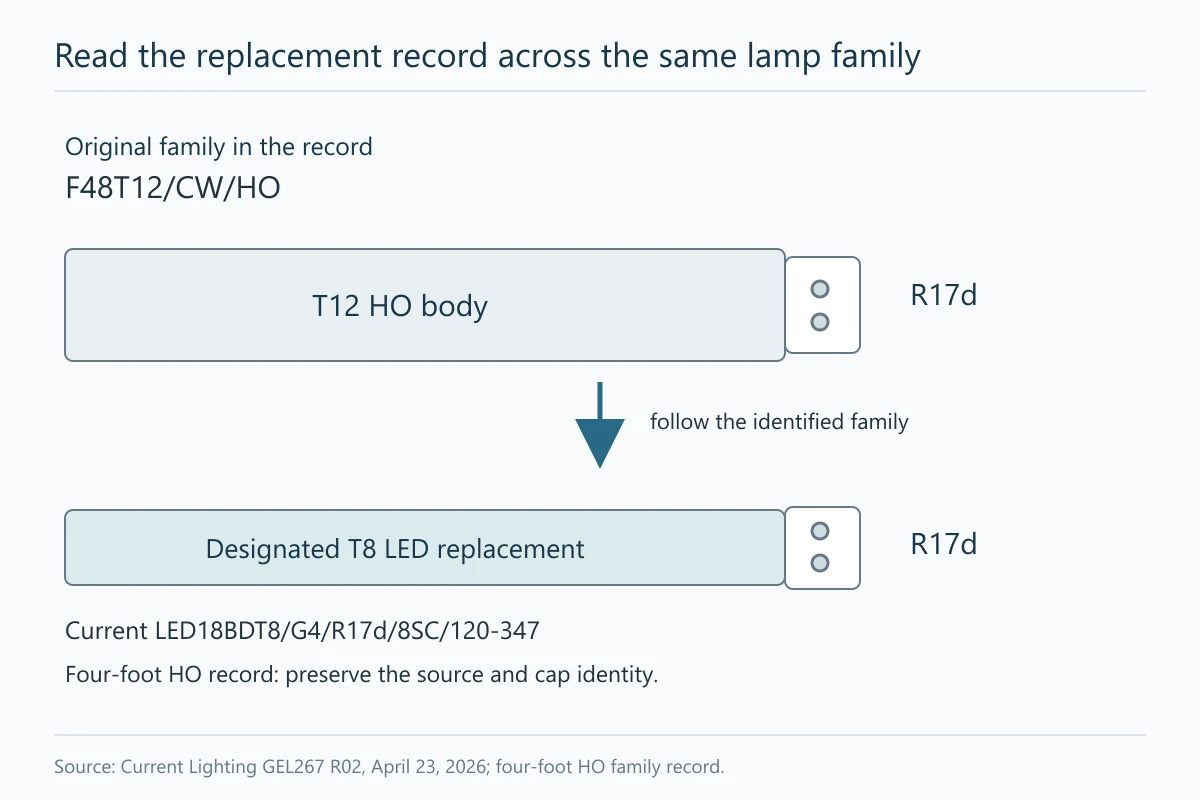
A manufacturer’s conversion record can be read without guessing from the shape of the lamp. In Current Lighting’s GEL267 R02 example, the four-foot T12 HO group uses the R17d family. The record includes F48T12/CW/HO, order code 10773, and identifies a selectable standard LED replacement as LED18BDT8/G4/R17d/8SC/120-347.
The useful sequence is to identify the fluorescent family first, then follow the stated record across to the manufacturer’s designated replacement object. The T8 in the LED description does not erase the R17d requirement. Nor does an unrelated 18W tube become the same replacement because its wattage is similar.
| Record field | Published identification | Reader’s conclusion |
|---|---|---|
| Existing family | F48T12/CW/HO within the T12 HO group | Use the HO record, not a generic four-foot medium bi-pin comparison |
| Cap family | R17d | Keep the recessed double-contact interface in the replacement description |
| Designated replacement | Current LED18BDT8/G4/R17d/8SC/120-347 | The source identifies a particular manufacturer’s replacement, not any T8 LED |
| Installation basis | Type B conversion within the source’s stated scope | Use the actual product instructions and qualified installation review for the work |
Keep the identified replacement scope intact
The result is a clear manufacturer-specific record, not approval of another supplier’s lamp. VST’s published T8 platforms, for example, list their own dimensions and G13/G5 options. Those records support a different inquiry and cannot be substituted into this R17d example. Keeping the source identity intact prevents a correctly read table from turning into an unsupported purchasing equivalence.
Decide what to retain in an older fitting
A sound housing with a defined lamp route
Retaining a fitting makes sense when its condition, mounting and optical arrangement still serve the room, and a supported lamp route is available. That choice can preserve the established positions and reduce the physical changes to the space. It still needs a lamp specification tied to the actual operating arrangement.
A fixture whose condition changes the choice
A brittle holder, damaged cover or restricted service opening changes the decision. Replacing only the light source may leave the difficult part of the assembly untouched. Similarly, buying more lumens will not correct an unsuitable reflector or a lamp that cannot be removed without disturbing surrounding construction.
Separate a repairable fitting issue from a reason to choose a new luminaire. The appropriate response depends on what is damaged, whether the intended work is permitted and what the room needs afterward. A T12 installation’s age alone is insufficient to decide that every housing should be discarded.
The original fixture can also serve more than one function. Its cover may protect the source or control its appearance, while the reflector redirects light that would otherwise remain inside the housing. Retaining only the metal box but changing those optical parts creates a different assembly. Compare that resulting assembly with the alternative new fitting, so that the decision includes the parts the room will actually use.
Replacement work changes project cost and future stock
Access labor and repeat visits
A purchase comparison should account for how people reach the lamps and which parts of the fitting the work changes. Where access requires disruption or specialist equipment, an incomplete equipment record can cause a second visit to obtain the right part. The mechanism is specific: the intended replacement cannot be released until the actual lamp and operating gear are identified.
Keeping converted and unconverted groups distinct
After a conversion, a familiar tube shape can conceal a changed operating arrangement. Maintenance stock should preserve that difference. Separate the lamp identity for the converted fitting from fluorescent stock and from other LED versions that use different equipment. The relevant label belongs with the fitting group and the permitted replacement, not merely the nominal length.
Choose the next step for the identified fitting
A concise decision by fitting group
Use the T12/T8 comparison to finish an identification and route decision. If the original fluorescent system remains, the replacement must belong to that lamp-and-gear combination. If an LED route is intended, identify whether it retains supported gear, changes the operating arrangement or replaces the fitting.
| Identified condition | Useful next decision | Specific boundary |
|---|---|---|
| Sound fitting and an evidenced LED/ballast combination | Evaluate the gear-retaining route | The combination must match the actual equipment |
| Usable housing but a different operating arrangement is required | Evaluate a documented conversion | Product instructions and qualified project review govern the work |
| Unsuitable housing, optics or access | Compare a complete luminaire replacement | The new assembly must meet the room and installation brief |
For a VST proposal, the T8 LED tube range is a starting point for the identified product family. Keep the cap, actual dimensional reference and intended operating arrangement with that discussion. Those details turn a broad T12-to-T8 request into a replacement question that can be answered.