A longer warranty can be useful, but the year number is only the beginning of the comparison. A replacement tube, an allowance toward another product and a service visit are different outcomes. The practical value depends on which one the written offer provides and which costs remain with the buyer.
For a custom lamp order, compare the named product, time basis, covered event and remedy together. Then consider the work needed to restore the lighting. That separates a meaningful service commitment from an attractive duration printed beside a lifespan rating.
Start with the product and the promise being compared
A complete tube, a component or a lighting system
A complete replacement lamp and a separately supplied driver are different products. A system warranty may involve a defined combination, while a product warranty may concern only the supplied item. Identify that object before comparing periods.
This distinction matters for a fitting that retains old equipment. A warranty for the new lamp may not settle responsibility for the existing ballast or surrounding fixture. A lamp’s familiar shape does not bring every nearby component into its supplied scope.
The named model and applicable policy
Connect the offer to its model, version and relevant terms. A general brochure or web banner can describe the supplier’s approach, but a purchasing decision needs the conditions applicable to the actual order. A written comparison should distinguish what the offer states from what has simply not been specified.
For a custom assembly, include the developed part identity. That helps distinguish the original product from a later design change, and the complete assembly from an individual component used to build it.
Calendar years, operating hours and lifetime ratings have different jobs
The date that starts the period
A stated number of years needs a starting event. Depending on the applicable terms, that could be purchase, installation, manufacture or another defined event. Those dates can differ when products spend time in distribution or wait for a project to become ready.
For a distributor holding stock before delivery to an installer, that difference can be commercially important. A period starting with the original purchase can already be running while the product is on the shelf. A period linked to installation raises a different question about the identified date and the conditions used when it is unavailable. Compare the actual clause rather than use the planned opening day as a convenient default.
Read any operating-hour condition separately. A calendar limit and a stated usage limit are different constraints. Where both appear, follow the actual relationship in the terms rather than assuming that the larger-looking number controls.
How the operating schedule affects the comparison
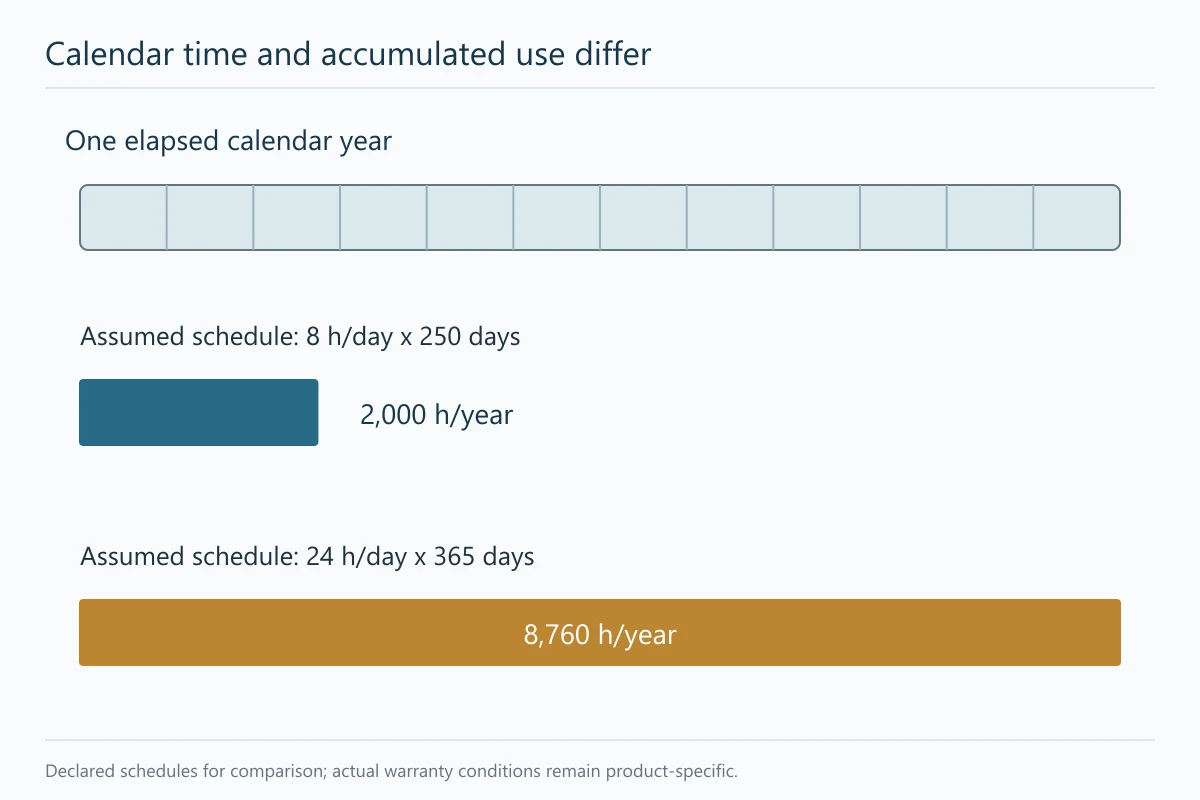
For an illustrative annual schedule, 8 hours per day over 250 days gives 2,000 operating hours. Continuous operation for 24 hours over 365 days gives 8,760 hours. The calendar year is the same; the accumulated use differs substantially. These are declared schedules, not a published warranty cap or a prediction of failure.
A lifespan field answers another question about performance under stated conditions. It does not extend a written coverage period by arithmetic. For example, VST’s catalog entries include a 50,000-hour lifespan field, but that field alone does not define the warranty start date, a covered failure or the remedy for a particular order.
Covered defects and performance conditions need a clear definition
What event triggers the stated remedy
A comparison should identify the event the offer covers. Failure to operate, a manufacturing defect, delivery outside an agreed specification and a defined optical-performance deviation are different descriptions. Avoid treating them as one undefined promise that the light will always look new.
For a batch with an optical concern, the original agreed version and requirement matter. A different cover or color setting can change the comparison before any question about a defect is considered. That is a reason to keep the actual product identity with the order.
Any optical-performance promise in the actual terms
Some offers may state an output or color condition; others may not. Where a quantitative promise exists, retain its quantity, time and operating basis. Where it is absent, a buyer should not create it from a general lifetime statement.
| Field | What to read | How it changes the decision |
|---|---|---|
| Covered product | Named lamp, component or defined system | Identifies the object receiving the remedy |
| Time basis | Starting event and stated period or usage condition | Shows which operating period is actually addressed |
| Covered event | The defined defect or performance condition | Separates a supported claim from an assumed promise |
| Remedy | The stated repair, replacement, credit or other response | Shows what the buyer would receive under the terms |
The permitted installation and operating conditions belong with coverage
Specified equipment and environment
The applicable product conditions can include the intended supply, operating equipment and environment. Compare them with the planned use instead of deciding coverage from tube length and wattage. The relevant terms may also distinguish individual product categories.
For a lamp intended to operate with particular equipment, that combination is part of understanding the offer. A tube record should not be substituted for an unrelated ballast or luminaire warranty. Each document needs to remain attached to the object it describes.
A changed or modified assembly
A custom change can alter the supplied assembly. Replacing a driver, changing the retention or rebuilding an enclosure may affect more than the outside appearance. Read how the offer addresses modifications rather than assume that every later change preserves the original coverage.
Actual electrical work and installation acceptance belong to qualified personnel using applicable instructions. The buyer’s document review here identifies the conditions being compared; it does not determine whether an unidentified site or modification is approved.
Repair, replacement and credit are different outcomes
Who chooses the stated remedy
Repair addresses an existing product. Replacement supplies another item. Credit contributes a stated value toward a transaction. These outcomes can differ in timing, practical use and who chooses the response. A headline warranty duration does not tell you which one applies.
If credit is prorated, the offer should explain the basis. A value related to an unexpired period is different from a full original-price refund. Compare that actual remedy with the cost and operational need of restoring the installation.
Credit toward a later purchase also performs a different job from a replacement ready for the current fitting. The buyer may still need to obtain the physical part and arrange the work. That distinction can affect which support arrangement is useful for an active project, without implying that one remedy is always better for every purchaser.
Comparable parts and a discontinued version
A later equivalent product may differ in envelope, interface or visible appearance. For a custom host, those differences can matter even when the replacement performs a similar general lighting function. The support arrangement needs to address the requirements the host actually depends on.
Also read what happens to the period after a remedy is provided. Replacing a part and restarting coverage are separate questions. Do not transfer a period rule from an unrelated category just because it appears on the same supplier website.
Access, removal and freight can remain outside the product remedy
The work required to reach and replace a tube
A free replacement product does not physically remove the original lamp. Someone still needs access, suitable scheduling and the intended service method. Where the lighting is built into joinery or equipment, reaching the replaceable object may be a significant part of the task.
Consider that work when comparing offers. A lamp that can be released through an accessible opening creates a different maintenance task from an assembly trapped behind a permanent panel. This is a design and service-scope distinction, not a reason to invent a labor cost.
Responsibility for returning and restoring the product
Read whether the offer addresses return freight, outward shipment, access work and reinstallation. An agreed extended service arrangement can add responsibilities beyond the product remedy, but its existence and scope need to be explicit. It should not be inferred from the word warranty.
| Part of the response | Offer to compare | Practical buyer question |
|---|---|---|
| Product or component | The stated repair, replacement or credit | Which usable object or value is supplied? |
| Access and removal | Any specifically included service work | Who reaches and removes the original item? |
| Transport | Return and replacement-shipping terms | Which shipment and costs does each party handle? |
| Restoration | Reinstallation or commissioning scope where relevant | Who restores the intended lighting operation? |
Support arrangements matter when the tube is customized
Replacement identity and availability
For a custom tube, the support discussion should preserve the specific end, mounting and optical version. A nominally similar lamp can be unsuitable if the host relies on a particular release direction or connection position. This links the original design choice to later service.
Spare stock can be part of that plan when agreed, but it is not the same as a promise of permanent finished-goods inventory. Consider which parts must remain available and which changes would require a new host or source review.
Agreed response and service scope
VST’s public warranty and after-sales framework distinguishes product categories and project-agreed deep-custom work. Use the applicable written order terms for the actual offer. A general framework is helpful context, not a substitute for that agreement.
Keep response, investigation and physical resolution as separate service questions. Acknowledging an issue, deciding its cause and supplying the agreed remedy require different actions. Comparing them separately avoids treating one response-time phrase as the whole service commitment.
Read one real lamp-and-tube warranty clause from scope to outcome
The category-specific wording
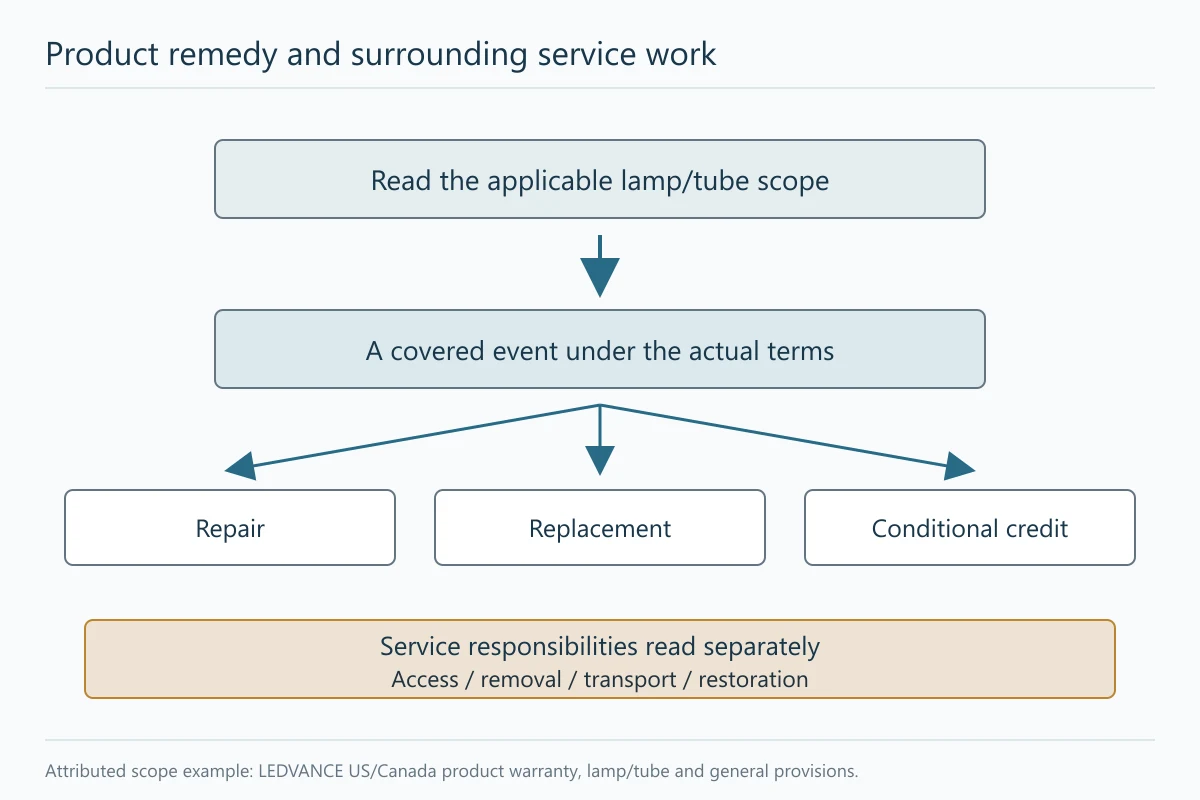
LEDVANCE’s published US/Canada Product Limited Warranty Terms and Conditions provides an attributed example. Its lamp-and-tube section describes repair or replacement and a credit route when replacement is unavailable, with eligibility conditions for that credit. The general provisions also address removal, installation and transport costs separately.
Read those provisions as one publisher’s stated scope. First identify the product category, then the covered event and remedy, and finally the service responsibilities. A ballast or separate system clause on the same document should not be moved into the tube offer.
Which obligation remains with the buyer
The reading identifies the product response, the condition attached to an alternative and the practical work left separate. Compare a proposed VST order using those same fields and its own applicable terms; the attributed manufacturer’s provisions remain attached to that manufacturer’s offer.
Choose coverage around the job that must continue
| Requirement | Relevant coverage feature | Remaining responsibility |
|---|---|---|
| Restore a failed supplied lamp | A clear applicable product remedy | Access, transport and restoration as allocated |
| Preserve a custom host interface | Support for the identified assembly or agreed alternative | Any changed fit or service requirement |
| Keep a project operating | The agreed service and replacement arrangement | Work or stock outside that stated scope |
Use failure-risk planning to reduce avoidable problems, and the written offer to compare the response if a covered problem occurs. The two decisions complement each other.