
To choose LED tube lights for parking areas, check the existing fixture type, wiring method, light level target, installation environment, safety requirement, and long-term maintenance plan before you compare prices. Parking lighting works for visibility, security, vehicle movement, pedestrian safety, and operating cost control. Consequently, the correct tube specification must match both the electrical system and the physical site.
What LED Tube Lights Mean in Parking Applications
LED tube lights are linear lamps designed to replace or function like fluorescent tubes, commonly in T8, T5, or T12 form factors. In parking areas, they are often installed in linear vapor-tight fixtures, strip fixtures, wraparound fixtures, or enclosed garage luminaires. The goal is to provide reliable horizontal and vertical illumination for vehicles, pedestrians, ramps, payment areas, lift lobbies, stair entrances, and service zones.
Parking areas create different conditions from normal office corridors. They may have vehicle exhaust, dust, vibration, moisture, cold starts, frequent switching, long operating hours, and lower ceiling reflectance. In semi-open garages, wind-driven rain and temperature swings can also affect fixtures. That matters because a tube that performs well in a clean indoor ceiling may fail earlier or produce poor visibility in a damp parking structure.
Specifically, buyers should evaluate three layers of fit. The first is electrical fit, including voltage, ballast compatibility, driver design, current, and wiring method. The second is optical fit, including lumen output, beam angle, glare control, CCT, CRI, and photometric distribution. The third is environmental fit, including IP rating, IK rating, operating temperature, housing condition, and maintenance access.
Parking lighting also affects perceived safety. A space can meet a basic wattage target but still feel dark if light does not reach vertical surfaces, columns, pedestrian paths, signs, and vehicle corners. Therefore, specification should focus on delivered lighting performance, not only lamp power.
When This Guide Applies
This guide applies when you are selecting LED tube lights for new parking fixtures, fluorescent retrofit projects, maintenance replacement, or energy-saving upgrades. It is especially useful for enclosed parking garages, basement parking, covered parking aisles, loading bays connected to parking, and semi-outdoor parking zones where linear tube fixtures are already installed.
However, LED tubes are not always the best answer. If the existing fixtures are damaged, poorly spaced, heavily corroded, or not suitable for the environment, replacing the full luminaire may be safer and more economical. In contrast, tube retrofit can be practical when fixtures are structurally sound, wiring access is acceptable, and the required lighting result can be achieved without major layout changes.
Use this guide when you need to answer questions such as:
- Can the existing fluorescent fixtures be reused safely?
- Should the project use ballast-compatible, ballast-bypass, or external-driver tubes?
- How much lumen output is needed for drive lanes, ramps, pedestrian routes, and entrances?
- Does the parking area need damp location, wet location, or impact-resistant products?
- What should be checked before quotation to avoid change orders and installation delays?
For large parking facilities, a lighting layout or photometric calculation should be reviewed before final purchase. The actual result depends on mounting height, spacing, surface reflectance, fixture optics, obstructions, and local lighting requirements.
Key Terms and Definitions Buyers Should Understand
Before comparing LED tube options, define the terms that affect project decisions. This avoids a common problem where two products look similar on a quotation but perform differently on site.
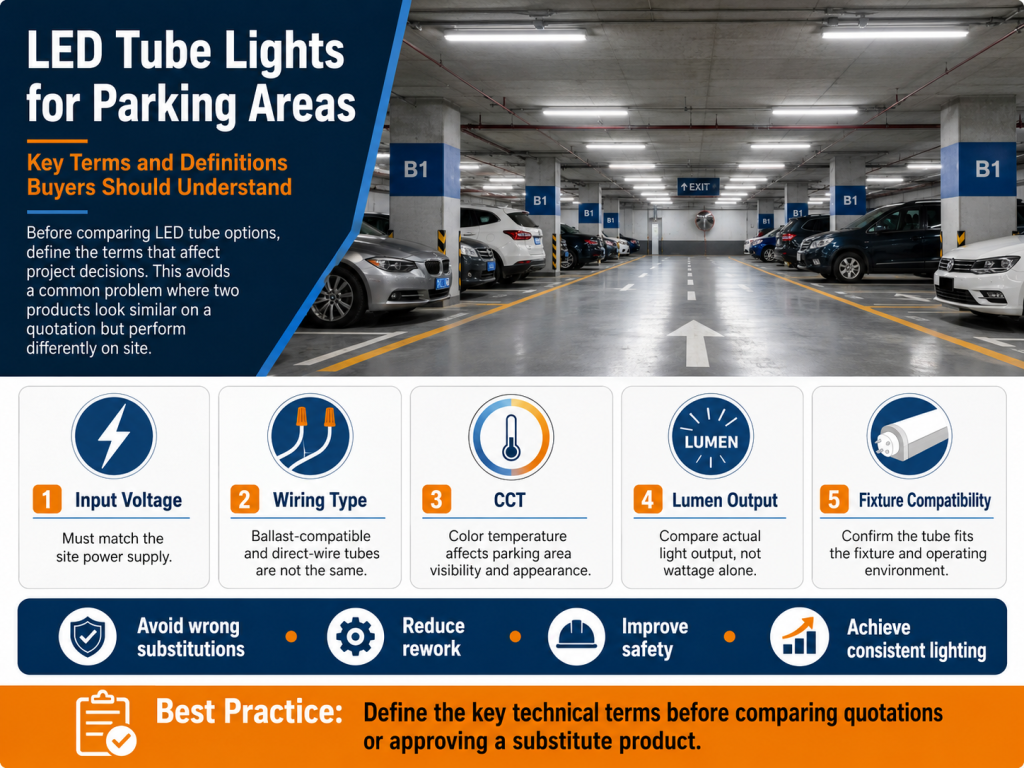
| Term | Meaning | Why It Matters in Parking Areas |
|---|---|---|
| Luminous flux | Total visible light output, measured in lumens. | Higher lumens can improve visibility, but only if the beam distribution suits the fixture and layout. |
| Luminous efficacy | Lumens produced per watt, usually written as lm/W. | Higher efficacy can reduce energy cost, but it should not replace checks for output, reliability, and thermal design. |
| CCT | Correlated color temperature, measured in Kelvin. | Parking areas often use neutral or cool white, such as 4000K or 5000K, depending on project preference and local standards. |
| CRI | Color rendering index, often specified as Ra or CRI. | CRI 80 is common for general parking visibility, but requirements may vary for security monitoring and user comfort. |
| Beam angle | The spread of light from the tube or fixture. | A narrow or blocked beam can create dark vertical surfaces, while very wide distribution may increase glare in low ceilings. |
| IP rating | Ingress protection against dust and water. | Damp, wet, dusty, or semi-open parking areas may need a higher IP-rated fixture or tube assembly. |
| IK rating | Impact resistance rating for enclosures. | Parking areas can face accidental impact, vandalism, or maintenance tool damage. |
| Type A tube | LED tube that operates with a compatible fluorescent ballast. | It may reduce rewiring labor, but ballast compatibility and future ballast failure must be considered. |
| Type B tube | Ballast-bypass LED tube wired directly to mains voltage. | It removes ballast losses, but requires correct rewiring, labeling, and electrical safety control. |
| Type C tube | LED tube powered by an external LED driver. | It can support better system control, but requires driver placement, compatibility, and maintenance planning. |
Technical Factors to Check
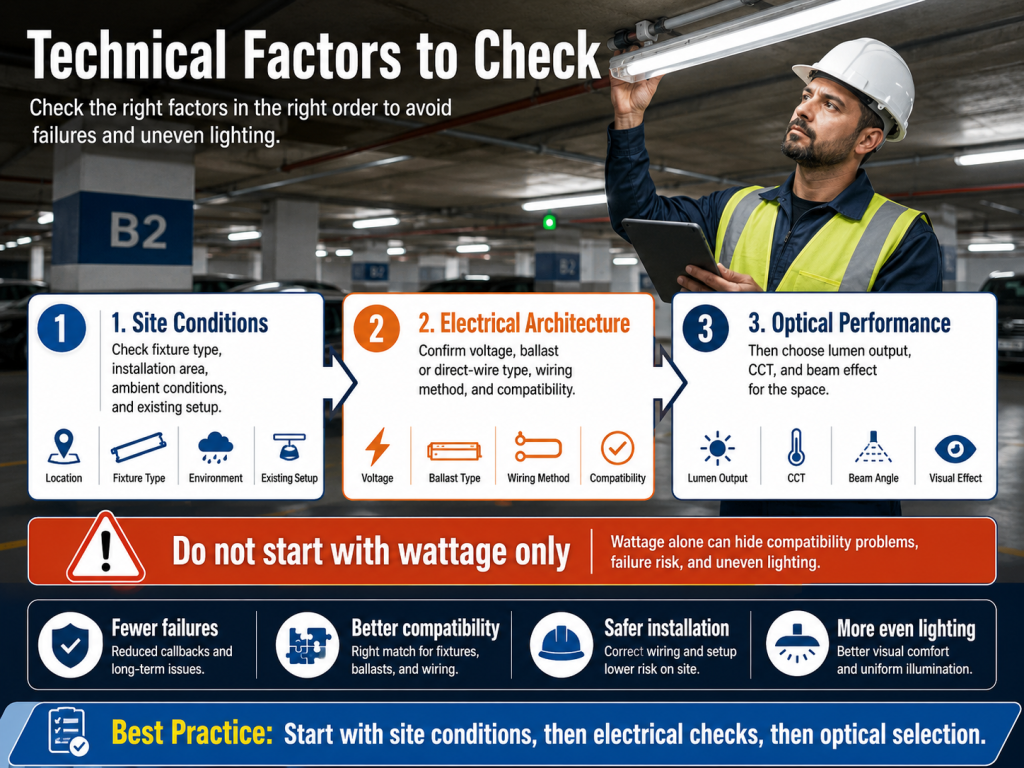
The most important technical checks are not complicated, but they must be done in the right order. Start with site conditions, then confirm electrical architecture, then select optical performance. If you start with tube wattage only, you may miss the factors that cause failures or uneven lighting.
Electrical configuration
Existing fluorescent parking fixtures may use magnetic ballasts, electronic ballasts, shunted lampholders, non-shunted lampholders, or previous retrofit wiring. Type A tubes depend on ballast compatibility. Type B tubes bypass the ballast and connect to line voltage. Type C tubes use an external LED driver. Each option changes installation labor, safety risk, future maintenance, and spare part strategy.
For Type B installations, verify whether the tube is single-ended or double-ended input. Incorrect wiring can create shock risk or immediate product failure. The fixture should also carry proper retrofit labels after modification, as required by local electrical code and the product instructions.
Light output and distribution
Parking areas need usable light on floors, ramps, walls, pedestrians, vehicles, and signage. Therefore, review lumen output together with beam angle and fixture lens type. A clear-lens tube can create visible lamp image and glare in low mounting heights. A frosted tube can improve visual comfort but may reduce peak intensity. In many parking areas, uniformity matters as much as average illuminance.
Environmental protection
Parking garages can be damp even when they are covered. Water can enter through open sides, cleaning operations, condensation, or drainage issues. Dust and insects can also reduce output over time. Consequently, confirm whether the complete fixture assembly is suitable for damp or wet locations. A tube alone may have a rating, but the final installed system also depends on the fixture, gasket, end caps, cable entry, and mounting condition.
Safety and compliance
Relevant compliance may include UL or ETL listings for North American projects, CE and RoHS documentation for many international markets, EMC requirements, DLC listing for rebate-driven projects, and local electrical code. For retrofit work, standards and requirements may relate to LED lamp safety, luminaire conversion, wiring labels, and installation instructions. Do not assume certification from appearance or part number. Request documents that match the exact model and configuration.
| Factor | What to Check | Project Impact |
|---|---|---|
| Voltage | Confirm 120V, 220 to 240V, 277V, or universal input range according to site supply. | Wrong voltage can cause non-operation, failure, or safety hazards. |
| Wattage | Compare system wattage, not only lamp wattage, especially when ballasts remain in use. | Energy saving and circuit load calculations depend on actual installed power. |
| Current | Check input current for circuit loading and inrush behavior where many tubes switch together. | Large circuits may require breaker and switching control review. |
| Lumen output | Use tested lumens and photometric files where available. | Insufficient output can increase safety concerns and customer complaints. |
| CCT and CRI | Select consistent CCT and acceptable CRI for parking visibility and camera recognition. | Mixed colors make the site look inconsistent and may affect visual comfort. |
| IP or damp rating | Match the product and fixture to condensation, washing, dust, and open-air exposure. | Poor environmental fit can shorten lifetime and increase maintenance calls. |
| Operating temperature | Confirm cold start and maximum ambient rating inside enclosed fixtures. | Temperature outside rating can reduce driver life and cause early failures. |
| Certification | Match certificates to the exact lamp type, input wiring, and region. | Missing documentation can delay approval, rebate, inspection, or handover. |
Step-by-Step Guide for Selection and Project Planning
A structured process reduces quotation errors and site delays. The following steps apply to both retrofit and new parking lighting projects. For larger sites, complete these steps before issuing the final purchase order.
| Step | Action | Key Output |
|---|---|---|
| 1 | Survey the parking area, including fixture count, mounting height, spacing, ceiling type, and exposure to moisture. | Site condition record and fixture schedule. |
| 2 | Identify existing lamp type, tube length, socket type, ballast model, wiring condition, and fixture housing condition. | Retrofit feasibility decision. |
| 3 | Define target performance for drive lanes, ramps, pedestrian paths, entrances, and security-sensitive areas. | Lighting performance requirement. |
| 4 | Choose Type A, Type B, or Type C according to labor, safety, compatibility, and maintenance strategy. | Electrical configuration selection. |
| 5 | Compare lumen output, wattage, beam angle, CCT, CRI, flicker performance, and thermal rating. | Technical product shortlist. |
| 6 | Confirm certification, installation instructions, retrofit labels, warranty conditions, and required test reports. | Compliance and documentation package. |
| 7 | Install a sample area or mock-up when the site has low ceilings, dark surfaces, or high safety expectations. | Visual confirmation before full rollout. |
| 8 | Commission the installation by checking operation, wiring labels, illuminance, dimming or sensor response, and maintenance records. | Handover-ready lighting system. |
Specifically, do not skip the fixture survey. Many parking projects contain mixed fixture generations because maintenance teams replace parts over several years. One zone may have electronic ballasts, another may have ballast-bypass wiring, and another may have damaged lampholders. A single tube model may not fit every area safely.
If occupancy sensors are used, confirm compatibility with the tube or driver. Frequent switching is common in parking areas, and poor sensor compatibility can cause flicker, delayed start, or reduced product life. For dimming systems, confirm the dimming method, such as 0 to 10V, phase dimming, DALI, or control relay switching, depending on the system design.
Installation, Testing, and Commissioning Checks
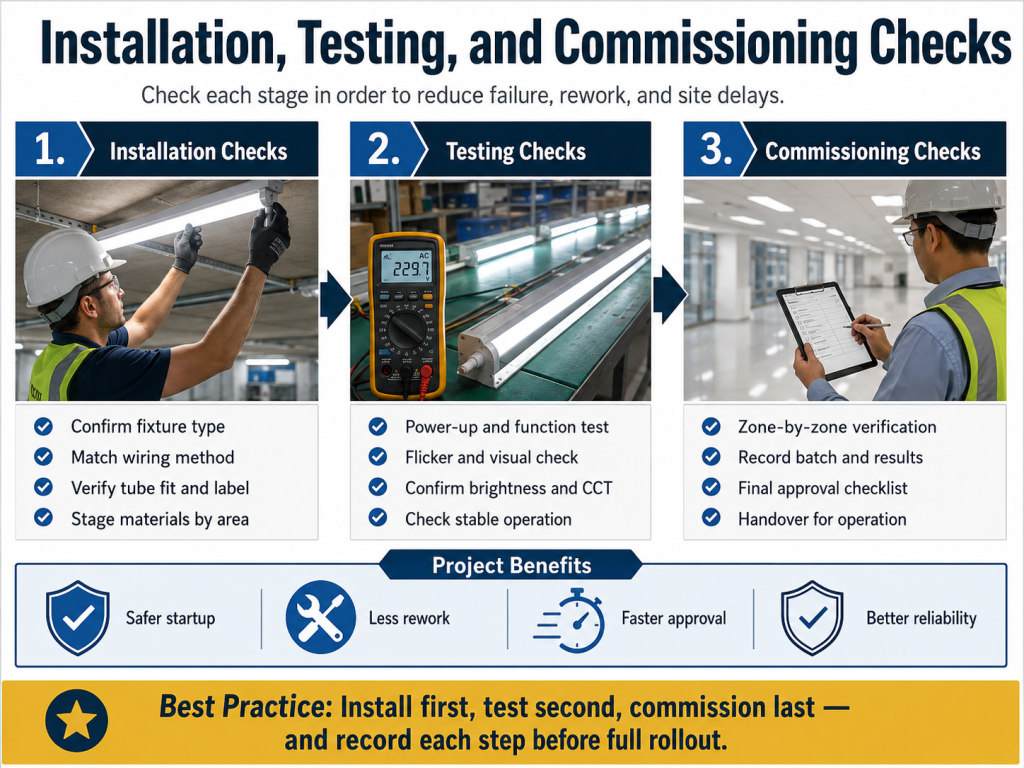
Installation quality strongly affects safety and reliability. LED tubes may look easy to install, but parking retrofit work often involves ladders, lifts, active circuits, old wiring, corroded housings, and restricted access. Therefore, installation should follow the product instructions and local electrical code.
Pre-installation checks
- Lock out and tag out circuits before wiring work.
- Inspect lampholders, fixture grounding, covers, gaskets, and cable entries.
- Confirm whether the fixture is open, enclosed, vapor-tight, or gasketed.
- Verify that the selected tube is approved for the intended fixture type.
- Prepare labels for ballast-bypass or retrofit wiring where required.
Testing methods
After installation, test the system under real conditions. Measure input voltage at the fixture, not only at the panel. Check start-up behavior when multiple tubes energize at the same time. Use a light meter to verify representative areas such as drive lanes, parking bays, pedestrian routes, ramps, and entrances. For projects with formal requirements, request photometric data such as LM-79 reports or IES files from the supplier where available.
Also check flicker and camera interaction where surveillance is important. Some low-quality drivers can create visible flicker or rolling bands on CCTV footage. This may not be obvious during a quick daytime inspection, but it can become a complaint after handover.
| Check Point | Method | Risk Controlled |
|---|---|---|
| Fixture wiring | Compare actual wiring to installation diagram before energizing. | Shock hazard, tube failure, and inspection rejection. |
| Voltage at fixture | Measure under operating load at several far-end locations. | Undervoltage, voltage drop, and unstable operation. |
| Illuminance | Measure representative floor and pedestrian areas with a calibrated light meter. | Dark zones, poor visibility, and non-compliance with project targets. |
| Thermal condition | Check enclosed or warm fixtures after burn-in. | Driver overheating and shortened service life. |
| Sensor response | Test occupancy, daylight, relay, or dimming control sequences. | Flicker, nuisance switching, and user complaints. |
| Emergency operation | Verify emergency circuits, battery packs, or maintained lighting requirements where applicable. | Safety and code compliance risk. |
| Documentation | Record model numbers, wiring type, certificates, and installation labels. | Maintenance confusion and future replacement errors. |
How Selection Affects Cost, Reliability, and Maintenance
Initial tube cost is only one part of the project cost. Installation labor, ballast removal, access equipment, outage scheduling, inspection, warranty handling, and future relamping can cost more than the lamp itself. Consequently, the lowest unit price may not produce the lowest total cost.
Type A tubes can reduce installation time because they use existing ballasts. However, they depend on ballast condition and compatibility. If ballasts fail later, maintenance teams must replace the ballast or change the wiring strategy. This may create mixed configurations across the parking area.
Type B tubes remove the ballast from the system, which can reduce ballast-related failures and power losses. In contrast, they require rewiring and careful labeling. Maintenance workers must know that the sockets carry line voltage according to the tube design. This is a safety and training issue, not only an electrical detail.
Type C tubes can provide controlled driver performance and may suit projects with dimming or central maintenance strategies. However, they require driver placement and future driver replacement planning. In tight or wet fixtures, driver location becomes important for heat and service access.
Thermal management also affects lifetime. Parking fixtures may operate for long hours, sometimes 24 hours per day. If the tube is installed in an enclosed fixture above its ambient temperature rating, the internal driver and LED components may age faster. LM-80 and TM-21 data can help evaluate LED package lumen maintenance, but they do not replace checking the complete product design and real fixture temperature.
Common Misunderstandings
Several project risks come from assumptions that sound reasonable but fail in real parking installations. The table below explains the most common misunderstandings and the practical reality.
| Misunderstanding | Reality | Better Decision |
|---|---|---|
| Same wattage means same brightness. | LED tubes with the same wattage can have different lumens, optics, and losses inside fixtures. | Compare delivered lumens, photometric data, and sample area results. |
| Any LED tube can replace any fluorescent tube. | Socket type, ballast type, wiring method, and fixture condition can prevent safe replacement. | Survey the fixture and confirm Type A, Type B, or Type C requirements. |
| Parking areas are indoor spaces. | Many garages are damp, dusty, cold, hot, or semi-open to weather. | Check damp or wet location suitability and operating temperature. |
| Higher CCT always improves safety. | Very cool light may increase perceived brightness, but glare and poor uniformity can reduce comfort. | Balance CCT, beam distribution, glare, and security camera needs. |
| Retrofit is always cheaper than fixture replacement. | Damaged housings, failed gaskets, old sockets, or difficult wiring can make retrofit expensive. | Compare total installed cost and maintenance risk. |
| Certification is a general brand issue. | Certification usually applies to specific models, configurations, and regions. | Request documents for the exact tube, wiring type, and destination market. |
Pro Tip / Field Experience
Before full installation, convert one representative parking bay, one drive lane, and one ramp area as a trial zone. Run the lights at night, check CCTV image quality, inspect glare from driver eye level, and measure voltage at the farthest fixture. This small test often reveals color mismatch, dark columns, ballast surprises, or sensor issues before they become expensive site-wide problems.
What This Means in Practice
In practice, a good LED tube specification for parking areas starts with the site, not the catalog. For example, a basement garage with low ceilings, enclosed fixtures, and long operating hours may need frosted tubes, stable drivers, good thermal rating, and careful glare control. A semi-open parking deck may need better moisture protection, corrosion-resistant fixture housings, and verification of cold-start performance.
A retrofit project in a commercial parking garage may appear simple if the existing lamps are standard 4 ft T8 tubes. However, the project can become complicated if half the fixtures still use electronic ballasts and the rest have already been rewired. In that case, the buyer should either standardize the wiring method during the project or clearly separate product types by zone. Otherwise, maintenance staff may install the wrong replacement tube later.
For new parking areas, the decision is different. You can choose between linear LED tube fixtures and integrated LED luminaires. LED tubes may support easier lamp-level replacement, while integrated luminaires may provide better sealed construction and optical control. The right choice depends on maintenance policy, installation height, environmental exposure, required lighting distribution, and budget structure.
For quotation accuracy, provide fixture counts, tube lengths, voltage, wiring preference, certification market, mounting condition, and any required reports. If dimming, occupancy sensors, emergency circuits, or rebate programs are involved, state those requirements at the beginning. You can contact our technical team to confirm project details when the site includes mixed wiring, damp conditions, or documentation requirements.