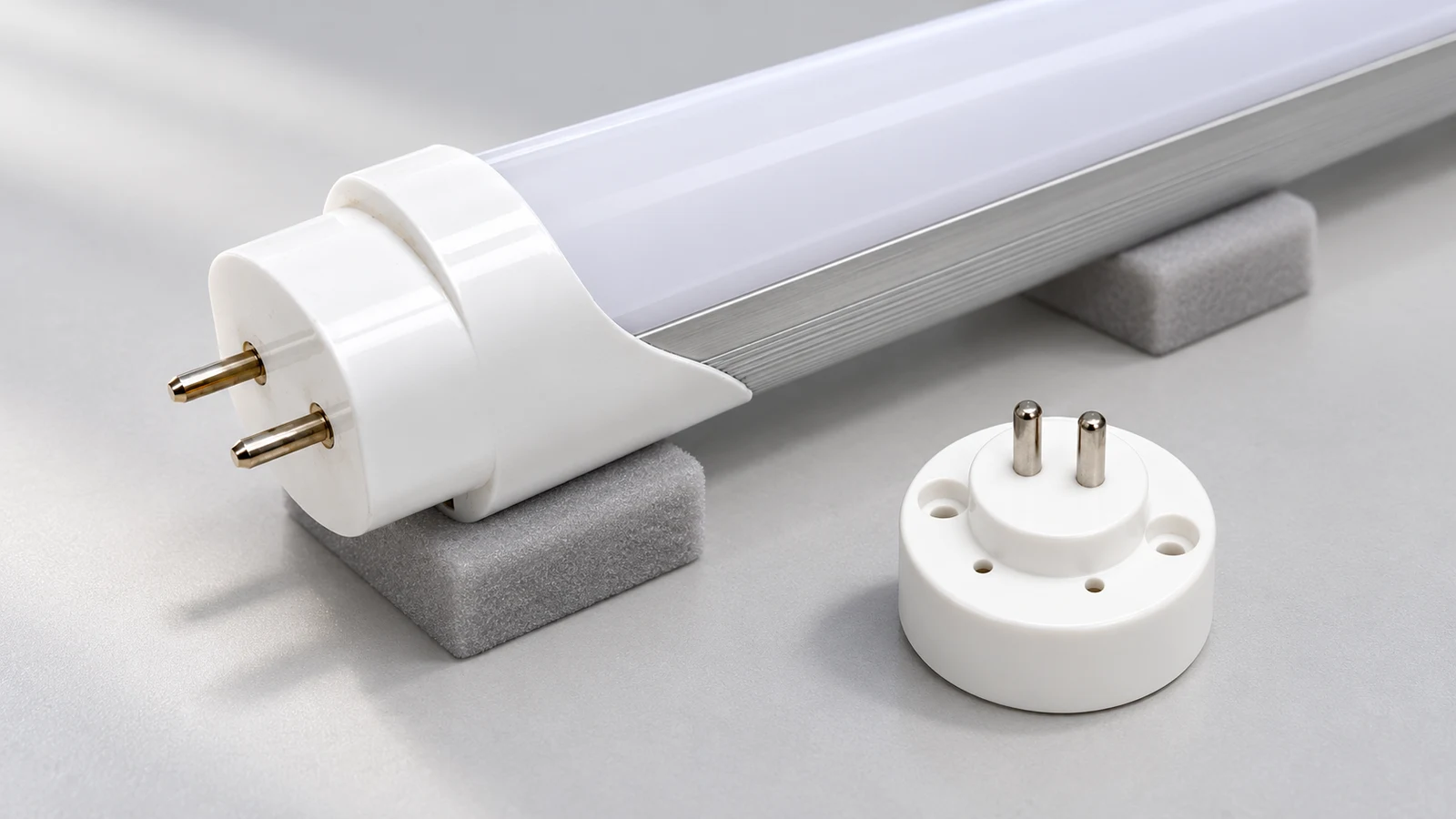
A pair of pins is a useful clue, but it is not a complete lamp description. The distance between their centers, the shape of the cap and the full marking can distinguish products that look almost identical from the floor. A single projecting pin and two recessed contacts belong to different interface families again.
For a replacement order, identify the existing straight linear lamp first. Then carry that identity into the size and operating-system decision. This approach is more reliable than ordering another tube from a nominal length or a photograph of the white body alone.
Which tube end are you trying to identify?
The contacts, cap and surrounding holder
The contacts are the conductive parts visible at the lamp end. The cap holds and organizes that interface. The lampholder is the separate part in the fitting that receives and retains it. A picture showing only the holder’s outside can leave the actual contact form unclear.
For the common straight-lamp examples discussed here, start with four families: G5 and G13 bi-pin ends, Fa8 single-pin ends, and R17d recessed double-contact ends. Use the code in the identified manufacturer’s record to complete the visual identification. Specialty compact and circular lamps need their own interface references.
A lamp-style replacement or a complete fitting
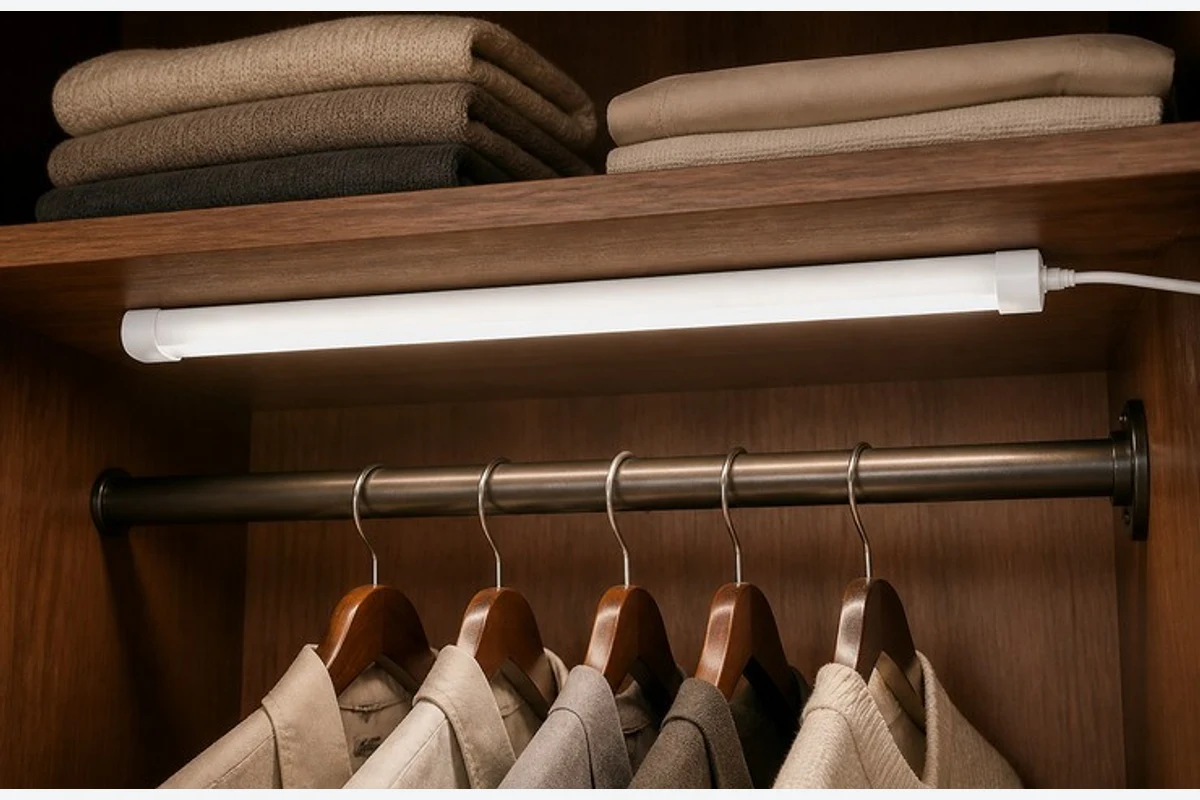
Some slim linear products have clips and a cable or connector instead of familiar fluorescent-style pins. They may be complete fittings or assemblies developed for another product. Their shape can resemble a lamp while their mounting and service arrangement are different. The tube-light classification guide separates those product objects.
G5 and G13: two pins with different spacing
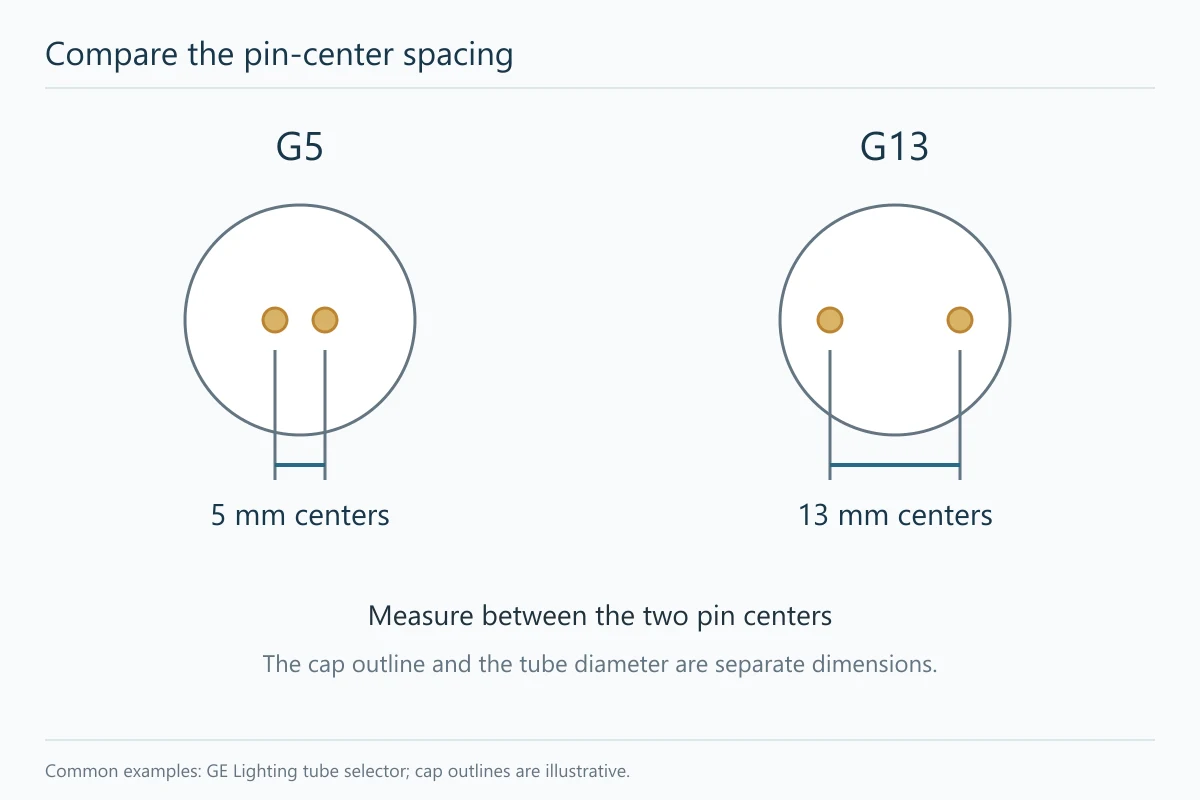
Read pin spacing separately from tube diameter
In common linear-lamp examples, G5 has 5mm pin-center spacing and G13 has 13mm spacing. GE Lighting’s replacement selector presents those figures separately from the lamp diameter. The distance is between the centers of the two pins, not across their outside edges or across the cap body.
The visible tube diameter answers another question. Familiar T5 fluorescent examples use G5; familiar T8 and T12 examples use G13. The wider T12 body can therefore share a cap family with a narrower T8 body. The cap code identifies the contact interface while the actual drawing describes the surrounding envelope.
In a close photograph, count the conductive contacts rather than every recess in the molded cap. An end component can have holes or surrounding features as well as its two metal pins. The useful comparison locates the pin centers on the contact face and then checks that observation against the stated code. A perspective view is useful for seeing projection, but it is a poor place to estimate an exact spacing from pixels.
Common examples and custom platform options
Product options can extend beyond those familiar combinations. VST’s published T8 platform entries, for example, list G13 or G5 options. That offering does not identify the cap on every supplied version. Keep the chosen base in the complete product description instead of replacing it with the word T8.
| End family | Visible feature | Identification detail to retain |
|---|---|---|
| G5 | Two projecting pins with common 5mm center spacing | The G5 code and exact lamp reference |
| G13 | Two projecting pins with common 13mm center spacing | The G13 code, body envelope and full lamp identity |
| Fa8 | One projecting contact at each relevant lamp end | The single-pin family stated in the product record |
| R17d | Two contacts recessed into the end interface | The recessed-contact code and full family marking |
Fa8: recognizing a single-pin end
A documented Slimline lamp example
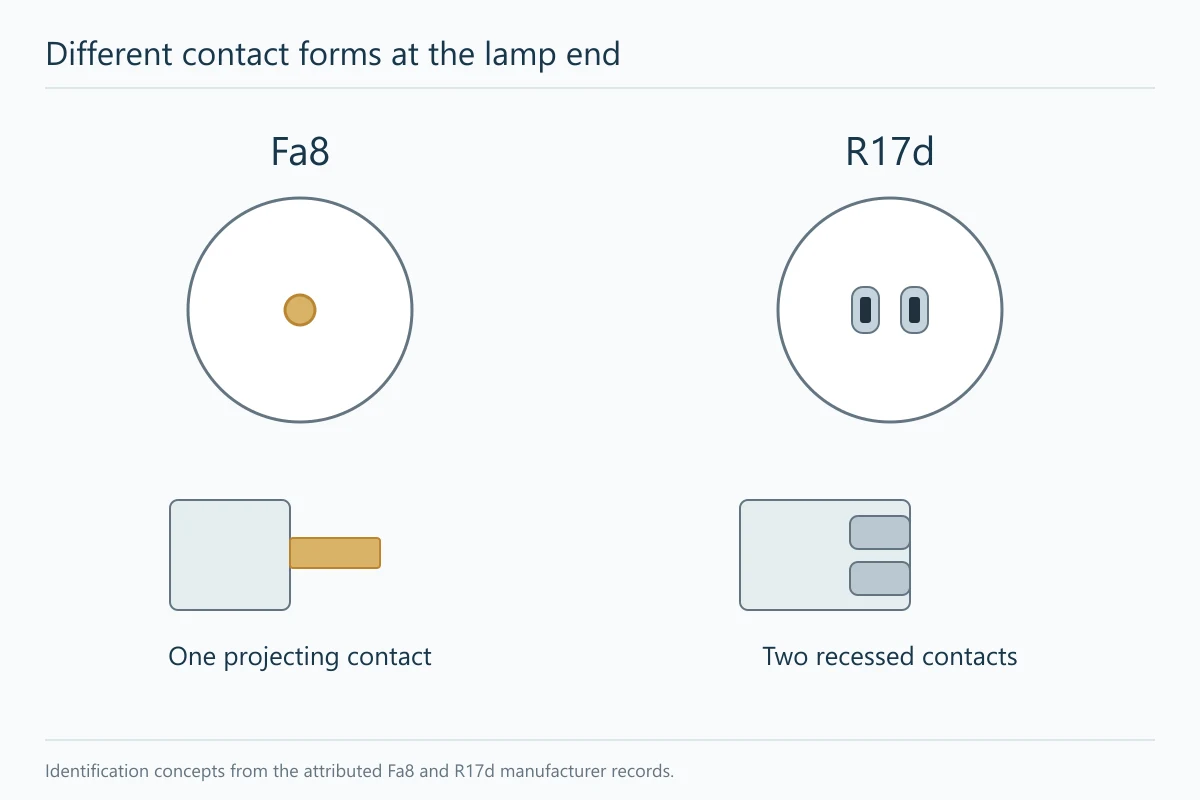
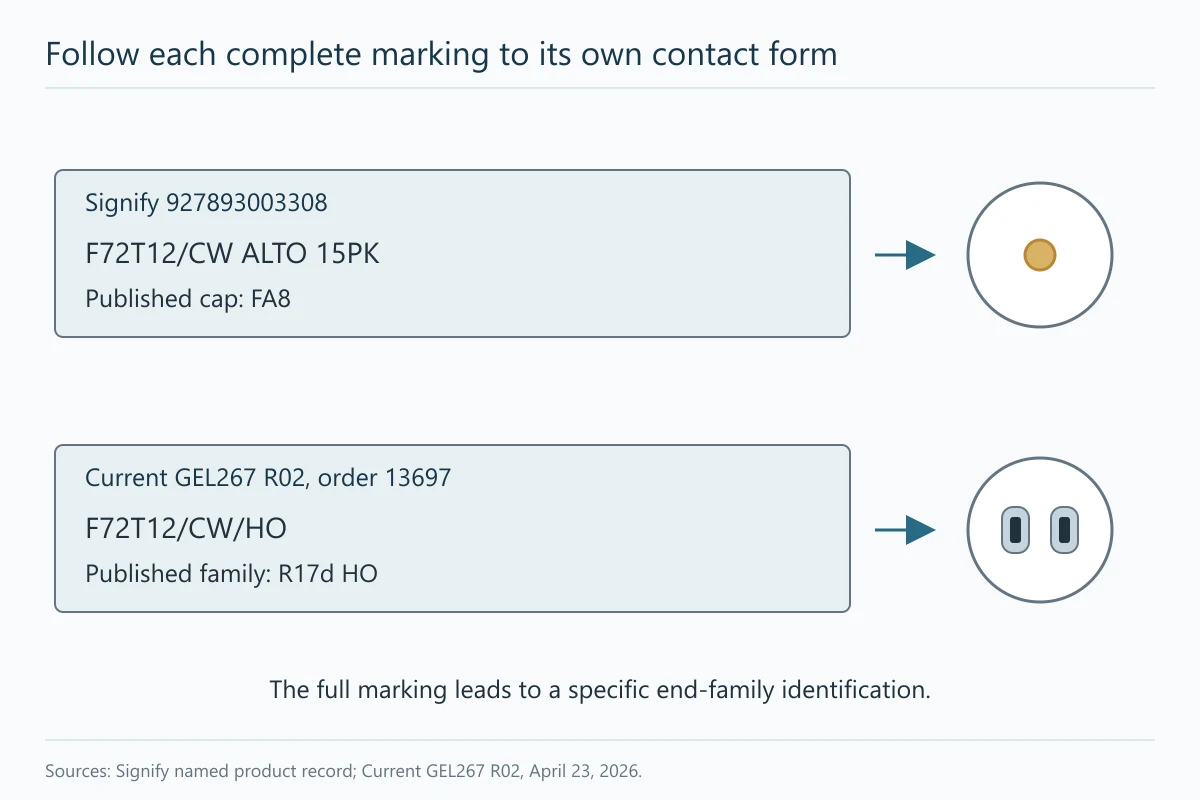
A Fa8 end has a single projecting contact rather than a pair. One specific manufacturer record is Signify’s Philips F72T12/CW ALTO 15PK, order code 927893003308, whose cap field is FA8. The complete identity matters: the T12 part describes the body family, while the separate cap field identifies the end.
The same cap code also appears on identified LED products. Signify’s 28T8/COR/96-835/IF40/G/FA8 record, order 929003556704, is an LED example. The presence of Fa8 does not tell you whether the source inside is fluorescent or LED, or which operating equipment the complete product expects.
For visual sorting, look for the projecting contact and the surrounding retaining form together. A cropped picture can conceal a recess or make two contacts overlap in perspective. A clear end view and a readable full marking are more useful than a distant side view of a long tube.
When two pins line up along the camera’s viewing direction, one may hide behind the other. A second accessible view of an unpowered sample can reveal that relationship without changing the product. Record what is actually visible; a shadow or a covered contact should remain unidentified until the corresponding view or source record resolves it.
R17d: recessed contacts in identified HO families
The contact face and the high-output marking
R17d identifies a recessed double-contact interface. The contacts sit within the end rather than appearing as the ordinary two projecting pins of a G13 example. Current Lighting’s GEL267 R02 conversion guide, revised April 23, 2026, documents R17d in its linear fluorescent HO families.
Keep the HO or other relevant suffix with the original marking. It can distinguish a family that a shortened request such as six-foot T12 misses. A full code gives the manufacturer’s table a specific object to identify.
Similar lengths can belong to different end families
Single-pin and recessed-contact lamps may both appear in a site’s long-lamp inventory. Sort them by their identified ends rather than by carton length. If one family is entered as another on the order, the immediate problem is a different receiving interface. More output or the same wattage cannot resolve that physical mismatch.
A lamp base and a lampholder describe different parts
The mating and retaining mechanism
The base code is only one part of understanding how the lamp sits in its fitting. The holder also has a retaining mechanism and occupies space. Its condition and the movement needed to engage the lamp belong to the actual fitting, not to a generic photograph of a cap.
A custom bracket or connector is a different interface again. It can retain a tubular assembly without behaving like a standardized lamp socket. Identify the part that actually receives the product before looking for a compatible lamp family.
Also separate a holder’s engagement mechanism from a lamp’s supported end-cap orientation feature. Current’s HO guide describes rotatable ends on a particular signage version to orient the source. That feature serves light direction within its intended assembly; it does not create a different cap family or provide a general method for inserting any lamp. The two mechanisms need their own product information.
Contact arrangement and supply arrangement
Physical pin count is separate from an LED lamp’s single-end or double-end supply arrangement. Likewise, shunted and unshunted describe a holder’s internal contact relationship. They cannot be established just by counting the lamp’s projecting pins.
| Question | Relevant record | Decision it supports |
|---|---|---|
| Which contact family is this? | Full lamp identity and stated cap code | Select the correct end family |
| How is the product retained? | Holder or mounting-part information | Identify the receiving mechanism |
| What overall space does it require? | Dimensional drawing with clear endpoints | Compare the complete envelope and access |
| Which operating arrangement applies? | The selected lamp’s applicable instructions and system information | Keep the electrical route distinct from the cap shape |
Building-electrical work requires the applicable product instructions and qualified personnel. The separate single-end and double-end resource addresses that operating distinction; the end-identification work here supplies no terminal connections.
Length and clearance still matter after the base matches
Body, cap and pin measurement endpoints
A drawing may measure the body, an assembled cap-to-cap distance or an overall dimension including projecting parts. Those endpoints can produce different numbers for one product. Compare like measurements rather than assuming every catalog length means the same thing.
VST’s VST-T8-1200-18W entry lists D28 x 1212mm. Its model name contains 1200, while the published dimension contains 1212. That is a useful reason to read the actual dimensional field. A selected drawing must still identify what its arrows include before that number can settle a mating fit.
The space needed to engage and release the lamp
Consider the surrounding cover, reflector and host opening as well as the distance between ends. A replacement can fit the final position but lack the movement needed to reach it. In an integrated product, a nearby shelf or permanent panel can similarly obstruct later removal.
Those are mechanical questions with mechanical responses: a different product envelope, an accessible host detail or an alternative mounting arrangement. They should be resolved before treating a familiar cap as a complete replacement specification. The tube size-selection guide develops the dimensional task.
Custom tube ends can use a different host interface
Lead exits and retained linear assemblies
A tubular assembly developed for furniture or equipment may connect through a lead or a designated connector. The host can retain it with clips, brackets or a shaped support. Its end detail then solves the host’s connection and service problem rather than copying a fluorescent socket.
VST’s custom tube-light page describes changes to length, section, end details, connection position and retention. In that context, an end cap can close the assembly, locate parts or provide a cable exit. It need not be a G13 lamp base.
When a familiar tube silhouette is misleading
Choose the purchasing object from its intended interface. An existing lampholder calls for an identified lamp-style product. A custom host may need an integrated assembly instead. Buying a complete cable-connected fitting for a socket-mounted lamp position creates a different installation task, even if the white emitting body looks similar.
Read two similar lamp markings without merging their identities
F72T12/CW versus F72T12/CW/HO in attributed records
Compare two published records as an identification exercise. Signify’s F72T12/CW ALTO 15PK record identifies FA8. Current’s GEL267 R02 table places F72T12/CW/HO, order 13697, in its R17d HO group. The shared beginning of the markings does not preserve the complete lamp identity.
| Published source | Identified marking | Stated cap result |
|---|---|---|
| Signify, order 927893003308 | F72T12/CW ALTO 15PK | FA8 single-pin family |
| Current, GEL267 R02, order 13697 | F72T12/CW/HO | R17d recessed double-contact family |
The identification result and the remaining replacement question
The inputs are the full markings and the manufacturers’ cap fields. Reading them produces two distinct interface lines. That result is already useful: the buyer can prevent the records from being combined under one shortened six-foot T12 description.
The records are not a replacement pair. A candidate LED product still needs its own applicable end, dimensions and operating arrangement. Keeping those next questions separate preserves the value of the identification instead of turning it into an unsupported substitution.
Carry the identified end into the correct replacement guide
A useful identification line contains the actual lamp reference, cap family and dimensional reference. With those established, the next task can be the operating route, the complete fit or the light required from the fitting.
For a VST platform discussion, the 600mm T8 product entry provides a specific published starting point. Keep the chosen cap option with that inquiry. For a host-integrated design, start with the custom tube assembly and its real mounting/connection requirements instead.