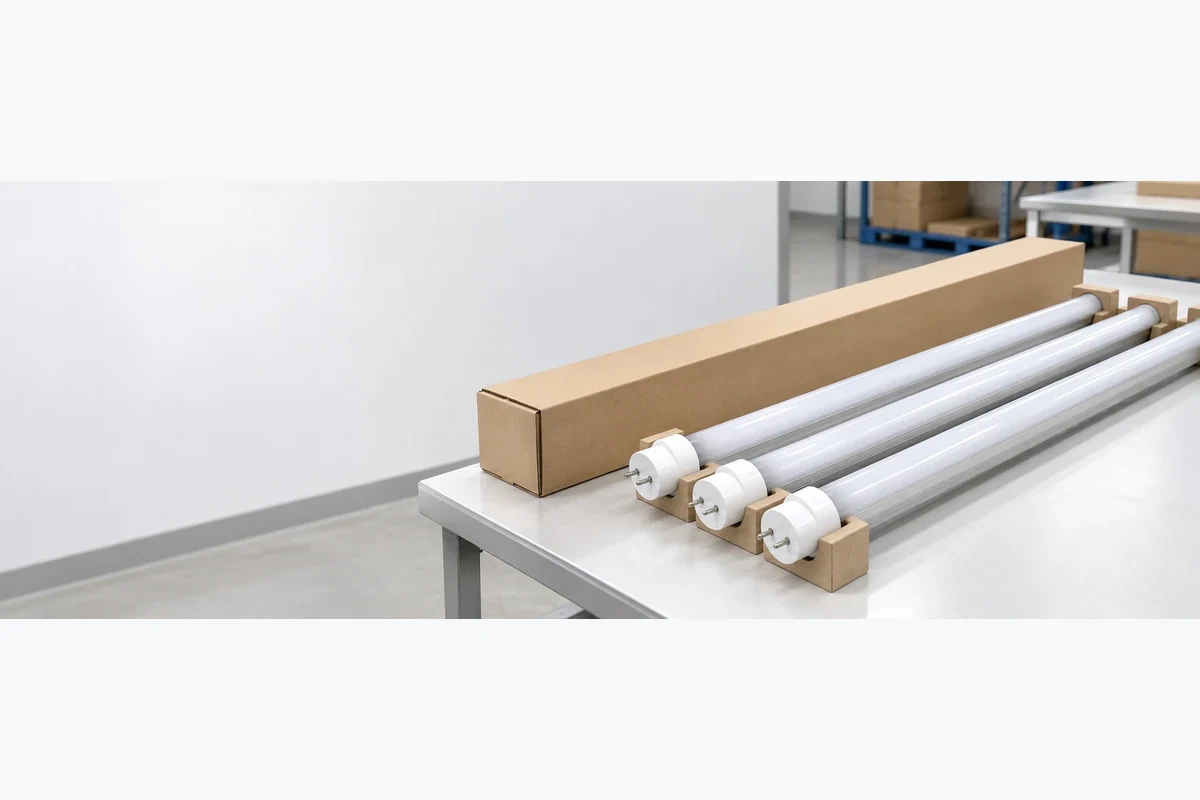
The cost of a custom LED tube starts with what changes. Choosing a different offered cover is a different task from developing a new section, end cap or internal carrier. Both may be called customization, but they can create very different development and production work.
For an OEM buyer, separate the one-time work from the cost of each supplied unit. Then compare options that meet the same fit and lighting brief at the same quantity and version mix. That makes the price discussion useful before an attractive unit figure hides an unsuitable assembly or an unpaid development task.
Identify the tube assembly whose cost you are comparing
A diffuser, a bare source and a finished tube
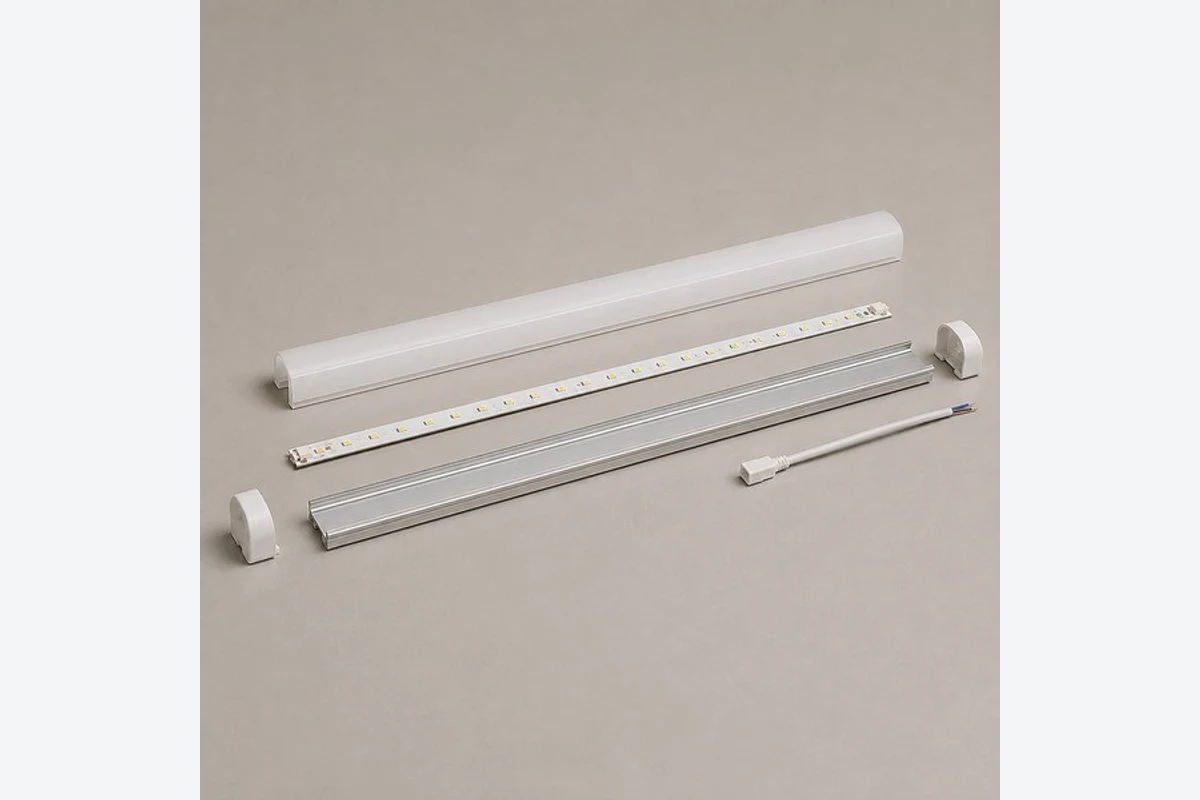
A translucent tube cover, an LED board and a complete lamp are different purchasing objects. A complete host-integrated assembly may add a carrier, end details, connections and retaining parts. A replacement lamp has its own intended holder and operating arrangement.
Prices for those objects cannot be treated as alternative quotes for the same supply. First establish which parts and functions the order includes. Otherwise the lower figure may simply omit the driver, end hardware, support or work that another offer includes.
The shared performance and fit requirement
Define what both approaches must achieve. The relevant requirements can include the host envelope, emitting area, light direction, connection and replacement movement. They need not be identical designs, but they must satisfy the same stated task before their costs are meaningfully comparable.
For example, a standard assembly that protrudes beyond the available host is not a low-cost solution to that fit requirement. Its unit price matters only after the physical problem has a workable response. The custom tube-light product page describes the construction and host-interface scope.
Reusing a platform changes the development work
Changes an existing platform can accommodate
An existing platform already defines relationships among its cover, source, support and ends. If the required variant can use those relationships, the development may focus on a limited part or setting rather than create a new assembly from the beginning.
VST’s published custom tube scope distinguishes adapting an existing platform from deeper development. That is a useful commercial distinction, not a fixed price list. The actual work depends on which parts the new requirement changes.
A new section, end or internal carrier
A different cross-section can affect the diffuser fit, board space and retention together. A changed connection position can involve the end part and the space beside the host. A new carrier may change support and the assembly method. Those relationships explain why a small-looking external change can reach several resources.
Trace the change before deciding its development depth. If the existing body and cover remain suitable, an end-interface problem may be solved through a limited adaptation. If the new section also changes the source spacing and retention, those parts need to be considered together. The commercial distinction follows the affected construction, not the number of words in the customization request.
| Requested change | Potentially reusable element | Work to identify | Cost category |
|---|---|---|---|
| An offered optical finish | The supported platform and interfaces | The actual optical/source version and supply | Variant cost and any relevant evaluation |
| A different end connection | Some body and source parts | End geometry, mating connection and assembly | Development plus recurring changed parts |
| A new section or carrier | Only parts that remain suitable | Geometry, dedicated resources and assembly relationships | Potential tooling/NRE and recurring build cost |
Separate one-time development from recurring production cost
Tooling, fixtures and development work
Nonrecurring work concerns resources or development needed for the defined project. VST’s published scope identifies possible examples such as an extrusion die, an end-cap mold or a checking fixture when a new dedicated resource is required.
The important question is which resource the design actually needs. A change that uses an existing part does not automatically require a new mold. Equally, a quotation should not leave a genuinely required tool hidden inside an unexplained prototype charge.
Parts, assembly and order-specific requirements
Recurring cost concerns the build supplied with each unit: the relevant source, cover, carrier, end parts, connections and assembly work. Packing and order-specific requirements also need a clear allocation. Some costs attach to a unit, others to a batch or consignment.
Keep those bases visible. A one-time amount divided by the planned quantity produces an allocation for that comparison; it does not turn the expense into an inherently recurring component. Conversely, a changed part remains a unit cost even after the development work has been paid.
If one offer includes development in its unit price and another lists it separately, align the total scope before deciding which is lower. This avoids counting a charge twice or overlooking it entirely.
Optics, electronics and end details affect different costs
The optical face and internal source arrangement
A request for a smoother visible line can involve the optical cover, source spacing and the distance between them. Selecting a different finish may be enough in one supported platform; another geometry may need a different source or carrier. The cost follows the actual change, not the adjective smooth.
Likewise, a changed light-output or control requirement can affect the electronics and source combination. Compare the intended build rather than assuming a higher wattage is the only route or that a control option is free to add to every version.
Connections, retention and the assembled build
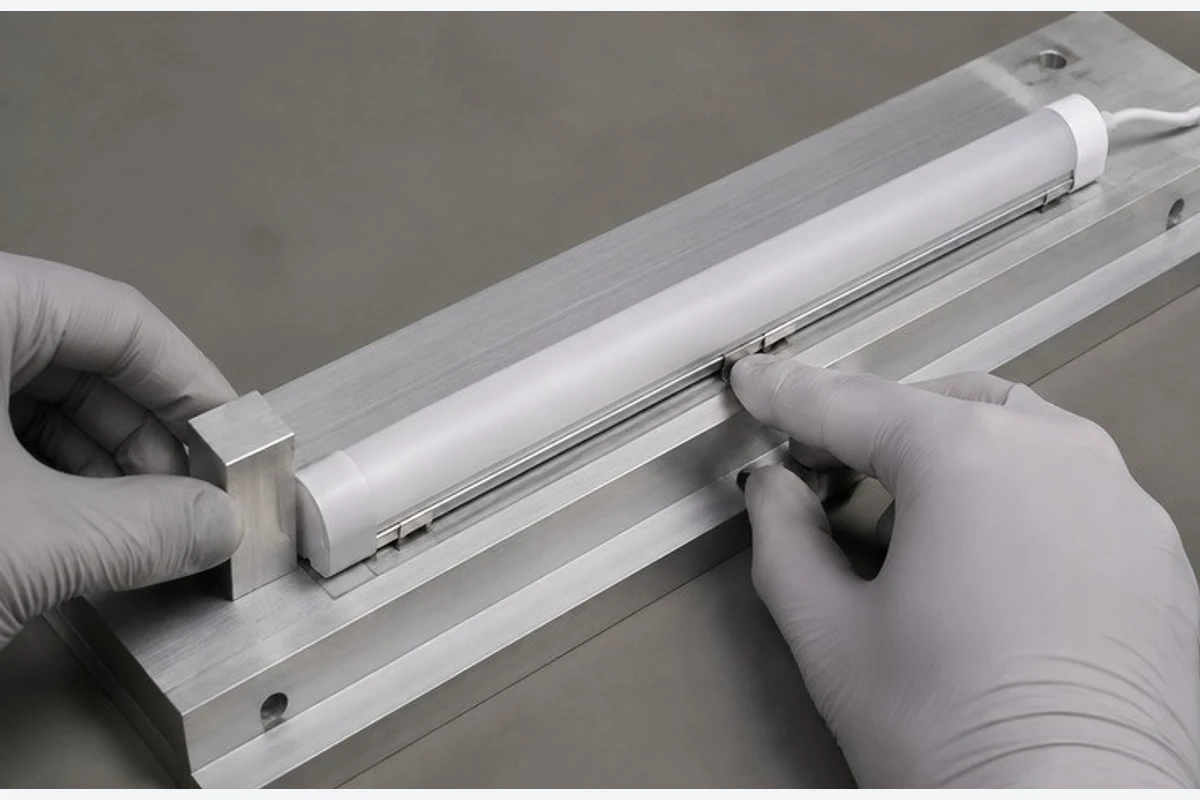
An end connection has a mating part, exit position and space requirement. A retaining clip has to work with the body and the host. Altering either can change parts, assembly or the work needed around the lighting product.
A targeted change can therefore be preferable to a complete redesign when the existing platform already meets the other requirements. If several interfaces conflict together, deeper development may be the more coherent approach. Neither direction can be selected by the tube’s nominal length alone.
Quantity matters per version and per production release
Total forecast versus each variant
A total forecast can contain several designs. Parts common to them may share a resource, while version-specific covers, ends or sources remain separate. Treating the entire forecast as one identical build can hide the work and quantities attached to each version.
Distinguish the forecast from an actual release as well. A supplier may discuss planning around expected demand, but that does not make every future unit a committed order or a guaranteed finished-stock position.
A repeat build versus a changed requirement
A genuinely unchanged repeat can use the same relevant resources. A revised host dimension, connection or source requirement can create new work even when the customer uses the old project name. Identify what is being repeated before assuming that every development charge disappears.
| Quantity statement | Cost treatment to clarify | Comparison impact |
|---|---|---|
| One defined design and release | Its unit build and applicable dedicated work | A clear basis for the order total |
| Several versions in one forecast | Shared versus version-specific resources | Prevents spreading unrelated costs across all units |
| Later unchanged release | What remains reusable and what recurs | Separates repeat unit cost from already completed development |
| Revised design | The actual affected resource and work | Avoids assuming that the old cost basis still applies |
The appropriate quantity, payment and delivery terms belong to the actual offer. A cost explanation cannot create a universal MOQ or discount schedule from these relationships.
Calculate when a lower unit cost repays the development work
Declare the equivalent requirements and illustrative figures
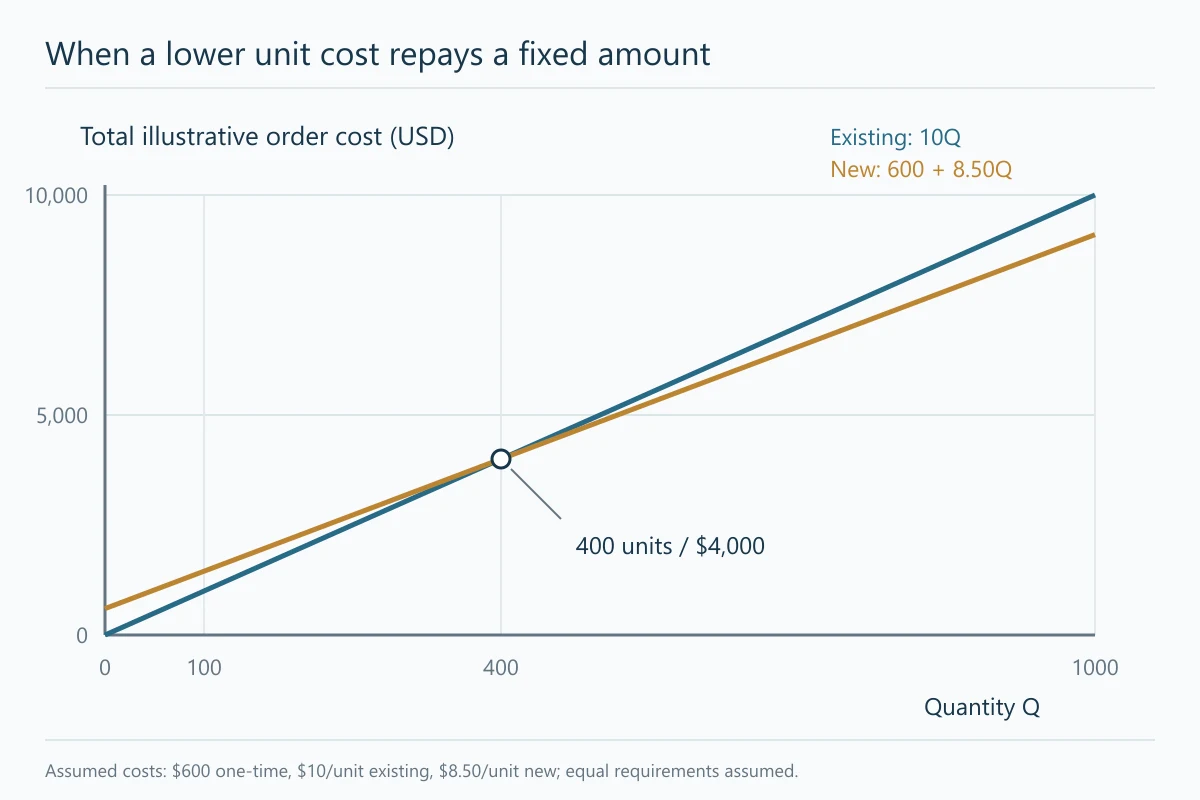
Consider a teaching calculation in which both approaches are assumed to meet the same defined requirements. An adapted existing platform costs $10 per unit. A new design costs $8.50 per unit and requires $600 of one-time development. These figures are assumptions, not VST prices or a verified pair of designs.
For quantity Q, the existing-platform total is 10Q dollars. The new-design total is 600 + 8.50Q dollars. Their difference comes from the $600 fixed amount and the $1.50 recurring difference per unit.
This calculation assumes the one-time charge is paid once and that the unit amounts include equivalent supply. It leaves freight, credits and any unequal scope outside the arithmetic until they are identified. If one approach includes a component or service that the other omits, correct that scope difference before using the intersection as a purchasing result.
Read the break-even result at the planned quantity
The totals are equal when Q = 600 / (10 – 8.50) = 400 units. At 100 units, the new-design total is $1,450, or $14.50 per unit including the allocation, compared with $1,000 for the existing approach. At 1,000 units, it is $9,100, or $9.10 per unit, compared with $10,000.
The lower recurring unit figure therefore wins this narrow arithmetic comparison only beyond the break-even quantity. It does not settle whether both designs genuinely meet the brief or whether future orders will occur. Change the actual fixed cost, unit difference or volume and the result changes too.
Tooling credits, samples and packaging need their own cost treatment
Which expenditure a written credit actually offsets
VST’s custom tube framework describes project-dependent treatment of eligible sample and tooling expenditure. The qualifying order, amount and credit method are discussed for the project. That can affect the comparison, but full reimbursement is not automatic.
Apply an agreed credit to the expense or payment it actually offsets. If the same expenditure is both removed from the fixed-cost total and deducted again from the later order, the comparison counts one benefit twice. Preserve the credit’s condition and timing rather than simply lowering every unit price.
Tool payment also needs a clearly described resource and commercial scope. If ownership, continued use, transfer or design-file access matters, put those questions explicitly into the offer discussion instead of treating the fee description as a complete rights agreement.
Packing and freight around the defined supply scope
Long tubular products need suitable support and protection. Carton format, end protection, labeling and consignment arrangements can add work or materials that are not part of the light source itself. A unit-only comparison can omit that supply scope.
The separate tube packaging guide develops the distribution task. Here, keep its actual included cost and responsibility with the order rather than assume that every freight or packing expense is contained in a lamp price.
Choose the smallest design change that meets the brief
An option that meets the brief at the intended volume
Start with the required result and the resources the current platform can reuse. Then compare the affected development work, recurring build and relevant quantity. A standard assembly can be the right direction when it fits; a focused adaptation can resolve one interface; deeper development is justified when the existing relationships cannot serve the task.
| Condition | Useful direction | Commercial basis |
|---|---|---|
| Existing assembly meets the defined task | Evaluate the supported platform | Compare its complete included supply |
| A particular interface needs changing | Evaluate a targeted adaptation | Identify the affected work and recurring parts |
| Several linked requirements cannot be met | Evaluate deeper development | Separate required resources, unit build and realistic volume |
When customization earns its added work
Keep the platform that serves the brief when its complete cost works at the intended volume. Use targeted or deeper development to resolve the requirement the existing build cannot meet. VST’s OEM development approach provides context; the tube quotation-input resource supports the next RFQ once that scope is clear.