
OEM buyers should check LED lighting for furniture products by reviewing the full system, including the light source, driver, wiring, connector, mounting structure, heat path, controls, and compliance requirements. This matters because furniture lighting is usually built into a product, so late changes can affect tooling, assembly time, packaging, warranty cost, and safety approval.
For concealed ambient lighting around a bed frame or headboard, review the bed LED strip planning guide before confirming the strip position, cable route and service access.
What LED Lighting for Furniture Products Means
LED lighting for furniture products refers to lighting that is integrated into furniture during manufacturing or final assembly. Common examples include wardrobe lights, cabinet linear lights, shelf lights, drawer lights, mirror lights, display cabinet lights, kitchen furniture lighting, and illuminated headboards.
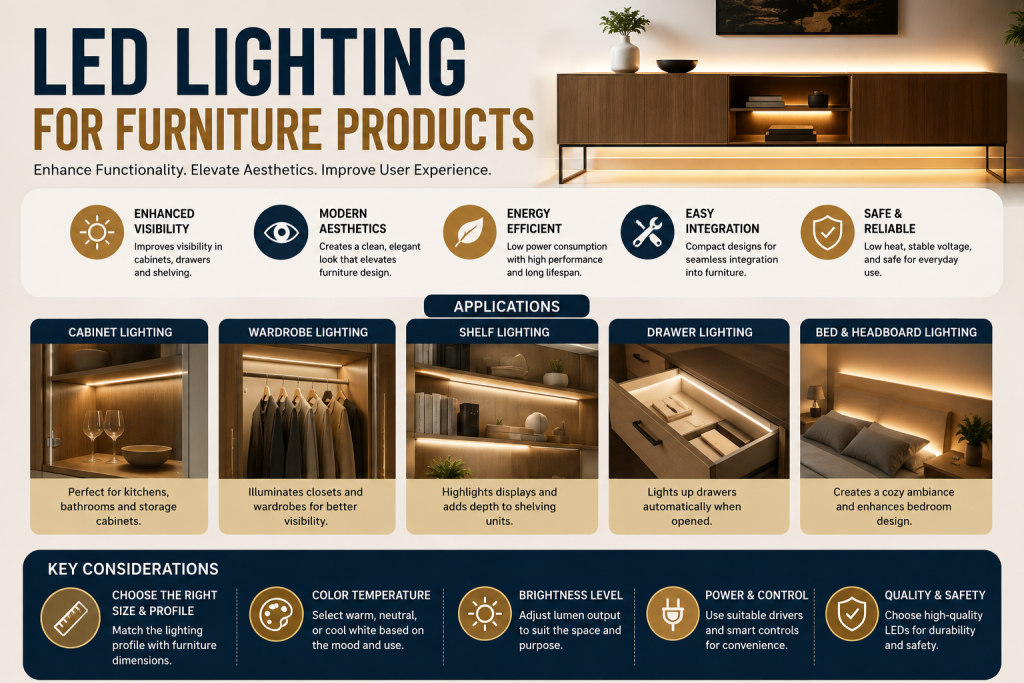
Unlike a standalone luminaire, furniture lighting is part of a larger product. The LED may be installed in wood, aluminum, glass, metal, plastic, or composite panels. The driver may be hidden inside a compartment. Cables may pass through narrow grooves. Sensors may be triggered by doors or drawers. Consequently, the lighting specification affects both electrical design and furniture design.
That matters because a technically correct LED product can still fail in the final furniture if the installation space is too hot, the cable is too long, the driver has poor access, or the connector cannot pass through the drilled hole. The buyer should therefore treat lighting as a system-level component.
When this guide applies
This guide applies when you source LED lighting for furniture that will be assembled into a finished product. It is especially relevant when you need repeated production, stable color appearance, safe wiring, predictable installation time, and controlled after-sales risk.
Typical project cases include:
- Wardrobe manufacturers integrating door sensor LED bars.
- Kitchen cabinet factories specifying under-cabinet LED strips or profiles.
- Retail fixture producers adding shelf and display lighting.
- Bathroom furniture suppliers integrating mirror or vanity lighting.
- Office furniture brands adding task lighting to desks or storage units.
Key Terms and Parameters OEM Buyers Should Understand
Before you compare prices or approve a sample, you need a common technical language. Specifically, you should know which parameters affect brightness, color, safety, compatibility, and production consistency.
| Term or Parameter | Meaning | Why It Matters for Furniture Products |
|---|---|---|
| Voltage | The electrical supply level, commonly 12 VDC or 24 VDC for furniture LED systems. | It determines driver choice, wiring size, voltage drop risk, and installation safety approach. |
| Wattage | The power consumed by the LED product, usually shown in watts or watts per meter. | It affects driver sizing, heat generation, energy use, and total project cost. |
| Current | The electrical flow required by the LED circuit. | It helps confirm cable size, connector rating, driver capacity, and circuit protection. |
| Luminous flux | The visible light output measured in lumens. | It helps compare real brightness instead of judging only by wattage. |
| Luminous efficacy | The light output per watt, measured in lm/W. | It affects energy efficiency, heat load, and driver capacity planning. |
| CCT | Correlated color temperature, such as 2700 K, 3000 K, 4000 K, or 5000 K. | It defines whether the light appears warm, neutral, or cool in the furniture environment. |
| CRI | Color rendering index, often specified as CRI 80, CRI 90, or higher. | It affects how accurately wood grain, fabric, cosmetics, and displayed products appear. |
| SDCM | Standard deviation of color matching, used to describe color consistency. | It helps control visible color variation between LED batches or adjacent furniture units. |
| IP rating | Ingress protection against dust and moisture. | It is important for kitchens, bathrooms, retail counters, or humid environments. |
| Dimming method | The control method, such as PWM, 0 to 10 V, TRIAC, DALI, touch sensor, or door sensor. | It must match the driver, controller, wiring layout, and user interface. |
| Operating temperature | The approved ambient temperature range for reliable operation. | It affects lifetime when LEDs are installed in enclosed or poorly ventilated furniture. |
However, no single parameter tells the full story. A low-wattage product may still overheat if installed in a sealed channel. A high-lumen product may create glare if the beam angle and diffuser are wrong. In contrast, a slightly lower lumen package with better optics and thermal control may produce a better final result.
Core Technical Principles Behind Reliable Furniture Lighting
Furniture lighting projects usually succeed or fail because of a few core principles. These principles are not complicated, but they must be applied early.
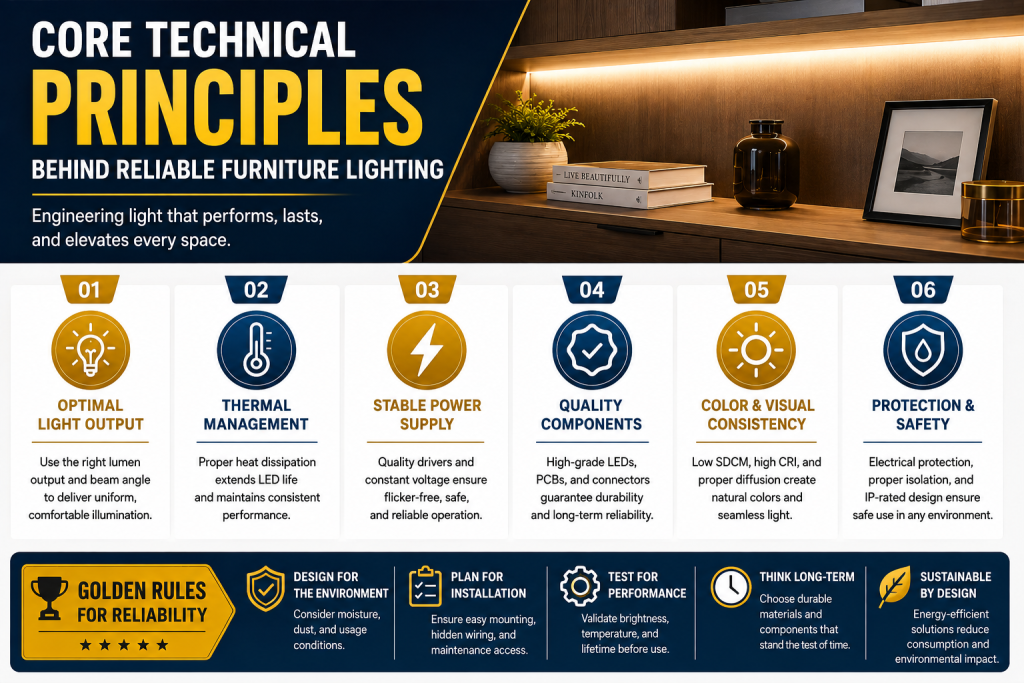
Electrical matching comes first
The LED light, driver, switch, sensor, dimmer, connector, and cable must be electrically compatible. For example, a 24 VDC LED strip should not be paired with a 12 VDC driver. A constant current LED module should not be connected to a constant voltage driver unless the module is designed for that input.
Driver capacity also matters. If a furniture unit uses four LED bars at 6 W each, the total load is 24 W. In many projects, the driver should not run continuously at its absolute maximum rating. A practical margin helps reduce heat stress and supports stable operation. The final margin should follow the driver supplier’s guidance and applicable electrical code.
Thermal management controls lifetime
LEDs convert part of their energy into heat. If heat cannot escape, junction temperature rises. As a result, lumen output may drop faster, color may shift, adhesive may weaken, and electronic components may fail earlier.
In furniture, thermal risk is often hidden. The LED may be installed inside a closed wardrobe, behind a diffuser, under a shelf, or inside a wood groove. Wood and plastic usually conduct heat poorly. Aluminum profiles or metal mounting surfaces help transfer heat away from the LED strip or module.
Optics affect user comfort
Brightness is not the only target. Beam angle, diffuser type, LED pitch, mounting position, and surface reflectance affect the visual result. A high-power LED strip installed close to eye level can cause glare. A strip with wide LED spacing may show dots through a thin diffuser. A narrow beam may create uneven light on shelves.
Specifically, furniture lighting often needs soft and even illumination. You should review the actual viewing angle, not just the catalog lumen value.
Mechanical integration affects assembly cost
Mounting clips, screws, magnets, adhesive tape, recessed channels, and snap-in aluminum profiles all have different installation times and tolerance requirements. A design that looks simple in a sample may slow down production if operators need extra cable handling or precise alignment.
Consequently, mechanical design should be reviewed with production staff before mass production. It is not only an engineering issue. It is also a manufacturing efficiency issue.
Technical Factors to Check Before Selecting a Product
The best LED lighting solution depends on the furniture design, installation environment, required lighting performance, control method, and commercial model.
Before selecting a product, I prefer to review the complete application rather than choosing only by wattage, CCT, or product type. A suitable LED strip, module, profile, or cabinet light should fit the furniture structure and also work reliably during assembly and long-term use.
Lighting Purpose
The first question is what the light needs to do.
It may be used for decoration, task lighting, display lighting, orientation lighting, or functional interior lighting. Each purpose creates different requirements for brightness, beam angle, diffuser type, glare control, and visual appearance.
For example, a decorative furniture light may prioritize soft and uniform illumination. A task light may need higher lumen output and better control of the beam direction.
Furniture Material
I check whether the LED product will be mounted on wood, aluminium, steel, glass, plastic, or composite board.
The mounting material affects heat dissipation, fixing method, electrical insulation, adhesive performance, and installation durability.
An LED strip mounted on aluminium may dissipate heat more effectively than the same strip installed directly on wood or plastic. Therefore, the mounting surface should be considered when selecting wattage and thermal design.
Installation Space
I review the available depth, width, cable clearance, connector space, and access to the driver or power supply.
A lighting product may fit in its main dimensions but still create problems because the wire cannot bend, the connector cannot pass through a hole, or the driver cannot be serviced later.
Enough space should be available not only for the LED product but also for wiring, connectors, mounting parts, diffusers, and assembly movement.
Power Architecture
I ask how the lighting system will be powered.
One driver may supply one furniture unit, several units, or a larger modular system. This decision affects total load, current, cable length, voltage drop, connector rating, driver capacity, and maintenance strategy.
For longer LED strip runs or multiple furniture units, the supplier may also need to review power-injection points and cable size.
Control Method
The control method should be confirmed before the driver and wiring layout are finalized.
The furniture lighting may use a door sensor, touch switch, motion sensor, dimmer, remote control, or smart-control system.
Each option can change the wiring, driver compatibility, standby power, sensor position, and user experience.
For example, a wardrobe light controlled by a door sensor needs a different installation arrangement from a display shelf controlled by a central dimming system.
Color Specification
The optical requirements should include more than a general description such as “warm white.”
I prefer to confirm the target CCT, CRI, and SDCM tolerance.
These values affect visual quality and consistency, especially when several furniture pieces are installed in the same room, showroom, hotel, retail store, or residential project.
If multiple batches will be supplied over time, tighter color control may also help replacement modules match the original installation.
Environmental Exposure
The installation environment affects the required level of protection.
I ask whether the furniture will be used in a dry bedroom, kitchen, bathroom, retail location, humid storage area, or another environment where moisture, dust, cleaning products, or temperature may affect the lighting system.
These conditions influence IP rating, connector protection, sealing method, material choice, corrosion resistance, and driver location.
A product suitable for a dry wardrobe installation may not be appropriate for bathroom furniture or a humid commercial environment.
Compliance Route
The destination market should be confirmed before the final product is selected.
Different markets may require different electrical-safety, EMC, environmental, labeling, or documentation requirements.
This can affect driver selection, connector design, certification scope, product labels, installation instructions, testing, and project approval time.
For OEM furniture manufacturers, private-label requirements should also be confirmed early because model numbers, packaging, manuals, and certification marks may need additional review.
Review the Complete System Before Quotation
In practice, a request such as “LED strip for cabinet” or “3000 K wardrobe light” does not provide enough information for a reliable product recommendation.
I prefer to receive the furniture drawing, available installation space, mounting position, expected cable length, power-supply location, control method, target market, lighting requirement, and intended sample-testing condition.
This information allows the supplier to select and quote the complete system rather than simply offering the cheapest LED component.
The correct product is not only the one that turns on and produces the required CCT. It should also fit the furniture, manage heat correctly, connect cleanly, work with the required controls, meet the target-market requirements, and remain practical for repeat production.
Step-by-Step Guide for OEM Specification and Procurement
A structured decision process helps prevent missing information. It also improves quote accuracy because suppliers can evaluate the same scope.
| Step | Action | Output to Confirm |
|---|---|---|
| 1 | Define the lighting function and viewing condition. | Decorative, task, display, safety, or interior illumination purpose. |
| 2 | Review furniture drawings and installation space. | Mounting depth, cable path, driver location, drilling size, and service access. |
| 3 | Select the LED product format. | LED strip, rigid bar, linear profile, puck light, sensor light, or custom module. |
| 4 | Calculate electrical load. | Total wattage, voltage, current, circuit grouping, and driver capacity. |
| 5 | Check color and optical requirements. | CCT, CRI, SDCM, luminous flux, beam angle, diffuser, and glare control. |
| 6 | Confirm driver and control compatibility. | Constant voltage or constant current driver, dimming method, sensor type, and wiring diagram. |
| 7 | Review thermal and mechanical design. | Heat path, aluminum profile, adhesive surface, screw fixing, clips, and ventilation. |
| 8 | Confirm compliance and documentation needs. | Safety certification expectation, EMC, RoHS, labeling, test report, and installation instructions. |
| 9 | Build and test samples under real conditions. | Temperature check, brightness review, color match, switching test, dimming test, and assembly timing. |
| 10 | Freeze the specification before mass production. | Approved BOM, drawings, cable lengths, packaging, labels, accessories, and QC criteria. |
Step 1: Define the real lighting purpose
A wardrobe interior light does not need the same optical design as a retail display shelf. A nightstand accent light does not need the same brightness as a kitchen task light. Start by defining what the user must see and from what distance.
Step 2: Confirm the mounting and cable route
Furniture often has limited space for cables and connectors. A connector may be electrically suitable but too large to pass through a drilled hole. A driver may fit into the furniture, but not leave enough space for ventilation or replacement.
Step 3: Calculate total load correctly
Total wattage equals the wattage of each LED item multiplied by the number of items in the furniture set. Current can be estimated by dividing wattage by voltage for constant voltage systems. For example, a 48 W load on a 24 VDC system draws about 2 A. This helps verify cable and connector ratings.
Step 4: Approve samples in the final structure
Bench testing is useful, but it is not enough. Install the sample inside the actual furniture or a realistic mockup. Check brightness, color, glare, sensor function, operating temperature, cable fit, driver noise, and installation time.
How LED Lighting Affects Product Specification and Cost
The lighting specification directly affects both purchase price and total cost. A lower unit price may increase cost elsewhere if it requires longer installation time, more rework, higher warranty risk, or additional accessories.
For example, adhesive-backed LED strip may seem economical. However, if the furniture surface is dusty, textured, oily, or too warm, the adhesive may lose strength. In that case, an aluminum profile with clips may cost more at purchase but reduce field failures and improve heat transfer.
Another example is color tolerance. A very loose color bin may reduce LED cost. However, visible color difference between furniture units can create customer complaints, especially in retail displays, hotel rooms, premium wardrobes, or kitchen showrooms. If the finished furniture is installed in groups, SDCM control becomes more important.
Driver selection also affects cost. A certified driver with reliable EMC performance may cost more than a basic power supply. However, it can reduce compliance risk and electrical noise issues. For export projects, the target market may require specific certification marks or documentation. You should confirm those requirements before quotation, not after sample approval.
Installation and Project Execution Considerations
Good lighting design must be easy to assemble repeatedly. That is especially important for furniture OEM production, where operators may install lighting into hundreds or thousands of units.
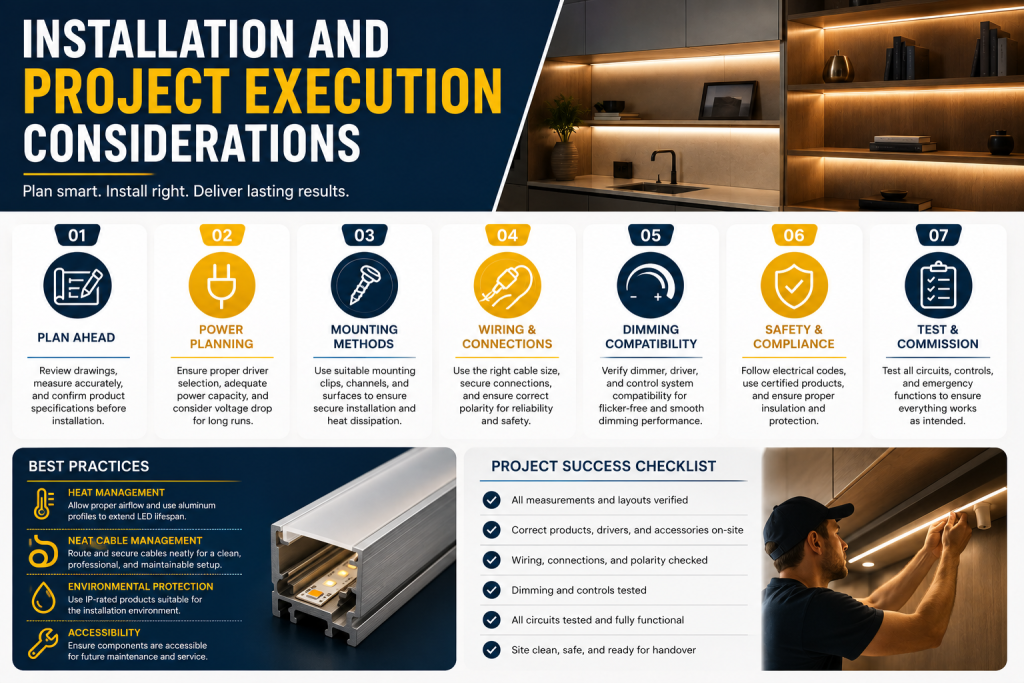
Mounting method
Common mounting methods include adhesive tape, screw clips, magnetic fixing, recessed channels, snap-in aluminum profiles, and bracket mounting. Each method has trade-offs. Adhesive is fast but depends on surface preparation. Screws are secure but require hole control. Recessed channels look clean but require accurate machining.
Driver placement
The driver should be accessible for inspection or replacement when possible. It also needs ventilation. Placing a driver in a sealed, insulated, or crowded compartment can raise operating temperature and shorten component life.
Cable length and voltage drop
Long cable runs can reduce voltage at the LED input. This is called voltage drop. The result may be lower brightness or visible difference between the first and last light point. Higher current, thinner cable, and longer distance increase this risk. In many furniture systems, 24 VDC helps reduce current compared with 12 VDC for the same wattage.
Connector and harness design
Connectors should match current rating, polarity protection, installation sequence, and available space. Color-coded or keyed connectors reduce assembly mistakes. Pre-made wiring harnesses can improve production speed and consistency, but the drawing must be controlled carefully.
Pro Tip / Field Experience
Field note: Always test the complete furniture lighting set after the driver, sensor, cable length, diffuser, and mounting surface are finalized. Many problems appear only in the assembled furniture, including sensor misalignment, adhesive failure, driver heat, visible LED dots, and voltage drop. A one-hour burn-in inside the real cabinet or wardrobe can reveal issues that a quick bench check will miss.
Testing, Quality Control, and Compliance Checks
Testing should confirm that the lighting system performs safely and consistently in the intended furniture environment. It should not only confirm that the LED turns on.
| Check Area | Recommended Check | Risk Controlled |
|---|---|---|
| Electrical input | Measure voltage at the LED input under full load. | Controls voltage drop and brightness inconsistency. |
| Driver loading | Confirm total wattage and current are within the driver rating. | Reduces overheating, shutdown, flicker, and early driver failure. |
| Temperature | Check LED profile, driver case, and nearby furniture surface after stable operation. | Controls heat damage, adhesive failure, discoloration, and lifetime risk. |
| Optical performance | Review brightness, beam spread, glare, diffuser effect, and color match. | Prevents poor user experience and inconsistent appearance. |
| Dimming and control | Test dimming range, sensor response, door switch timing, and restart behavior. | Controls flicker, compatibility problems, and user complaints. |
| Mechanical fit | Confirm clips, channels, holes, connectors, and cable bend radius. | Reduces assembly delays and mechanical damage. |
| Documentation | Review wiring diagram, labels, test reports, and installation instructions. | Supports compliance, repeat production, and after-sales service. |
Relevant standards and reports may include CE, RoHS, UL, ETL, EMC testing, IEC-based safety evaluation, LM-79 photometric testing, LM-80 LED package data, and TM-21 lumen maintenance projection. The exact requirement depends on product type, market, voltage level, and whether the lighting is treated as a component or part of a finished electrical product.
You should not assume that a component certificate automatically covers the finished furniture assembly. The final product may still need review for wiring, strain relief, insulation, grounding, labeling, temperature, and user access according to the target market.
Realistic Application Scenarios and Decision Cases
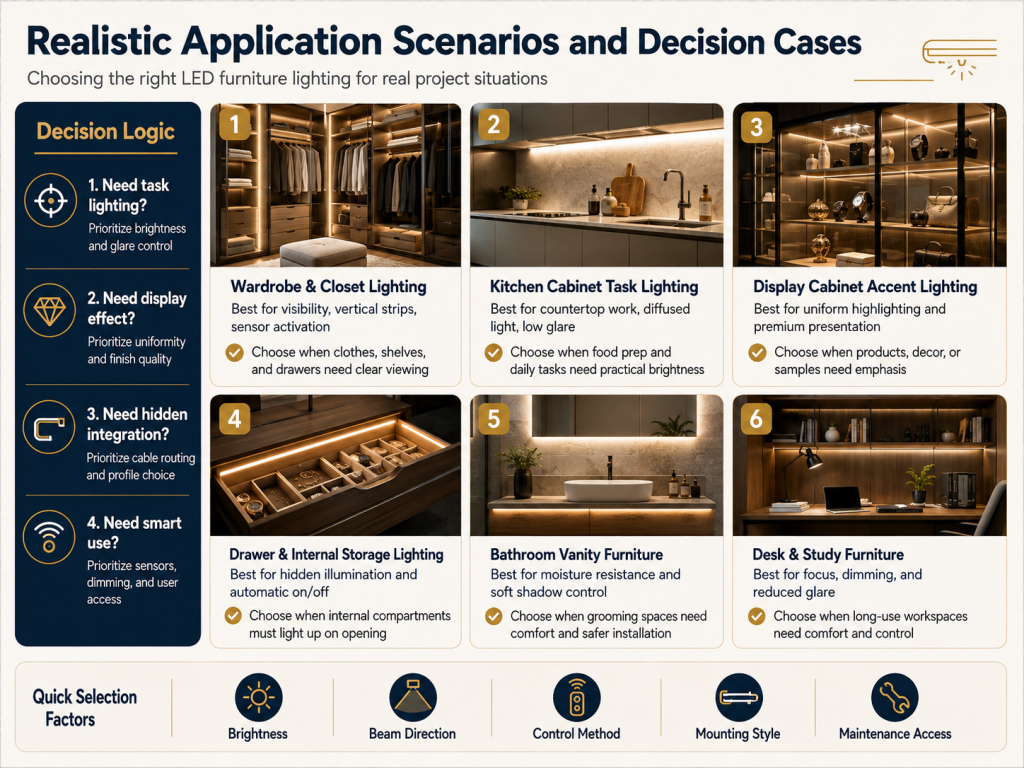
Wardrobe with door sensor lighting
A wardrobe light often needs automatic switching, soft illumination, and hidden wiring. The key checks are sensor position, door gap tolerance, low standby power, connector access, and uniform color between left and right compartments. If the sensor is too close to metal hinges or misaligned with the door movement, the light may fail to switch reliably.
Kitchen cabinet under-lighting
Kitchen cabinet lighting may be exposed to moisture, steam, grease, and frequent cleaning. Therefore, IP rating, diffuser material, easy-to-clean surfaces, and driver location become important. A warm or neutral CCT with suitable CRI can improve countertop visibility and food appearance.
Retail display furniture
Retail display lighting must highlight products without color distortion. CRI, beam angle, glare control, and color consistency are critical. In this case, a higher-quality LED and controlled SDCM tolerance may be more important than the lowest wattage cost.
Bathroom vanity or mirror furniture
Bathroom furniture may require higher moisture protection and careful electrical safety review. Driver location, insulation, IP rating, local electrical code, and user contact risk should be checked early. The lighting should also avoid harsh shadows on the face if it supports grooming tasks.
Common Myth vs Reality
Myth: If the LED strip works during sample testing, it will work in mass production.
Reality: Sample testing only proves one condition. Mass production introduces cable length variation, different mounting surfaces, worker handling, batch color tolerance, packaging stress, and field voltage variation. You need controlled drawings, approved components, and repeatable QC checks.
Myth: Higher wattage always means better furniture lighting.
Reality: Higher wattage can increase heat and glare. The better target is suitable luminous flux, correct beam distribution, good color rendering, stable driver performance, and safe thermal design.
Myth: All 24 V LED products work with all 24 V drivers.
Reality: Voltage is only one compatibility factor. You must also check power rating, current capacity, dimming type, protection functions, connector polarity, ripple, EMC behavior, and control interface.
12. What This Means in Practice
In practice, the right procurement approach is to freeze the lighting specification together with the furniture design. Do not leave the LED system as a late accessory decision. Once grooves, holes, panels, packaging, and assembly methods are fixed, lighting changes become expensive.
A complete specification should include the LED product type, voltage, wattage, total current, CCT, CRI, SDCM, luminous flux target, beam angle, diffuser, driver model or driver requirements, dimming or sensor method, cable length, connector type, mounting method, operating temperature, IP rating if needed, compliance documents, packaging requirements, and sample approval criteria.
You can contact a technical team to confirm project details when the furniture drawing, electrical requirement, and target market are available. A short technical review before quotation often saves more time than correcting mismatched samples later.