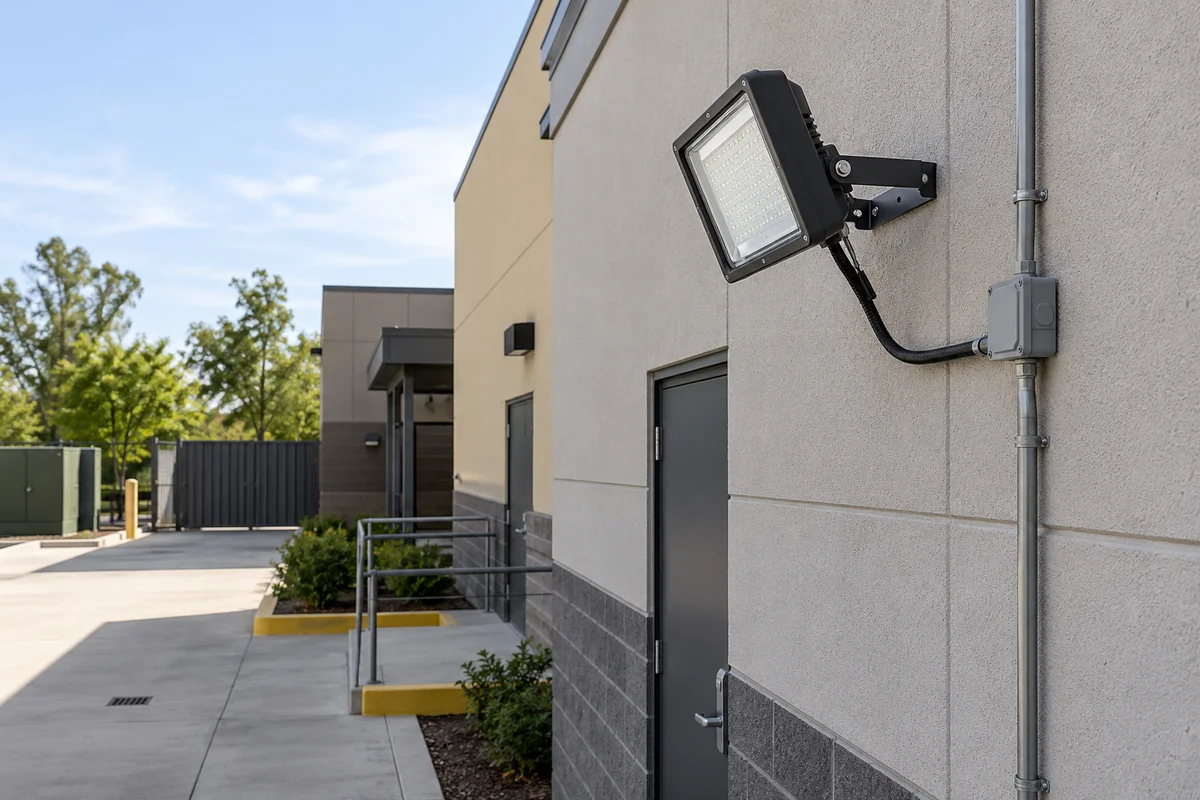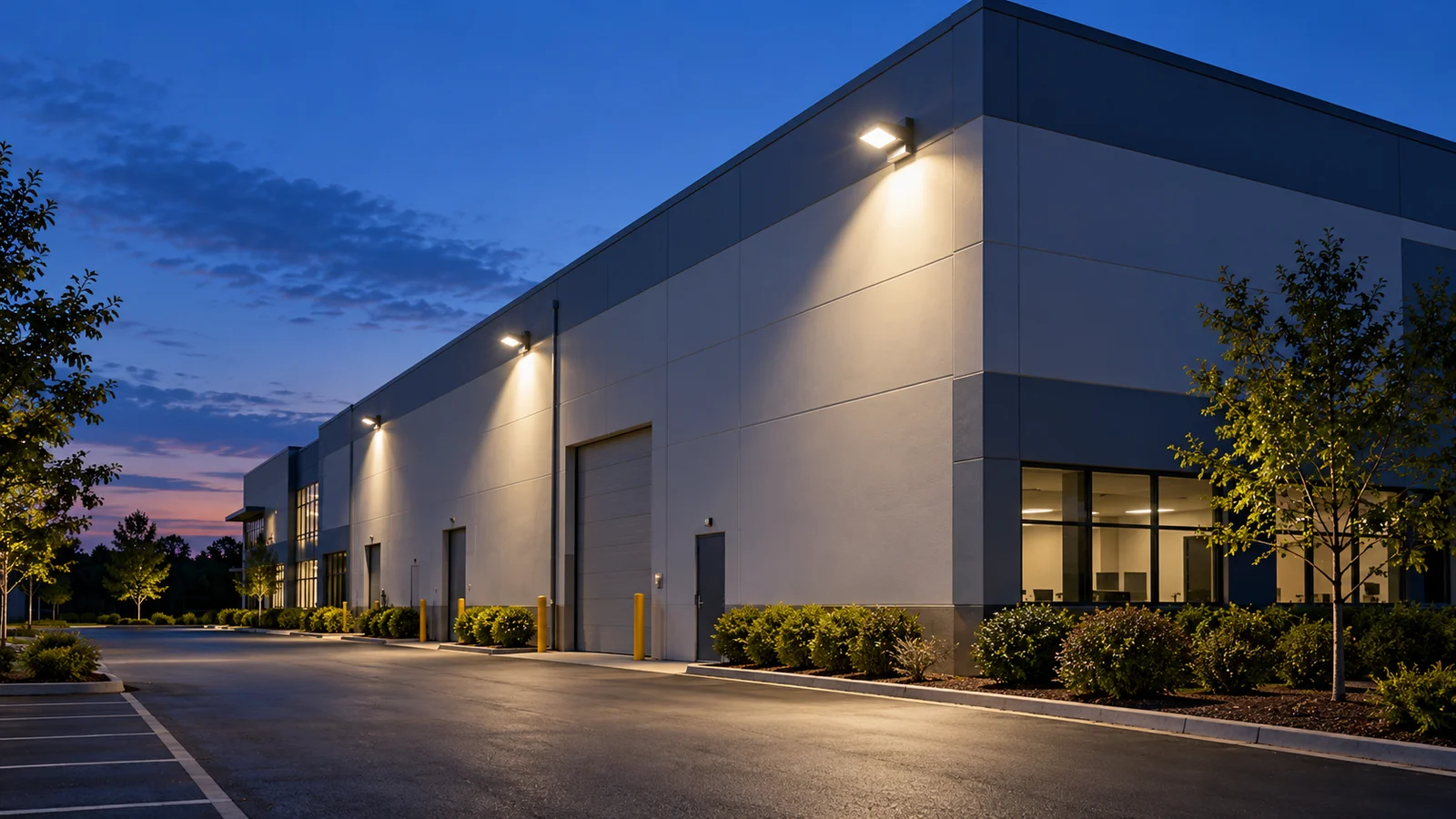
A catalog lifetime can look generous until you put it beside your operating schedule. A floodlight used through every night accumulates hours much faster than one lighting only an evening shift. Meanwhile, its driver, optical surfaces and enclosure all have to remain fit for the job.
VST’s FL20-100W catalog lists 50,000 hours and a five-year warranty period. Those are different entries with different uses: the hours describe a stated life claim; the warranty period belongs to the service agreement. Understanding that distinction helps you compare products and budget for work without assigning an unsupported replacement date.
What does an LED floodlight lifetime claim measure?
Fading light and a fitting that stops working
LED output can decline gradually, and color can change during service. A complete floodlight can also stop operating when a driver or another component fails. For a yard or loading entrance, either outcome may need attention, but the work involved can be quite different.
L70 refers to maintaining 70% of an initial light-output value under the stated basis. Its scope matters: a result for an LED package does not describe every component in the finished fitting. The DOE-hosted LED luminaire lifetime guide discusses these distinctions between output maintenance and complete-system reliability.
Read the number attached to the selected model
The published FL20-100W model entry states 50,000 hours, but does not name the life endpoint or its supporting test conditions. You can use that number to compare hour accumulation. It is not enough to predict when the complete fitting will need replacement, or to label the entry L70.
When comparing two quotations, look for the defined endpoint, the component or complete product covered, and the temperature and operating conditions behind each claim. If one quotation supplies those details and another gives only a larger hour number, the larger number alone is a weak basis for paying more. The extra evidence changes how confidently you can use the claim.
How many years do 50,000 operating hours represent?
Calculate the hours your site actually uses
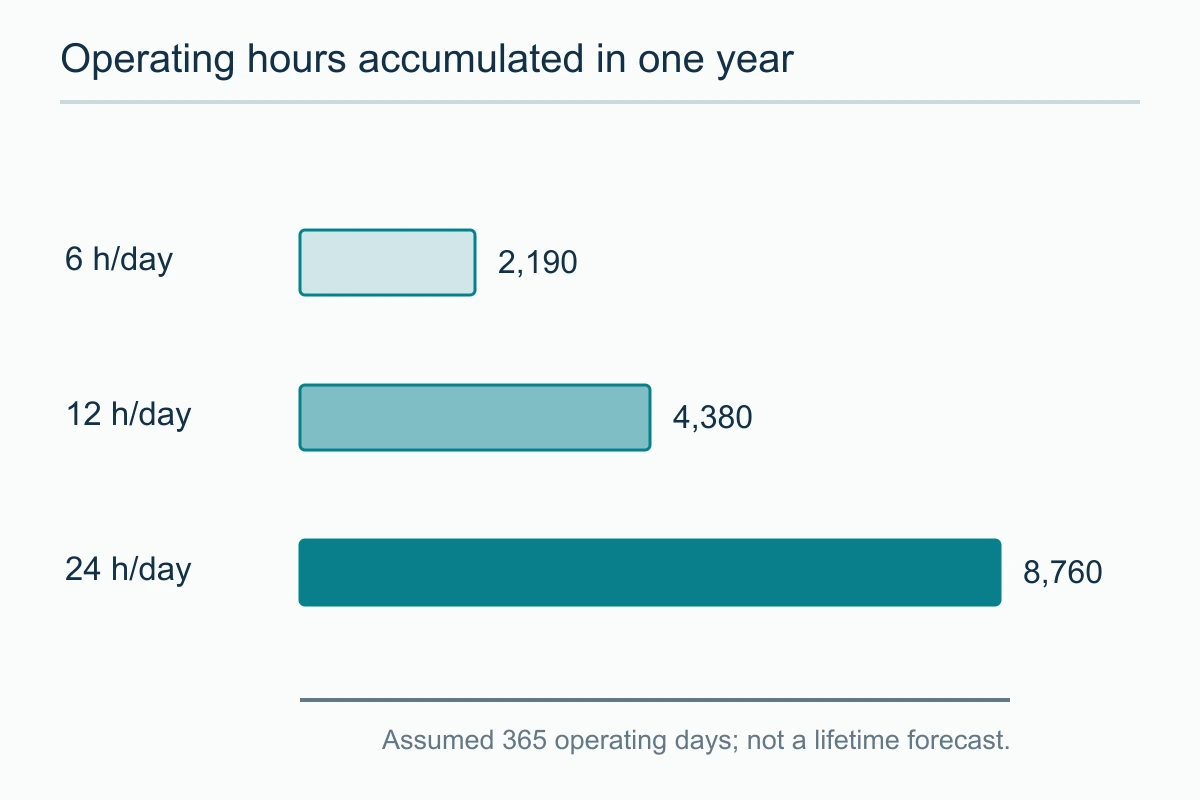
Annual operating hours equal hours per operating day multiplied by operating days per year. Use separate periods when the schedule changes seasonally. For example, an assumed six hours on 180 days plus twelve hours on 185 days gives 1,080 + 2,220 = 3,300 hours per year.
Dusk-to-dawn operation varies with the location and season, so a constant twelve-hour day is a planning assumption rather than a measured schedule. Motion control may introduce standby, dimmed and full-output periods. Keep those periods distinct; a dimming percentage by itself does not tell you how the selected product’s life claim applies.
| Assumed use, 365 days a year | Annual operating hours | Time to accumulate 50,000 hours |
|---|---|---|
| 6 hours per day | 2,190 | 22.83 years |
| 12 hours per day | 4,380 | 11.42 years |
| 24 hours per day | 8,760 | 5.71 years |
Apply the result to a five-year review
Suppose your planned duty is twelve hours every day. The arithmetic is 12 × 365 = 4,380 hours per year, and 50,000 ÷ 4,380 = approximately 11.4 years. After five years, that schedule would have accumulated 21,900 operating hours.
The useful conclusion is that the catalog hours and the five-year warranty period reach different points on this assumed schedule. Neither calculation establishes a failure date, the warranty’s coverage, or how much useful life remains after year five. For the purchase, compare the defined life evidence; for the budget, allow for the service work and costs your agreement actually covers.
Why can outdoor service differ from the catalog claim?
Heat depends on the mounting position
A floodlight under a deep overhang releases heat into the conditions around that position. Rear airflow, nearby surfaces and deposits on cooling features can differ from an open mounting location. Matching the product’s documented environment and clearances gives the thermal design the conditions it needs.
For a replacement, compare the space around the new housing as well as its outline dimensions. A unit that fits between two walls may leave less cooling space than the old fitting. Later changes also matter: a roof extension or stored material can obstruct a previously open area. Address the changed position rather than repeatedly replacing a fitting in the same unsuitable arrangement.
Moisture and corrosion involve the complete installation
Rain exposure, cleaning, airborne deposits and coastal salt are different demands. The enclosure, joints and cable-entry arrangement all contribute to the installed result. An ingress rating addresses a defined scope; it does not settle the separate question of corrosion resistance or suitability for a particular cleaning exposure.
If the site has aggressive deposits or saline exposure, that is a product-selection issue from the outset. Select construction supported for those conditions rather than expecting a general outdoor description to cover them. Calendar exposure continues while a light is off, which is another reason reduced operating hours cannot be converted directly into a fixed life extension.
Why does a floodlight seem dimmer before it fails?
Separate surface deposits from gradual aging
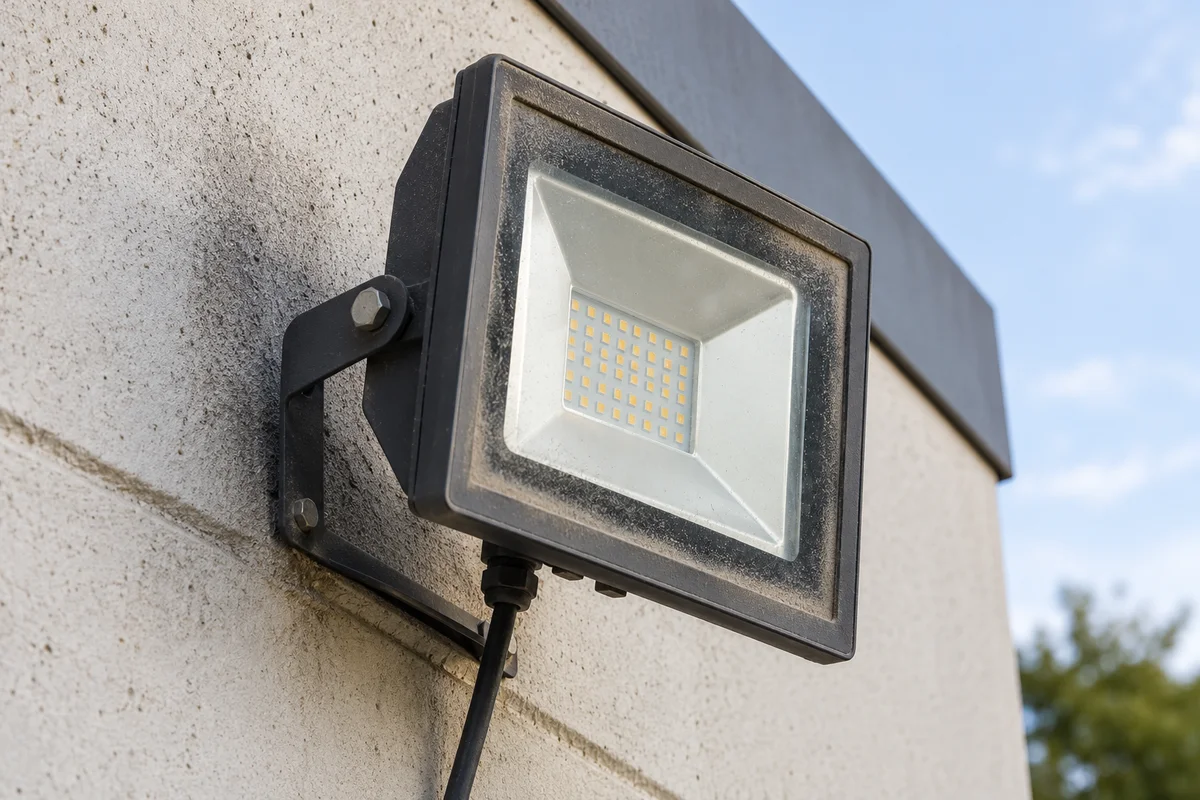
Dirt on the optical face can reduce the light passing through it. Permitted cleaning can address that deposit; it cannot reverse aging within an LED or optical material. The distinction matters because replacing a dirty but otherwise suitable fitting and cleaning a deteriorated one can both leave the real problem unresolved.
Compare accessible observations over time: the location of a deposit, a visible material change and whether one fitting or several are affected. Ordinary photographs are useful for communicating these conditions. Their exposure settings make them unsuitable for calculating an exact percentage of output loss.
Check what changed in the working area
A parked trailer, new canopy or relocated container can interrupt a useful light path. A different operating scene may leave some fittings dimmed or switched off. The relationship between distribution and the target still governs coverage after the installation has aged.
If the weak area appeared after a site alteration, review that obstruction or layout first. A like-for-like replacement in the same position may reproduce the shadow. Where the task has changed, a different optic, position or local task light may be more useful than restoring the old arrangement.
When should you clean, service or replace the fitting?
Choose work that addresses the observed problem
A useful maintenance decision links the condition to a job. External deposits may justify permitted cleaning; loss of function needs fault assessment; an altered loading route may need a lighting-layout change. Being precise here avoids buying a new fixture to solve a problem that belongs elsewhere.
| Condition | First appropriate route | What determines the next decision? |
|---|---|---|
| Accessible external deposit | Permitted cleaning | Documented method, safe access and the result afterward |
| Unlit fitting, damage or unexplained intermittent operation | Qualified service assessment | Established cause, covered support and serviceability |
| New shadow after a site alteration | Layout and obstruction review | Whether the light path can reach the changed task |
| Required lighting result remains inadequate | Compare repair, replacement and layout options | Performance against the task and complete intervention cost |
Keep an older fitting when it still serves the task
A working floodlight need not be discarded on an arbitrary birthday. If its condition, useful light and service arrangement remain suitable, continued use can be reasonable. Replacement becomes more attractive when the required result cannot be restored economically or when the site now needs a different lighting arrangement.
Electrical faults, damaged enclosures and work at height belong with personnel competent for that work. Facilities staff can provide the model, dates, operating pattern and accessible observations without opening a fitting or testing an energized circuit.
What does the warranty change in your service budget?
Separate the period from the costs covered
The FL20-100W catalog’s five-year entry tells you the stated warranty period, not every term of the agreement. Coverage for failure, exclusions, remedies and operating conditions comes from the applicable written terms. A supplied replacement unit may still leave access, removal, labor, transport or site disruption outside the covered scope.
This matters above an active vehicle lane. The fitting’s price can be only one part of restoring service once lifting equipment and a controlled work area are involved. Compare quotations using the same service scope and real contractor costs; a longer warranty period has limited value for a particular cost if that cost is excluded.
Check the replacement approach before a phased change
Some products have documented service units; others are replaced as complete fittings. That distinction changes the work, access time and items purchased. The chosen product’s service instructions establish the available approach.
For phased replacement, also match the required output, color, optic, fit and operating behavior. A similar housing can direct light differently. If another version changes the useful distribution, include any layout or aiming assessment in the replacement scope rather than comparing unit prices alone.
Turn the lifetime reading into a practical maintenance plan
Use the five-year review to separate operating and service assumptions
For the twelve-hour schedule above, use 21,900 hours as the five-year operating total. Then plan the jobs around the actual exposure and product instructions. A sheltered entrance and a dusty yard can accumulate the same operating hours while needing different cleaning and access arrangements.
| Planning item | Input in this example | Budget or service decision |
|---|---|---|
| Operating-hour total | Assumed 12 hours daily × 365 days × 5 years = 21,900 hours | Use for the stated duty comparison, without scheduling failure |
| Routine permitted cleaning | Actual deposits, product method and access arrangement | Price the relevant planned visits |
| Unscheduled intervention | Written remedy and excluded work | Identify responsibility for access, labor and replacement supply |
| Review at year five | Current condition, lighting task and available service options | Choose continued use, corrective work or replacement on that evidence |
Compare offers on the work needed to keep useful light
If two offers have the same hour label, the better-supported life definition, suitable exposure conditions and practical service arrangement can distinguish them. If their definitions differ, resolve that difference before ranking the numbers. For a selected VST configuration, the outdoor floodlight range is the next step for matching the product to your site and duty.
The outcome is a maintenance plan you can act on: known operating assumptions, planned tasks, clear service responsibilities and a condition-based replacement decision.