
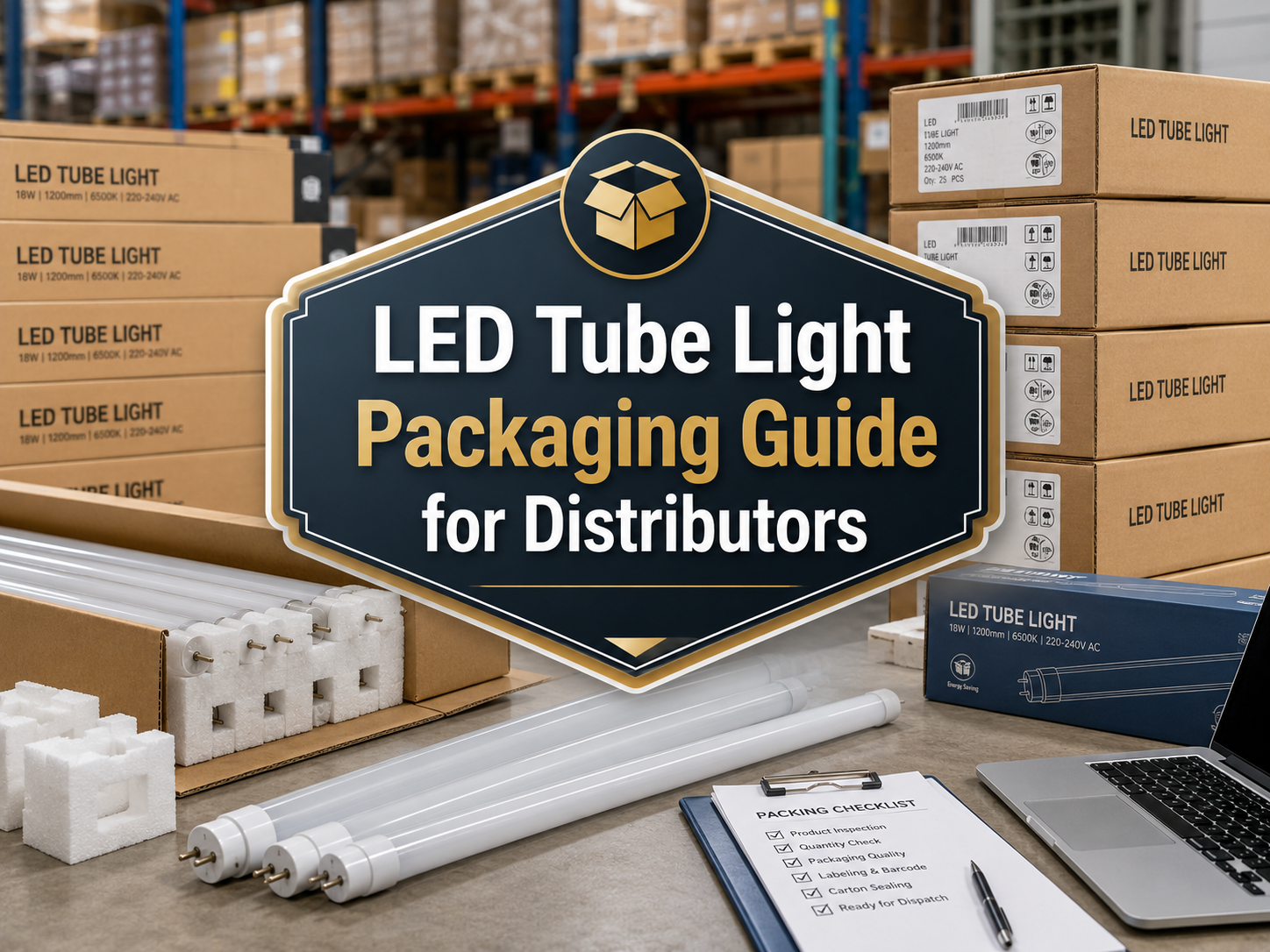
Distributors should confirm LED tube light packaging before ordering because packaging affects product protection, label accuracy, freight cost, warehouse handling, and installation efficiency. The practical answer is simple: specify the tube model, carton structure, inner protection, label content, pallet method, barcode system, accessory packing, and any required compliance marks in the purchase specification, not after production starts.
LED tubes are long, lightweight, and vulnerable to bending force, end-cap impact, and carton compression. A technically good tube can still create project losses if the packaging allows cracked covers, bent pins, mixed CCT cartons, missing wiring labels, or unreadable barcodes. That matters because distributors often handle multiple SKUs, mixed pallets, fast delivery schedules, and installer claims after goods leave the factory.
What LED Tube Light Packaging Means in Procurement
LED tube light packaging is the complete packing system used to protect, identify, group, store, ship, and install LED tube products. It includes the individual sleeve or box, inner support, master carton, label, barcode, accessory bag, instruction sheet, pallet wrapping, and export shipping marks.
For a distributor, packaging is not only a visual presentation issue. It is a supply chain control point. Specifically, it connects the manufacturer’s production line, the freight forwarder, the warehouse team, the electrical contractor, and the final installation site.
In contrast, poor packaging creates problems that may not appear during factory inspection. The tubes may pass electrical testing, photometric testing, and visual checking, but still arrive with dented aluminum housings, damaged pins, cracked PC covers, or missing installation notes. Consequently, packaging should be reviewed as part of product specification.
When this guide applies
This guide applies when you source or distribute LED tube lights such as T5, T8, T10, and integrated linear replacement tubes. It is especially relevant for project shipments, private-label products, export orders, mixed-SKU pallets, retrofit programs, and warehouse stocking programs.
It is also useful when you need to compare packaging cost against damage risk. A low-cost bulk pack may work for local warehouse transfer. However, it may not be suitable for sea freight, parcel delivery, long-term storage, or jobsite handling by multiple subcontractors.
| Packaging Element | Technical Meaning | Why Distributors Should Confirm It |
|---|---|---|
| Individual box or sleeve | The first layer that holds one LED tube and shows product information. | It supports SKU identification and reduces scratches during handling. |
| Inner divider or tray | A paper, foam, molded pulp, or corrugated structure that separates tubes inside the master carton. | It reduces tube-to-tube impact and end-cap damage during transport. |
| Master carton | The outer carton that groups several tubes for shipping and storage. | It must match tube length, carton weight, stacking condition, and warehouse handling method. |
| Label and barcode | The printed identification system for model, wattage, voltage, CCT, quantity, batch, and logistics tracking. | It prevents mixed-spec delivery and improves receiving speed. |
| Pallet packing | The unitized loading method using pallet, corner protector, stretch film, straps, or top cover. | It controls stacking stability, container loading efficiency, and forklift handling safety. |
| Instruction and warning sheet | The printed guide for wiring, compatible ballast condition, input voltage, and installation limitation. | It reduces miswiring risk and supports field compliance review. |
Key Terms and Definitions to Confirm
Before comparing packaging options, define the product and logistics terms clearly. LED tube projects often involve similar-looking products with different wiring methods, wattages, color temperatures, and certification requirements. If the label does not show the correct information, the warehouse team may not detect the difference before shipment.
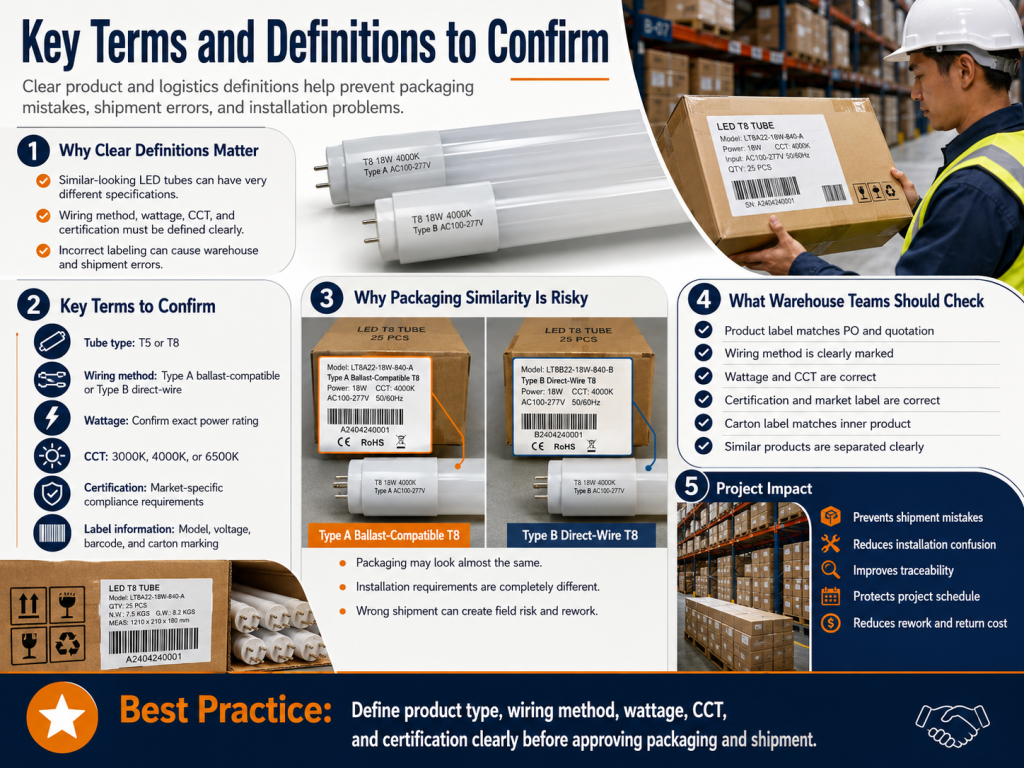
For example, a Type A ballast-compatible T8 tube and a Type B direct-wire T8 tube may look nearly identical in packaging. However, they create very different installation requirements. If cartons are mixed, installers may connect the wrong product to the wrong circuit or spend extra time checking every tube manually.
Product terms that affect packaging
Base type refers to the lamp end connection, such as G13 for many T8 tubes or G5 for many T5 tubes. Wiring type refers to how the tube receives power, such as ballast-compatible, ballast-bypass, single-ended input, double-ended input, or external driver input. These terms should appear on packaging when they affect installation safety.
CCT means correlated color temperature, such as 3000K, 4000K, 5000K, or 6500K. CRI means color rendering index. SDCM describes color consistency tolerance. These values are important when tubes are installed in visible commercial spaces, retail aisles, offices, or maintenance replacement programs where color mismatch causes complaints.
| Parameter | Typical Packaging Information | Project Impact |
|---|---|---|
| Tube length | 2 ft, 3 ft, 4 ft, 5 ft, 6 ft, or 8 ft depending on product range. | Determines carton size, pallet length, container loading, and breakage risk. |
| Wattage | For example, 9 W, 12 W, 15 W, 18 W, 22 W, or 36 W. | Supports energy calculation, inventory separation, and replacement accuracy. |
| Input voltage | For example, AC 120 V, AC 220 to 240 V, or AC 100 to 277 V. | Prevents incorrect regional shipment and electrical compatibility errors. |
| CCT and CRI | For example, 4000K CRI 80 or 5000K CRI 90. | Controls visual consistency and project specification compliance. |
| Wiring type | Type A, Type B, Type A plus B, single-ended, or double-ended. | Reduces installation mistakes and supports local code review. |
| Certification marks | UL, ETL, CE, RoHS, DLC, or other marks only when valid for the product. | Supports market access and avoids improper label claims. |
| Batch or date code | Production date, lot number, or traceability code. | Helps warranty tracking, quality investigation, and inventory rotation. |
Core Technical Principles of Safe and Efficient Packaging
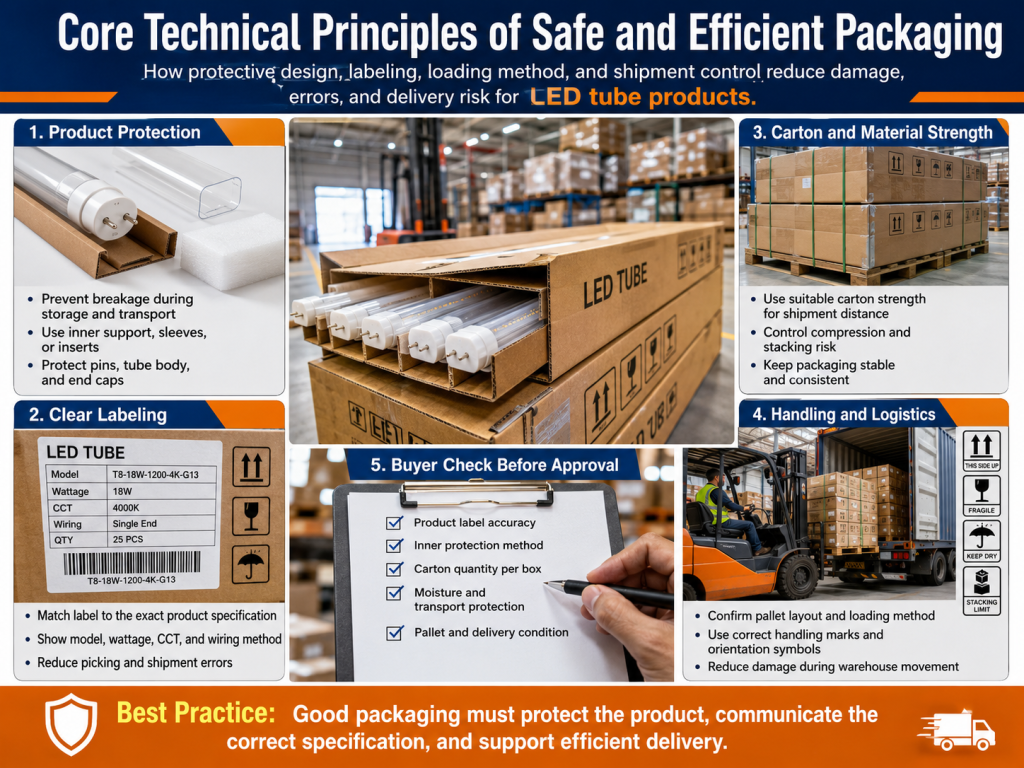
Good LED tube packaging follows three technical principles: protect the product from mechanical stress, keep identification visible and accurate, and support efficient handling through the logistics chain. These principles apply whether the order is a private-label retail pack or a bulk project carton.
Mechanical protection
LED tubes usually include a PC cover, aluminum or plastic body, LED PCB, driver electronics, pins, and end caps. The weakest areas are often the end caps, pins, lens cover, and long housing. During transport, the tube can experience vibration, drop impact, compression, and bending.
Consequently, inner packaging must prevent the tube from sliding inside the carton. End protection is especially important for 4 ft and 8 ft tubes because carton drops often transfer force directly to the pins and end caps. A long carton with weak side walls can also flex during manual lifting, which may crack covers or deform housings.
Label and traceability control
Packaging labels must match the product inside the carton. That sounds basic, but it is a common source of claims when distributors handle multiple wattages and CCTs. The label should identify model number, tube length, wattage, voltage, CCT, CRI, wiring type, quantity, barcode, and batch number when required.
If the product is private label, confirm whether the packaging uses brand artwork, neutral carton, or project-specific label. Also confirm who approves the final artwork. However, avoid adding certification marks, energy labels, or regulatory logos unless the product and packaging claim are properly supported.
Logistics and storage performance
Packaging must fit the real shipping route. Local truck delivery, courier parcel shipment, full container sea freight, air freight, and long-term warehouse storage create different risks. For export shipments, moisture, pallet stability, container loading pressure, and carton edge strength become more important.
Carton strength is often described by burst strength or edge crush test values. The correct level depends on tube weight, carton size, stacking height, pallet method, and expected handling. A carton may look strong when empty, but it can collapse when stacked in a humid warehouse for several weeks.
Step-by-Step Guide to Confirm Packaging Before Order
A structured confirmation process reduces rework. It also prevents the most expensive packaging mistakes, which usually appear after mass production or after goods arrive at the warehouse.
| Step | What to Confirm | Why It Matters |
|---|---|---|
| 1 | Confirm tube type, length, wattage, voltage, CCT, CRI, wiring method, and base type. | The packaging must identify the exact product and prevent SKU mixing. |
| 2 | Select individual box, sleeve, bulk divider, or project carton according to sales channel. | Packaging style affects cost, warehouse picking, and jobsite installation speed. |
| 3 | Define inner protection for end caps, pins, PC cover, and tube body. | Proper support reduces breakage and cosmetic damage during shipment. |
| 4 | Approve label content, barcode format, batch code, warning text, and installation icons. | Accurate labeling improves receiving, traceability, and field safety communication. |
| 5 | Confirm master carton size, quantity per carton, gross weight, and stacking limit. | These values affect freight quotation, pallet planning, and warehouse labor. |
| 6 | Confirm pallet material, pallet size, corner protection, wrapping, and container loading method. | Stable pallets reduce forklift damage, carton crushing, and container unloading risk. |
| 7 | Review compliance marks, instruction sheets, safety warnings, and language requirements. | Packaging must support market requirements without unsupported certification claims. |
| 8 | Request packaging sample, drop check, carton compression review, or shipping simulation when needed. | Testing helps detect weak packaging before mass shipment. |
Step 1: Lock the product specification first
Packaging should not be finalized before the electrical and optical specifications are confirmed. At minimum, confirm wattage, voltage, CCT, CRI, lumen output, luminous efficacy, beam angle, wiring method, and certification requirement. If one value changes after artwork approval, the packaging may need to be reprinted.
Step 2: Choose the correct packing format
Retail-style color boxes improve visual presentation and are useful for shelf sales. Neutral single boxes are common for distributor inventory. Bulk project cartons reduce packaging volume and cost, but they require excellent carton labeling and careful warehouse handling.
Specifically, installers usually prefer packaging that is easy to open and identify on site. If a project uses several CCTs or wattages, carton labels should be large enough to read without opening the box. This small detail can save labor during fixture retrofit work.
Step 3: Confirm artwork and label approval workflow
Packaging artwork should be reviewed by both technical and commercial teams. Technical review confirms specifications, warnings, wiring diagrams, certification marks, and model data. Commercial review confirms brand layout, barcode, SKU number, carton mark, and order information.
Use one approved file version. Do not rely on screenshots or message history. In practice, many packaging errors come from outdated artwork files or informal label changes made after sample approval.
Technical Factors to Check
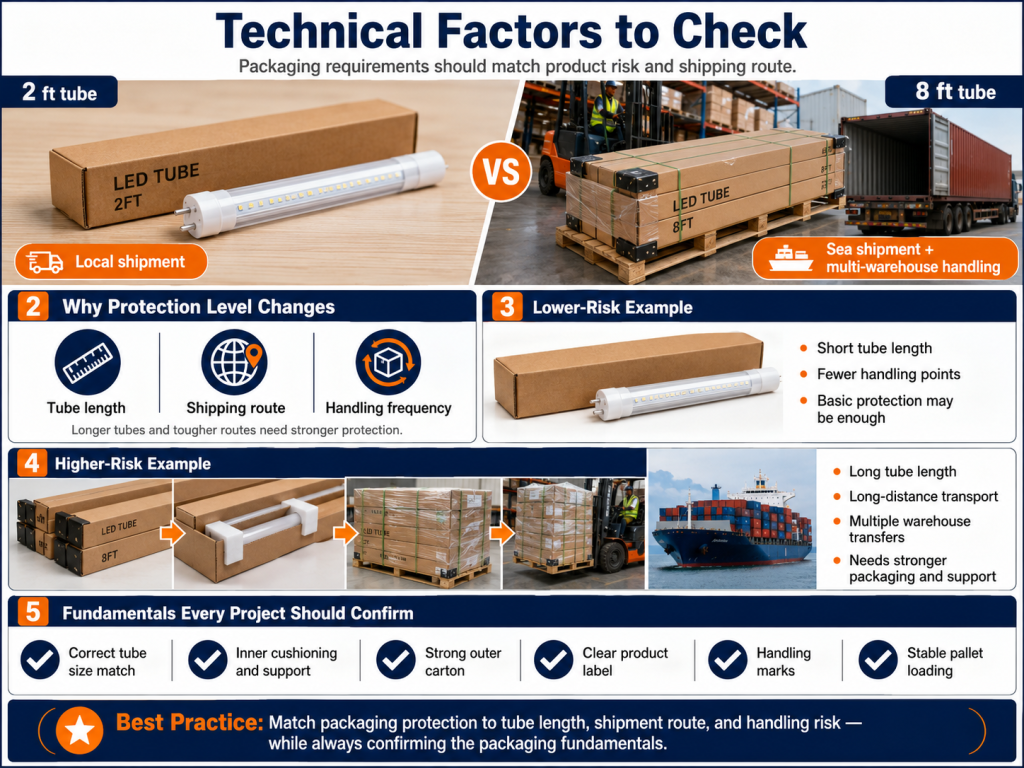
Technical packaging checks should match the product risk and the shipping route. A 2 ft tube in a local shipment may need less protection than an 8 ft tube shipped by sea and handled through several warehouses. However, every project should confirm the fundamentals.
Carton strength and dimensions
The master carton should fit the tube length without excessive empty space. Too little space can transfer impact to the tube ends. Too much space allows movement and carton deformation. Confirm carton wall grade, internal divider design, gross weight, and stacking limit.
For long tubes, pay attention to carton bending. A carton that is easy to flex can stress the tube body during manual lifting. Corner boards and full-length support may be needed for longer formats or heavier cartons.
Inner protection and material choice
Common inner materials include corrugated dividers, paper sleeves, foam end caps, molded pulp, and plastic trays. Corrugated options are recyclable and cost-effective. Foam can provide strong impact absorption, but it may conflict with sustainability requirements or customer packaging policies.
End-cap protection is usually more important than thick side padding. If the tube cannot move forward and backward inside the carton, the risk of pin damage is lower. That matters because damaged pins can create installation failure even when the LEDs and driver still work.
Moisture and warehouse conditions
LED tubes are usually installed indoors, but packaging may face humid ports, containers, or warehouses before installation. Moisture can weaken cartons, blur printed labels, and cause pallet instability. For export or long storage, consider moisture-resistant cartons, desiccant where appropriate, pallet covers, and clear storage instructions.
Barcode and warehouse system compatibility
Distributors should confirm barcode type, scan direction, label location, and data structure. Common options include UPC, EAN, Code 128, QR code, or customer-specific warehouse labels. The barcode should remain visible after pallet wrapping or carton stacking.
If a warehouse management system requires item number, purchase order, batch code, or serial traceability, confirm this before production. Retrofitting labels after shipment is slow and error-prone.
Compliance and documentation
Packaging may need to show regulatory marks, caution statements, recycling marks, country of origin, energy program references, or installation warnings. Relevant requirements can include UL, ETL, CE, RoHS, DLC listing information, EMC requirements, IEC-related safety references, and local electrical code considerations. Only use marks that apply to the specific product and order scope.
For photometric or performance claims, supporting documents may include LM-79 test reports for complete lamp performance, LM-80 data for LED package lumen maintenance, and TM-21 projections where applicable. These documents are not packaging by themselves, but packaging claims should not conflict with verified technical documentation.
| Risk Area | Typical Problem | Control Method |
|---|---|---|
| End-cap damage | Pins bend or caps crack after carton drop. | Use end supports, tight inner positioning, and drop review for long cartons. |
| Mixed specifications | 4000K and 5000K tubes enter the same shipment by mistake. | Use visible CCT labels, barcode scanning, and batch separation during packing. |
| Carton collapse | Bottom cartons deform during warehouse stacking. | Confirm carton strength, stacking height, pallet layout, and humidity exposure. |
| Installer confusion | Wiring type is not clear on the box. | Print Type A, Type B, input side, and wiring warning where applicable. |
| Compliance issue | Packaging shows an unsupported certification mark. | Approve artwork against actual certificates, listings, and regional requirements. |
| Freight cost increase | Cartons are oversized or pallet loading is inefficient. | Review carton quantity, pallet height, container utilization, and gross weight. |
How Packaging Affects Product Selection and Specification
Packaging requirements can influence the product you select. For example, a glass tube may need stronger protection than a PC or aluminum plus PC tube. An 8 ft tube may require special carton reinforcement and pallet handling. A high-volume retrofit program may need bulk cartons with large project labels instead of individual color boxes.
Packaging can also affect quotation accuracy. Carton size and pallet volume influence sea freight, air freight, courier cost, and warehouse storage cost. If packaging is not defined, two suppliers may quote the same tube with very different shipping volumes. The lower unit price may not be the lower landed cost.
For private-label programs, packaging also becomes part of the product identity. However, technical accuracy must remain the priority. The label must not sacrifice critical information such as input voltage, wattage, wiring method, CCT, certification status, or installation warning.
Specification example
A practical specification may state that each 4 ft T8 LED tube shall be packed in an individual kraft box with printed model, wattage, voltage, CCT, CRI, base type, wiring type, barcode, batch code, and installation warning. The master carton shall contain 25 tubes with internal dividers, end protection, carton gross weight marking, stacking limit, and palletized export packing with corner protection.
This level of detail reduces ambiguity. It also gives the supplier a clear basis for quotation, sample preparation, artwork approval, and production inspection.
Installation and Project Execution Impact
Packaging affects installers before the tube is energized. Clear packaging helps the team sort products by area, fixture type, color temperature, and wiring method. Poor packaging forces installers to open cartons, inspect tubes one by one, and call the distributor for clarification.
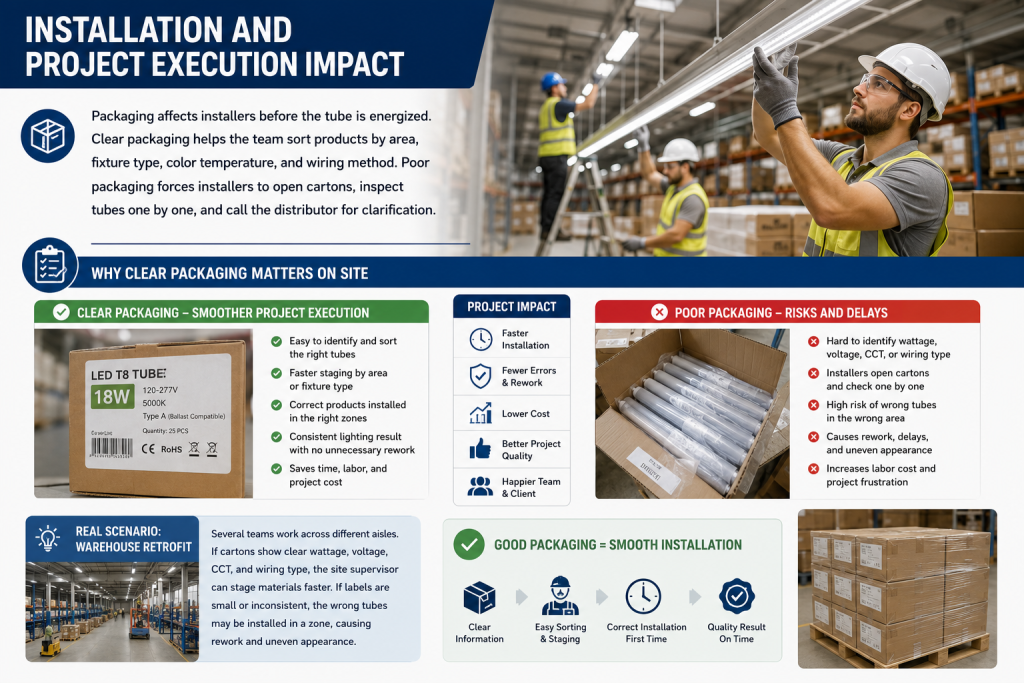
In a warehouse retrofit, for example, several teams may work across different aisles. If the cartons show clear wattage, voltage, CCT, and wiring type, the site supervisor can stage materials faster. In contrast, if the labels are small or inconsistent, the wrong tubes may be installed in a zone, causing rework and uneven appearance.
Packaging also supports maintenance. Facility teams may store spare tubes for years. If the carton has a readable model number, batch code, and specification label, future replacement is easier. If the spare stock is unmarked or the label fades, maintenance teams may install mismatched CCT or incompatible wiring type.
Common Misunderstandings
Myth: Stronger packaging always means better packaging. Reality: Strong packaging must still be efficient, readable, recyclable where required, and suitable for the shipment route. Over-packing can increase freight cost and waste without solving the main damage risk.
Myth: The tube label is enough, so carton labels are not important. Reality: Warehouse teams often manage products at carton or pallet level. If the master carton label is unclear, receiving errors and mixed-SKU shipments become more likely.
Myth: Packaging can be finalized after production. Reality: Packaging materials, artwork, carton size, and pallet method affect lead time. Late changes can delay shipment, require reprinting, or create inconsistent carton batches.
Myth: Certification logos are only a graphic design issue. Reality: Certification marks must match valid product approvals and regional requirements. Incorrect use can create compliance risk and customer rejection.
What This Means in Practice
In practice, distributors should treat packaging as part of the purchase specification. Do not limit the purchase order to lamp wattage and CCT. Include packaging structure, label data, carton quantity, barcode format, pallet method, artwork approval, and test requirements.
This approach improves project control in four ways. First, it reduces physical damage during transport. Second, it lowers the chance of mixed specifications. Third, it improves warehouse and installation efficiency. Fourth, it makes landed cost more predictable because carton volume and pallet loading are known before shipment.
For repeat orders, keep an approved packaging standard for each SKU or product family. If the product changes, review the packaging again. A change from 18 W to 15 W, from 4000K to 5000K, or from Type A to Type B may seem small, but it can require different label content and installation warning language.
Pro Tip / Field Experience
Before approving mass packaging, ask for one packed master carton with real tubes inside and handle it the way your warehouse handles incoming stock. Lift it from the ends, scan the labels, stack it, open it, and check whether installers can identify wattage, CCT, voltage, and wiring type within a few seconds. This simple review often finds issues that artwork approval alone misses.
Practical Packaging Confirmation Checklist
A good checklist should be short enough for purchasing teams to use, but technical enough to prevent errors. The following checklist can be used during supplier confirmation, pre-production approval, or incoming inspection planning.
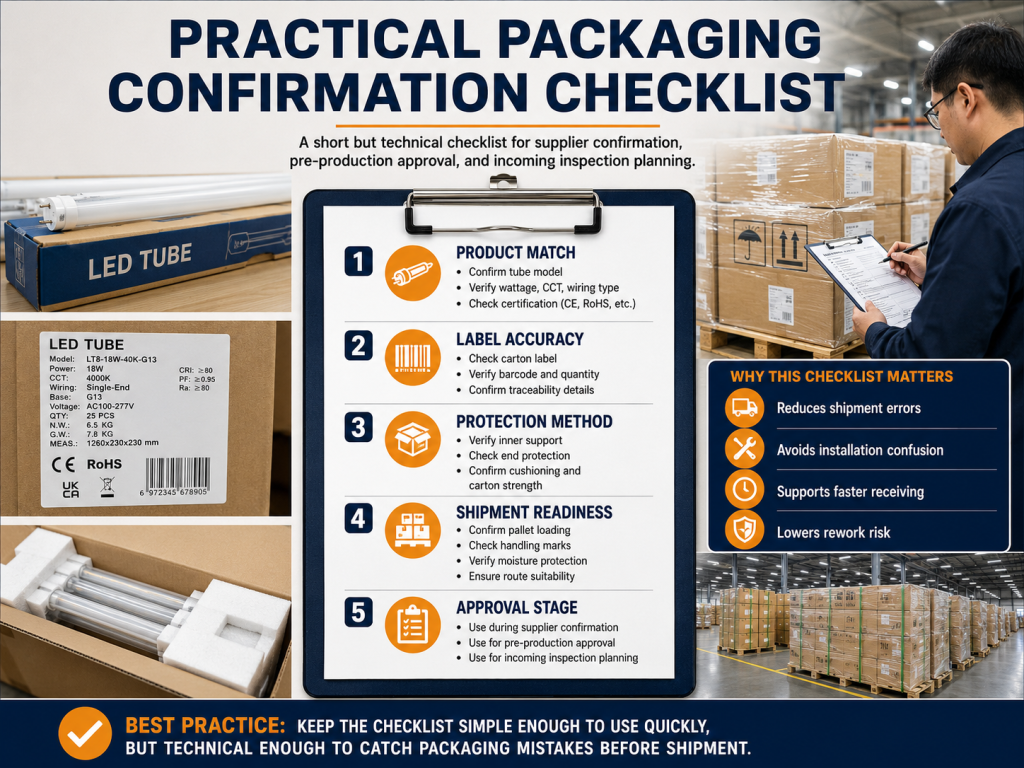
| Confirmation Point | Required Detail | Inspection Method |
|---|---|---|
| Product identification | Model, wattage, voltage, CCT, CRI, length, base type, and wiring method. | Compare label, carton, purchase order, and product sample. |
| Inner protection | Divider type, end support, tube spacing, and movement control. | Open carton sample and check tube movement manually. |
| Master carton | Carton size, quantity per carton, gross weight, carton grade, and stacking mark. | Measure carton and verify printed shipping mark. |
| Barcode and SKU | Barcode type, SKU number, batch code, and scan readability. | Scan sample labels using warehouse devices when possible. |
| Instruction content | Wiring diagram, voltage warning, ballast note, and safety caution. | Review against product wiring type and local installation practice. |
| Compliance marks | Applicable marks, certificate references, country of origin, and recycling marks. | Check artwork against valid approval documents. |
| Pallet packing | Pallet size, carton layout, stacking height, corner protection, wrap, and straps. | Review pallet drawing or packed pallet photo before shipment. |
| Testing need | Drop check, vibration review, compression review, or shipping simulation where required. | Agree on method, acceptance criteria, and photo or report format. |
You can contact a technical team to confirm project packaging details when carton structure, label requirements, or compliance marks are not yet clear. The best time to resolve these points is before artwork approval and before packaging materials are ordered.