
For outdoor LED projects, the correct IP rating is only one part of the decision. You also need to control how water moves around the luminaire, how cables enter the system, how drivers are protected, and how heat leaves the installation. In practice, many outdoor failures happen because an IP-rated product is installed in a way that creates water pooling, condensation, corrosion, voltage drop, or service access problems.
What Outdoor LED Lighting IP Rating Means
An IP rating is an ingress protection code. It describes how well an enclosure resists dust, solid objects, and water under defined test conditions. The first digit covers protection against solids. The second digit covers protection against water. For outdoor LED lighting, the second digit often receives more attention, but both digits matter in dusty, coastal, industrial, or roadside environments.
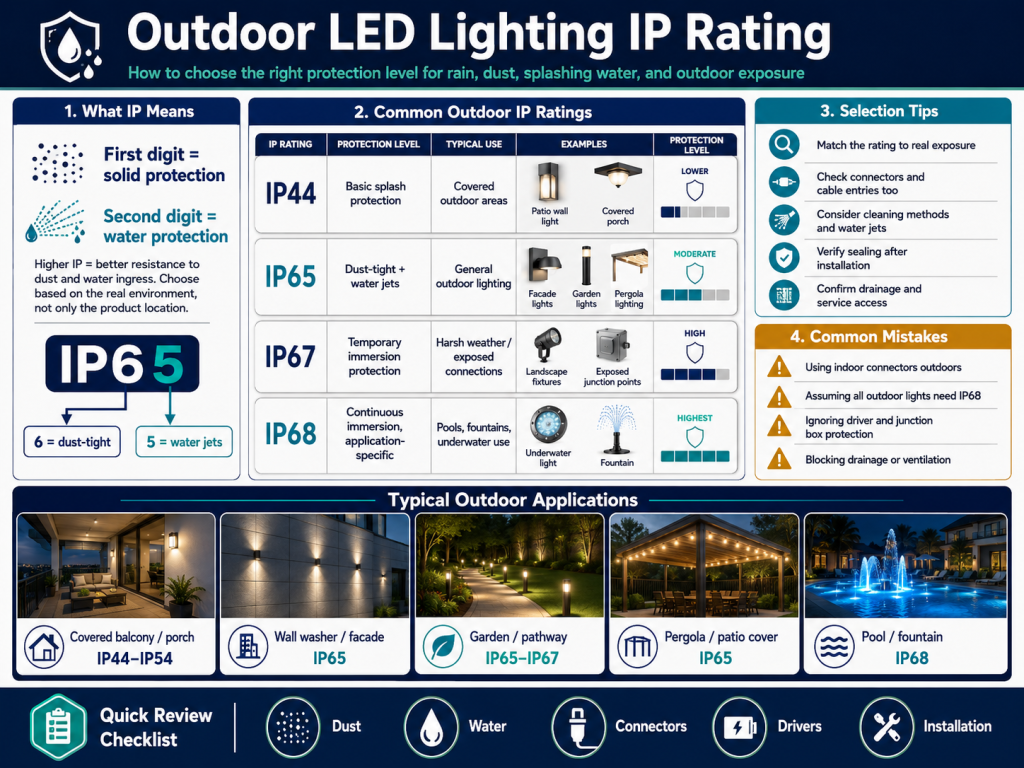
However, an IP rating is not a complete installation guarantee. It does not automatically confirm corrosion resistance, UV stability, impact resistance, chemical resistance, thermal performance, driver compatibility, or cable joint reliability. Specifically, the luminaire body may be IP66, while an exposed connector, field-cut cable, or poorly sealed junction box may not achieve the same level of protection.
That matters because a project is only as reliable as its weakest protection point. If water enters through a cable gland, condensation accumulates inside a housing, or a driver is placed in a wet service cavity, the product rating on the datasheet will not prevent failure.
| Parameter | Meaning | Project Planning Impact |
|---|---|---|
| IP65 | Dust-tight and protected against water jets from common directions. | Often suitable for covered exterior areas, facade lighting, wall washing, and general outdoor use with drainage. |
| IP66 | Dust-tight and protected against powerful water jets. | Useful where heavy rain, washdown, wind-driven water, or exposed mounting is expected. |
| IP67 | Dust-tight and protected against temporary immersion under defined test conditions. | Useful for low-level exterior lighting, landscape zones, and locations where temporary water accumulation may occur. |
| IP68 | Dust-tight and protected against continuous immersion under manufacturer-defined conditions. | Required only when immersion depth, duration, and product limits are clearly confirmed. |
| IK rating | Mechanical impact protection rating for the enclosure. | Important for public areas, pedestrian zones, parking areas, transport facilities, and vandal-risk locations. |
| Operating temperature | Allowed ambient temperature range for safe product operation. | Critical for sealed luminaires, roof areas, metal structures, cold climates, and high-solar-load installations. |
When This Guide Applies
This guide applies when LED lighting is used in exterior or semi-exterior environments where moisture, dust, UV exposure, vibration, temperature swing, and installation access can affect performance. Typical examples include facade lighting, pathway lighting, canopy lighting, bridge lighting, signage lighting, exterior linear lighting, landscape lighting, outdoor step lighting, and building perimeter lighting.
It also applies to sheltered locations that are not fully dry. For example, a luminaire under an awning may still face wind-driven rain, condensation, hose cleaning, insects, dust, and temperature cycling. In contrast, a fully sealed indoor ceiling space has different risks even if the luminaire looks similar.
Typical outdoor risk conditions
- Direct rain exposure on the lens, housing, end cap, or cable entry.
- Wind-driven water reaching surfaces that appear protected on drawings.
- Standing water near recessed channels, ground fixtures, or landscape housings.
- Condensation caused by daily temperature changes inside sealed enclosures.
- Dust, salt spray, fertilizer, pool chemicals, or industrial airborne contaminants.
- Movement caused by wind, vibration, thermal expansion, or building settlement.
- Difficult maintenance access after the facade, ceiling, deck, or landscape is completed.
Consequently, the lighting specification should not stop at “outdoor rated.” It should define the water exposure type, installation position, mounting material, cable route, driver location, service method, and testing requirement.
Key Terms and Definitions for Outdoor Projects
Outdoor lighting documents often use short technical terms. Before you make a specification or installation decision, confirm what each term means in the project context.
| Term | Definition | Why It Matters |
|---|---|---|
| Ingress protection | Resistance of an enclosure against entry of solids and water. | It helps match the luminaire to rain, dust, washdown, and immersion risk. |
| Cable gland | A fitting used to seal and secure cable entry into an enclosure. | A poor gland installation can allow water to enter even when the housing is rated. |
| Potting | Encapsulation of electronics or connections with resin or compound. | It can improve moisture protection but may reduce serviceability and affect heat transfer. |
| Condensation | Water vapor that forms liquid droplets when temperature drops below dew point. | It can damage electronics even when rainwater does not directly enter the fixture. |
| Voltage drop | Voltage loss along a cable due to resistance and current load. | It affects brightness consistency and driver selection, especially for long outdoor cable runs. |
| Thermal management | Control of heat generated by LEDs, drivers, and enclosed electronics. | Heat affects lumen maintenance, electronic component life, and sealing material durability. |
| Photometric testing | Measurement of luminous flux, beam angle, intensity distribution, and related optical data. | It supports lighting design accuracy and helps avoid over-lighting or under-lighting. |
Core Technical Principles Behind IP Rating and Installation Risk
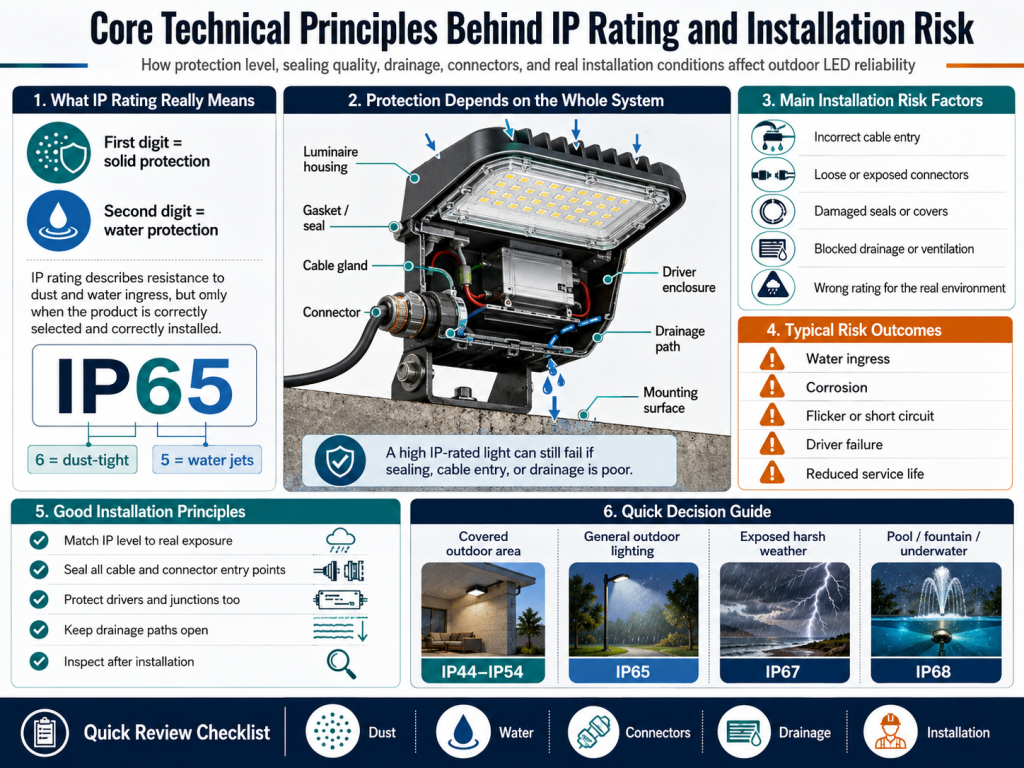
IP rating is tested under defined conditions
IEC 60529 defines the general IP code structure. However, the test condition is not the same as every real installation condition. A product that passes a water jet test may not be designed for long-term immersion. A product that survives temporary immersion may still need correct cable sealing, drainage, and thermal control.
Therefore, read the product documentation carefully. Confirm whether the rating applies to the complete assembled product, the luminaire body only, the driver enclosure, the connector set, or a specific factory-sealed version.
Water moves through pressure, gravity, capillary action, and condensation
Rainwater does not always enter from above. It can be driven sideways by wind, pulled into joints by capillary action, or accumulate behind surfaces because of poor drainage. In addition, temperature change can pull moist air into an enclosure during pressure equalization. When the temperature drops, condensation can form inside the fixture.
That matters because the visible leak path may not be the original failure point. For example, water found inside an LED linear fixture may have entered through the cable joint several meters away and traveled along the cable sheath or mounting channel.
Sealing and heat dissipation must be balanced
Higher sealing levels can reduce ventilation. This can increase internal temperature if the product design, mounting surface, and ambient condition are not suitable. LEDs and drivers generate heat through wattage and current. If heat cannot move away from the LED board, housing, or driver case, lumen output and service life can decline.
Specifically, a sealed luminaire mounted on dark metal under direct sun may operate hotter than the same luminaire installed under a shaded canopy. The IP rating does not replace thermal review.
Step-by-Step Guide to Selecting and Installing Outdoor LED Lighting
A structured process reduces specification gaps and installation rework. Use the following steps before final procurement and again before site installation.
| Step | Action | Decision Output |
|---|---|---|
| 1 | Define the installation environment, including rain exposure, dust, UV, chemicals, salt air, and temperature range. | Required IP rating, material finish, corrosion protection, and operating temperature range. |
| 2 | Confirm mounting position, drainage path, orientation, and whether the product will be recessed or surface-mounted. | Mounting method, housing style, gasket risk, and service access requirement. |
| 3 | Calculate voltage, wattage, current, cable length, and voltage drop for each circuit. | Driver capacity, cable size, run length limit, and power feed location. |
| 4 | Review driver location, driver IP rating, dimming method, and wiring protection. | Compatible power supply, control method, junction box layout, and protection level. |
| 5 | Check photometric needs, including lumen output, beam angle, CCT, CRI, and glare control. | Fixture model, optic, color specification, and lighting layout confidence. |
| 6 | Confirm compliance needs such as local electrical code, CE, RoHS, UL, ETL, EMC, or project-specific documentation. | Required certification documents, test reports, and approval path. |
| 7 | Plan installation testing, including visual inspection, continuity check, insulation test where applicable, and functional burn-in. | Commissioning checklist and responsibility for acceptance testing. |
| 8 | Document maintenance access, spare parts, replacement drivers, connector type, and seal inspection intervals. | Lower service risk and clearer long-term maintenance planning. |
Step 1: Assess exposure before choosing the rating
Start with the site, not the product catalog. Is the fixture under a canopy, on an open facade, inside a landscape bed, near a pool, or mounted on a bridge? Is water expected as rain, spray, hose wash, pressure wash, temporary flooding, or continuous immersion? These conditions are different.
For many outdoor luminaires, IP65 or IP66 may be adequate when the product is mounted correctly and water can drain. However, ground-level products or landscape fixtures may require IP67 if temporary water accumulation is realistic. Continuous underwater use requires a confirmed IP68 product with specific depth and duration limits.
Step 2: Treat drivers and accessories as part of the system
The LED module, power supply, connector, dimmer, control interface, junction box, and cable all form one electrical system. If the driver is installed in a damp cavity with low protection, the system risk remains high even when the luminaire is IP67.
Check whether the driver is constant voltage or constant current. Confirm output voltage, current, wattage reserve, dimming method, and control protocol if used. Outdoor projects often require a margin for temperature, cable length, and future maintenance. Do not load a driver at its absolute maximum rating unless the manufacturer documentation allows that operating condition.
Step 3: Control cable entry and field connections
Many water failures begin at field-made connections. Use rated connectors, glands, junction boxes, and strain relief. Avoid leaving cable joints where they sit in water or receive direct spray. If splicing is required, use a sealing method suitable for the voltage, current, cable type, and environment.
Also consider serviceability. Fully potted joints may resist water well, but they can be difficult to repair. In contrast, accessible rated connectors may support faster maintenance if installed in a protected and drainable position.
Step 4: Verify mounting and drainage
Mounting details can either support or defeat the IP design. Avoid upside-down installation unless the product documentation allows it.Extra holes should not be drilled into the housing unless the manufacturer provides an approved method. Gaskets must be compressed evenly, while cable exits should not be buried in wet soil unless they are specifically designed for that environment.
Drainage is especially important in recessed channels, facade pockets, stair nosings, landscape housings, and exterior coves. If water cannot escape, the installation may convert a rain-exposed fixture into an immersion-risk fixture.
Technical Factors to Check Before Final Specification
Outdoor LED lighting should be specified as a complete application package. The following factors directly affect reliability, cost, installation time, and maintenance risk.
| Factor | What to Check | Risk if Missed |
|---|---|---|
| IP rating | Rating of luminaire, driver, connector, junction box, and assembled cable path. | Water entry through the lowest-rated component. |
| IK rating | Impact resistance for public, roadside, and low-level installations. | Lens breakage, exposed wiring, and safety issues. |
| Material and finish | Aluminum grade, stainless hardware, powder coating, anodizing, UV resistance, and corrosion exposure. | Corrosion, discoloration, fastener failure, or housing damage. |
| Electrical load | Voltage, wattage, current, driver margin, inrush current, and circuit grouping. | Overloaded drivers, nuisance tripping, dimming instability, or uneven brightness. |
| Cable length | Run distance, conductor size, connection count, and voltage drop. | Reduced output, color inconsistency, or unstable operation at the far end. |
| Thermal path | Mounting surface, ventilation, ambient temperature, solar exposure, and driver heat. | Reduced lumen maintenance, shorter electronic life, and seal aging. |
| Optical performance | Lumen output, luminous efficacy, beam angle, glare control, CCT, CRI, and SDCM. | Poor lighting effect, inconsistent color, or redesign after installation. |
| Compliance documents | Required standards, certification marks, EMC data, RoHS status, and test reports when specified. | Approval delays, failed inspections, or documentation gaps. |
How IP Rating Affects Product Selection and Project Cost
Higher IP ratings can improve protection in the right environment, but they can also affect cost, lead time, thermal design, service method, and accessory selection. Therefore, the goal is not always to choose the highest number. The goal is to choose the correct protection level for the actual exposure.
For example, IP68 may be necessary for a fountain light. However, using an IP68-style sealed product in a high-temperature facade cavity may create heat and maintenance issues if the design was not intended for that use. In contrast, an IP66 luminaire with better thermal performance, correct cable glands, and proper drainage may be the better choice for an exposed wall-washing application.
Quoting accuracy also depends on installation details. A fixture price alone does not show the full project cost. Rated connectors, custom cable lengths, waterproof junction boxes, mounting clips, surge protection, driver enclosures, control gear, testing documentation, and spare parts can affect the final budget.
How Installation Risk Affects Reliability, Safety, and Maintenance
Installation quality has a direct effect on electrical safety and service life. Moisture can cause corrosion, leakage current, short circuits, dimming faults, insulation breakdown, and driver failure. In public outdoor areas, a damaged fixture can also create touch safety and trip hazards.
Specifically, low-voltage systems are not risk-free. A 24 V LED strip or linear module may reduce shock risk compared with mains voltage, but moisture can still damage copper traces, connectors, solder joints, and control circuits. It can also cause voltage drop and uneven output if corrosion increases circuit resistance.
Maintenance access should be planned before construction. If a driver is sealed behind stone, glass, soil, or a completed facade without access, even a small failure can become expensive. Consequently, service points should be accessible, labeled, and protected from direct water exposure.
Practical Scenarios and Decision Examples
Facade wall washer on an exposed building elevation
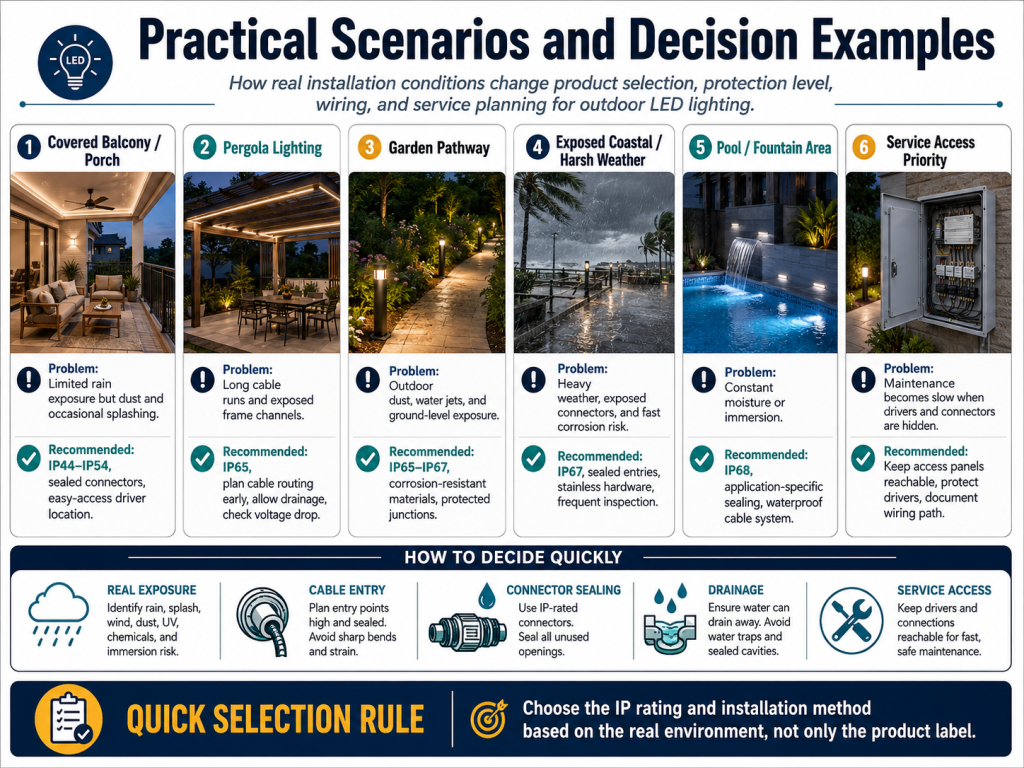
A facade wall washer may face wind-driven rain, UV exposure, and thermal cycling. IP66 is often considered for exposed locations, but the mounting bracket, cable exit, and driver enclosure must also match the environment. Beam angle, setback distance, lumen output, and glare control should be confirmed with the lighting design.
Landscape linear light near soil and irrigation
Landscape lighting may face wet soil, fertilizer, insects, and sprinkler spray. If the product sits low or water can collect in the channel, IP67 may be more appropriate than IP65. However, drainage, cable protection, and sealed junction boxes remain critical.
Outdoor canopy or covered walkway
A covered walkway may seem low risk, but wind-driven rain and cleaning water can still reach the fixture. IP65 may be suitable in many cases if the product is not exposed to pressure washing or pooling water. The driver should be installed in a dry or properly rated enclosure with service access.
Bridge, tunnel entrance, or transport infrastructure
Infrastructure lighting may require higher mechanical protection, vibration review, corrosion resistance, EMC consideration, and stricter documentation. IP rating should be reviewed together with IK rating, mounting hardware, surge protection, local code, and maintenance access.
Common Myth vs Reality
| Myth | Reality | Practical Response |
|---|---|---|
| IP67 is always better than IP65. | IP67 is better for temporary immersion, but it is not automatically better for every outdoor mounting condition. | Match the rating to exposure, drainage, heat, and service needs. |
| If the fixture is IP-rated, the full installation is waterproof. | The driver, connector, cable gland, junction box, and field splice may have different protection levels. | Specify the complete system protection level, not only the luminaire body. |
| Covered outdoor areas are dry areas. | Wind-driven rain, condensation, insects, dust, and cleaning water can still enter protected-looking spaces. | Assess real exposure instead of relying only on architectural cover. |
| More sealant always improves reliability. | Incorrect sealant can trap water, block drainage, attack materials, or prevent service. | Use manufacturer-approved sealing methods and maintain drainage paths. |
| Low-voltage outdoor lighting does not need serious protection. | Moisture can still cause corrosion, voltage drop, flicker, control faults, and early failure. | Protect low-voltage circuits with the same discipline used for system reliability. |
Pro Tip / Field Experience
Before approving an outdoor lighting mock-up, inspect the cable exit after water exposure, not only the front lens. In many real projects, the visible fixture looks sealed, but the cable path runs through a wet channel or unprotected joint. A five-minute review of cable direction, drip loop, gland compression, and junction box position can prevent repeated site failures later.
Testing, Commissioning, and Risk Control
Testing should confirm that the installed system performs safely and consistently. It should not damage the product or create unrealistic exposure unless a defined project test procedure has been approved. For example, aggressive pressure washing at close distance may exceed the product’s intended rating even if it is suitable for heavy rain.
| Check | Method | Acceptance Focus |
|---|---|---|
| Visual inspection | Check gaskets, screws, end caps, cable glands, connectors, mounting brackets, and housing damage. | No missing seals, loose parts, cracked lenses, or exposed conductors. |
| Polarity and wiring check | Verify positive and negative connections, circuit grouping, grounding where required, and driver output. | Correct wiring before energizing the system. |
| Insulation or electrical safety test | Apply project-approved test method according to voltage class and local electrical practice. | No unsafe leakage or insulation fault. |
| Functional test | Operate luminaires under load and verify output, dimming, controls, and circuit stability. | No flicker, dropout, abnormal heating, or inconsistent brightness. |
| Water exposure review | Use controlled inspection appropriate to the specified rating and site condition. | No water accumulation at unprotected joints or vulnerable cable entries. |
| Thermal check | Review surface temperature after operation in representative ambient conditions where practical. | No unexpected overheating at fixture body, driver, or enclosed space. |
| Documentation check | Confirm datasheets, wiring diagrams, certification documents, test reports, and maintenance notes. | Clear records for inspection, handover, and future service. |
What This Means in Practice
In practice, outdoor LED lighting should be specified as an environmental system rather than a single product. The luminaire, driver, cables, connectors, mounting hardware, drainage path, and service access must work together. If one part is under-rated or poorly installed, the project risk increases.
For planning, define the exposure first. Then select the IP rating and supporting accessories. After that, confirm electrical loading, driver compatibility, dimming method, thermal conditions, and compliance documentation. Finally, inspect the actual installed condition because drawings do not always show water paths, cable stress, or access limitations.
This approach improves cost control because the quote can include the correct cable lengths, waterproof accessories, driver enclosures, mounting hardware, and testing requirements from the beginning. It also improves installation efficiency because the contractor receives clearer instructions and fewer assumptions are left to field improvisation.
If project conditions are complex, you can contact a technical team to confirm the required IP rating, driver arrangement, cable length, and installation details before final quotation or site work.