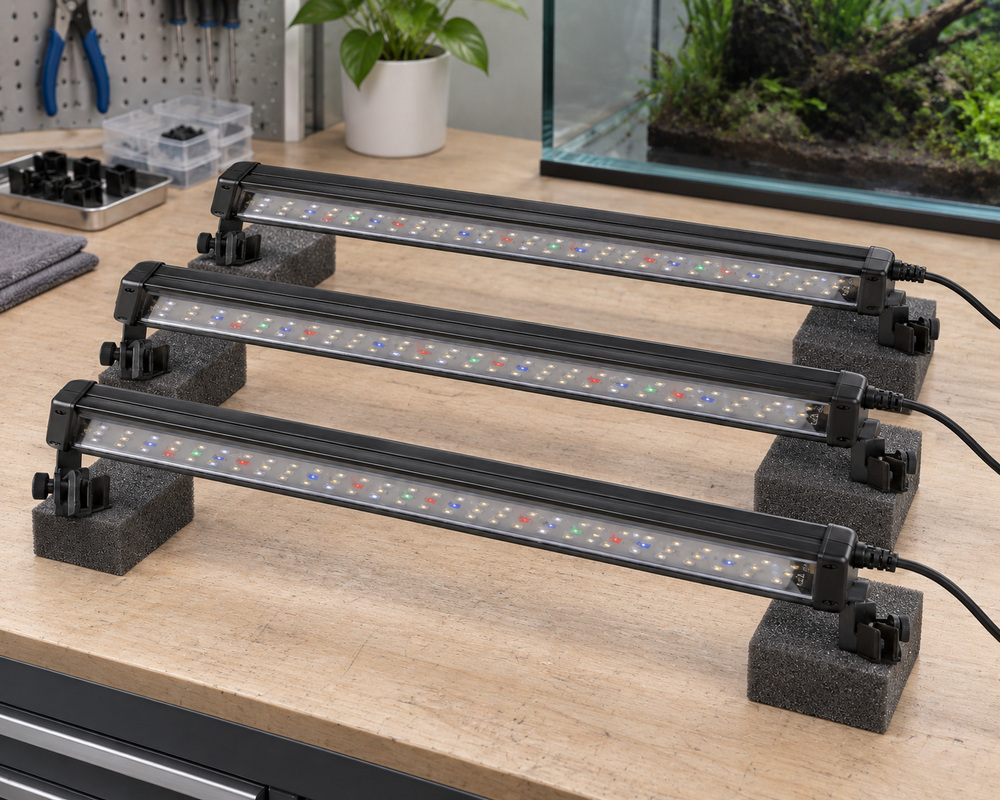
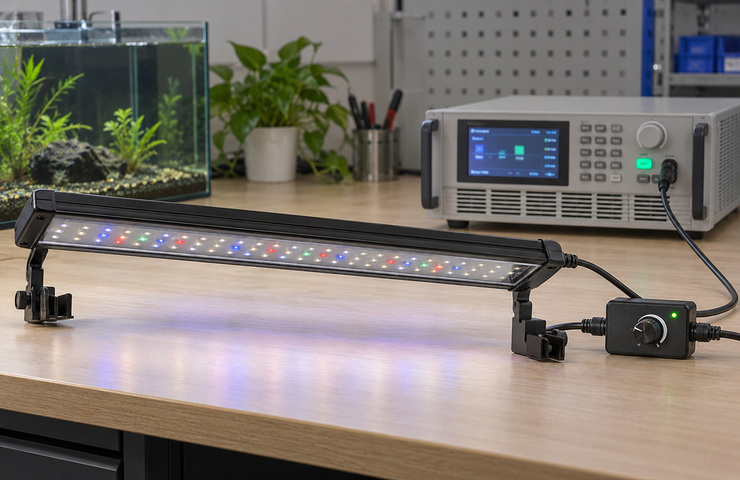
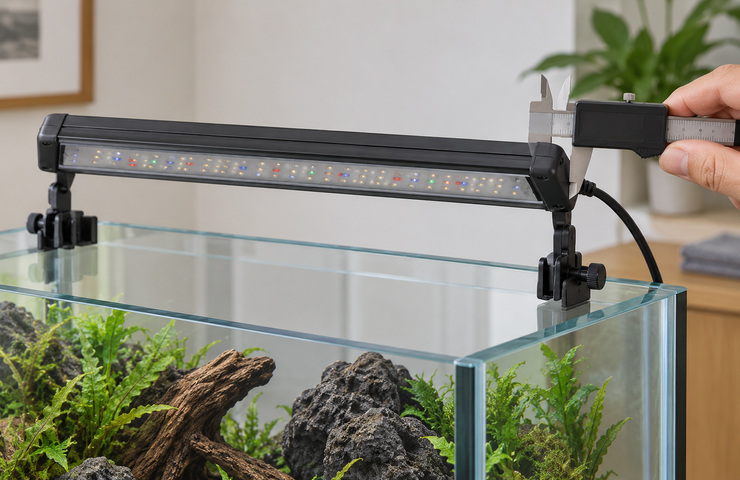
Custom LED aquarium lights that fit your tank setup
VST can assess a tank-specific LED assembly around the mounting, lighting task and moisture exposure. Define display requirements, biological targets and environmental evaluations separately before sample development.
Coordinate rim engagement with access for feeding and tank maintenance.
Distinguish visual display needs from species-specific biological lighting targets.
Specify the wet-area boundary and protected electrical connections before sample development.
Begin with your tank layout and lighting goal; a photo can help when the mounting details are undecided.
Fit custom LED aquarium lights to tank use
Aquarium lighting can serve display or biological tasks. Define the intended task and measurement conditions before selecting the source arrangement. The concepts shown do not establish biological performance.
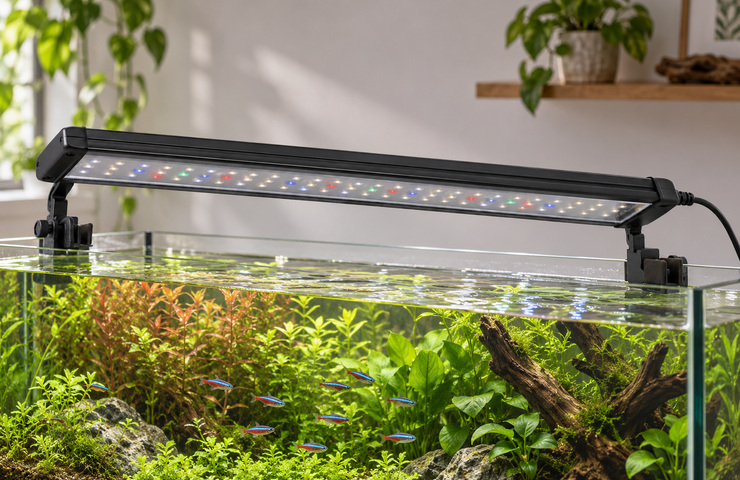
Freshwater planted aquariums
Operating environment
Above-water installation over a planted freshwater tank.
Buyer requirement
Align the light placement with the usable planted area.
Design constraint
Tank depth and hardscape can change light at plant level.
Design direction
Plan coverage assessment at the actual aquatic measurement positions.
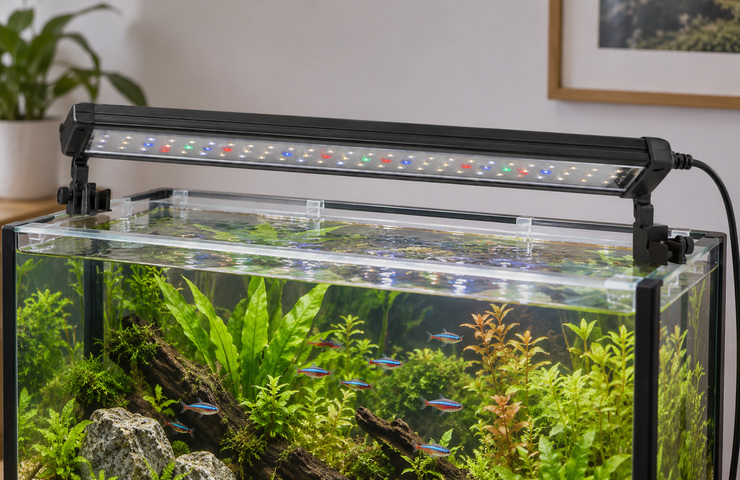
Aquarium display lighting
Operating environment
Indoor fish display with routine feeding and maintenance.
Buyer requirement
Make the tank contents visible without obstructing access.
Design constraint
Rim hardware and lid movement compete for space.
Design direction
Consider a rim-supported bar with a clear removal path.
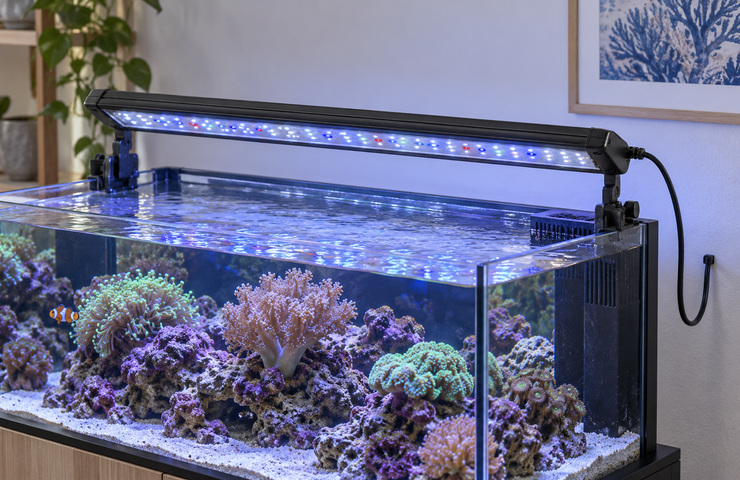
Marine display tank development
Operating environment
Above-water installation exposed to salt-laden moisture.
Buyer requirement
Define the environmental and species-specific lighting requirements separately.
Design constraint
Salt exposure changes the housing and connection assessment.
Design direction
Discuss materials and spectral goals without assuming reef suitability.
Remove tank installation risks
Mounting feet fit the tank but block the lid
Purchasing risk: Daily operation becomes awkward even when the light is secure.
Confirm: Lid opening path and rim obstruction details.
VST solution direction: Check the supports against lid movement and daily tank access as well as rim width.
Customize aquarium fixtures around mounting and exposure
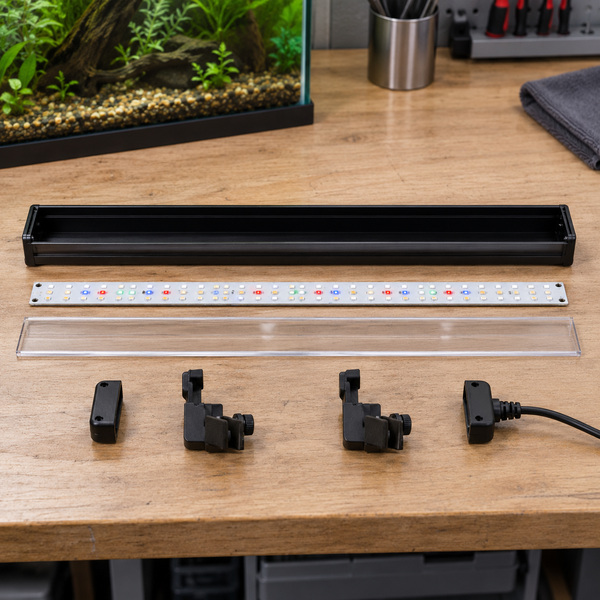
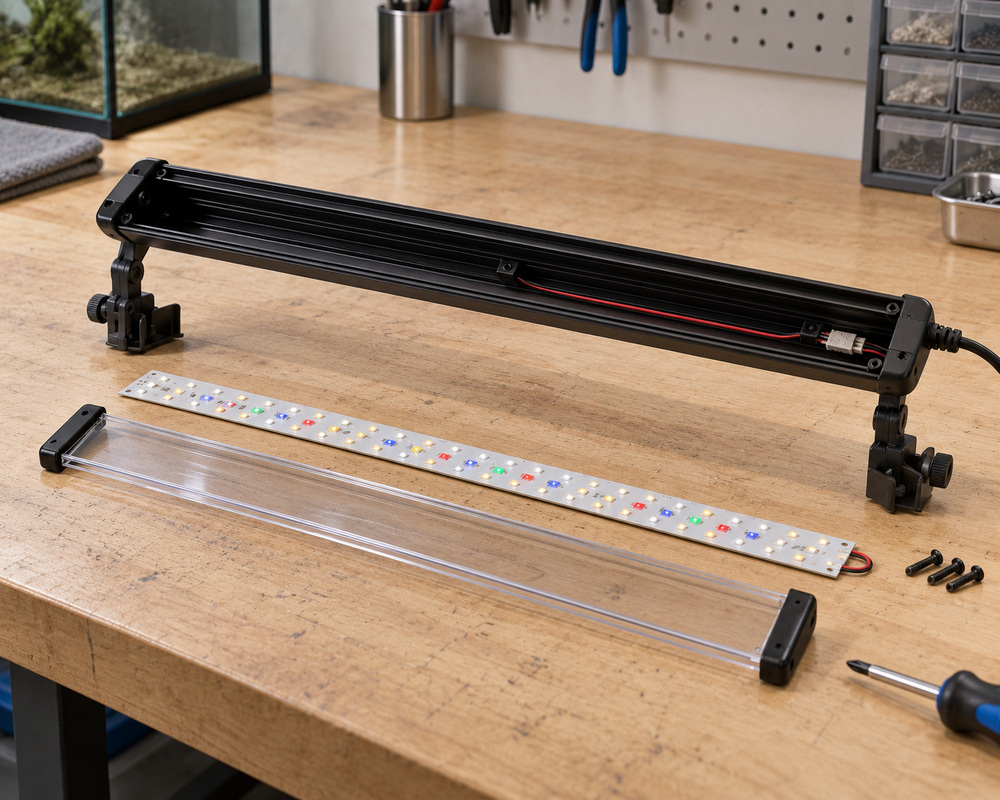
Custom LED aquarium lights may need a different housing, optical window, source layout or electrical interface. Assess these options for the tank environment. A photograph of an enclosure cannot establish its protection rating or the final development scope.
Tank interface and mounting
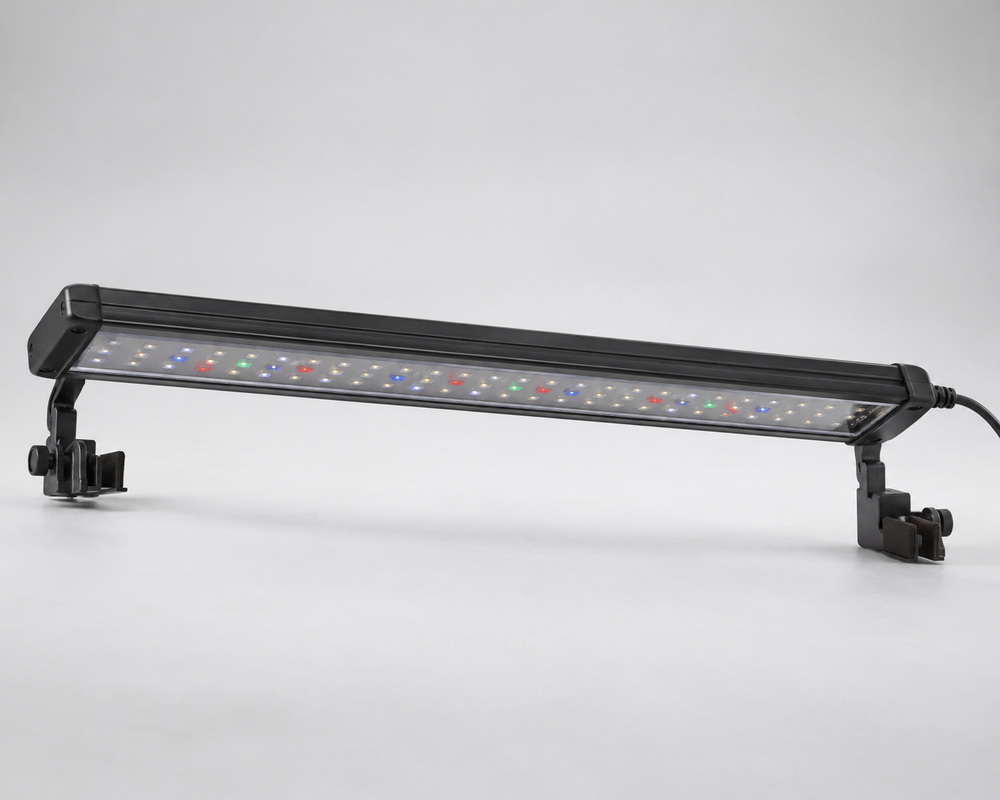
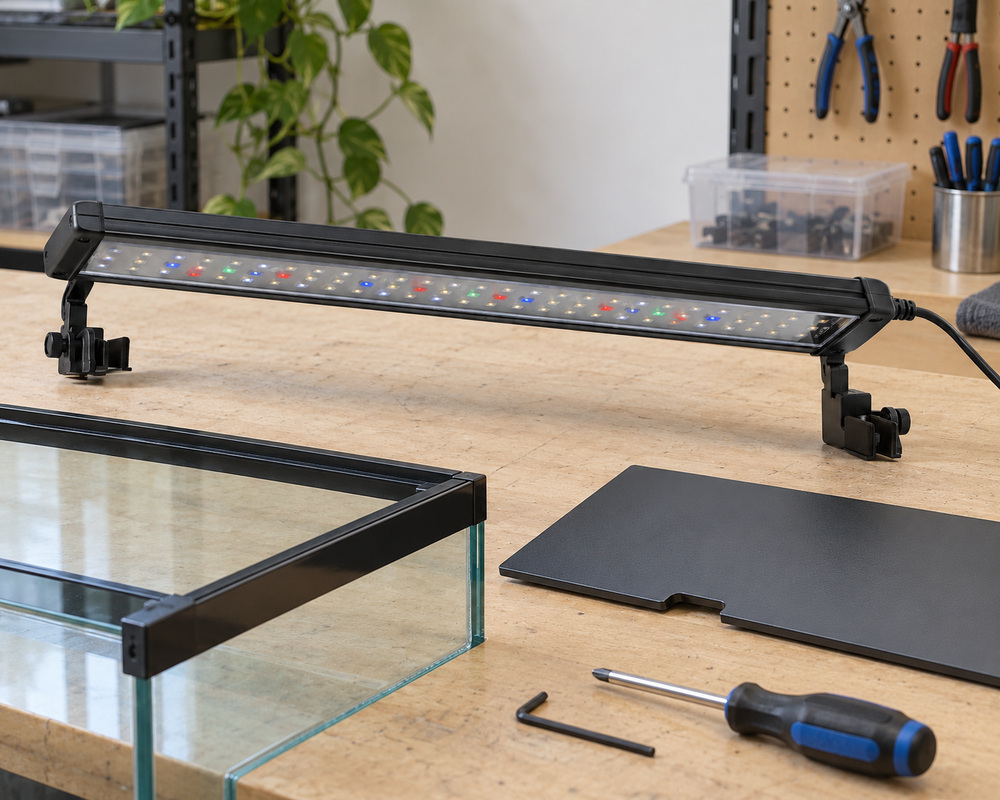
Discuss rim feet, brackets or suspension against the actual tank geometry. Changing the support affects stability and access. Check rim engagement and the required lid movement; an adjustable bracket alone does not establish compatibility with every tank.
Buyer input: Rim profile and the lid movement that must remain clear.
Source mix and lighting task
Custom aquarium lights can have different spectral objectives for display, plants or specialist marine use. A changed channel layout may need board and driver development. The visible color mix cannot establish useful photon delivery or a biological result.
Buyer input: Species context and whether independent channels are necessary.
Housing and optical window
Specify freshwater or marine exposure and the cleaning method before choosing the housing, end caps and optical cover. Sealing affects heat loss. Evaluate the complete fixture with its cable entry and mated connector; marine proposals need distinct water-ingress and salt/corrosion assessments, not an assembly inspection alone.
Buyer input: Expected splash, salt and cleaning conditions.
Power and operating controls
Define the cable exit, power supply and controller interface together. An aquarium LED lighting system may include equipment beyond the fixture. Specify the operating states and parts supplied; an app, timer or controller is included only when listed.
Buyer input: Required timer or dimming interface and supply boundary.
Compare rim mounted bars with suspended assemblies
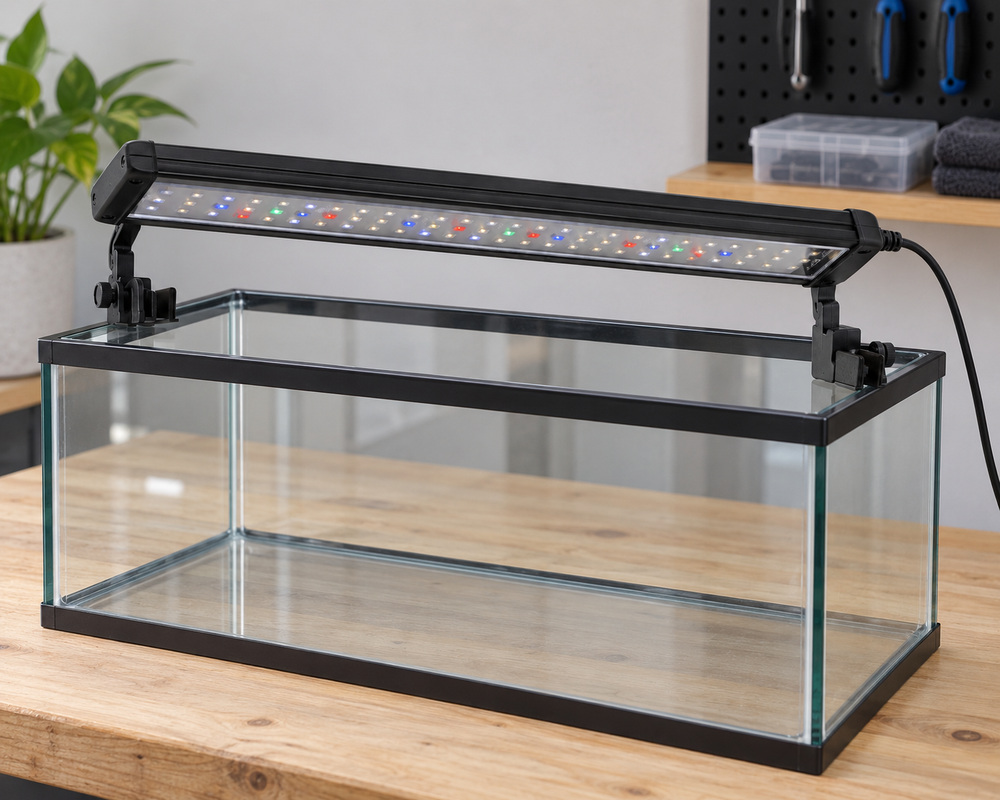
Rim-mounted fixtures rely on the tank edge for support. Suspended fixtures use a separate structure. Choose for tank access, lid movement and service reach before judging the appearance of light in the water.
Decision factor
Rim mounted light bar
Suspended light assembly
Buyer guidance
Mechanical support
Fixture feet engage the selected tank rim
Support attaches to a separate suspension structure
Choose the support the installation can safely provide.
Tank opening access
Fixture occupies part of the tank opening
Height and suspension position affect access
Preserve the lid and routine maintenance movement you need.
Coverage evaluation
Assessment follows the chosen rim mounting height
Assessment follows the selected suspension height
Compare underwater coverage using the actual installation position.
Trade-off
Compact tank integration with rim compatibility limits
More mounting freedom with separate support responsibility
Distinguish tank hardware from suspension parts in the supply scope.
Develop a tank interface into a defined light assembly
The feasibility review defines the LED, structural and electrical work, the tank interface and the supplied components. Aquatic performance and complete-system requirements need separate evaluation.
01
Establish the tank and light-use boundary
VST work: Identify above-water installation, support interfaces and the intended display or biological task.
Stage output: An installation scope separating fixture development from claims about aquatic performance.
02
Prepare the candidate enclosed bar
VST work: Develop the proposed housing, optical window and protected connection arrangement as a sample.
Stage output: A fixture sample for assessing the proposed enclosure and electrical connections.
03
Inspect a representative tank installation
Customer input: Customer provides rim-fit and service-access observations from the intended tank.
VST work: VST assesses the reported product-interface issues. The customer or appointed integrator arranges actual tank-fit checks. Any VST bench mockup, optical measurement or environmental evaluation must identify its responsible party, supported method and deliverable in the agreed scope.
Stage output: A mounting record showing interference and service access at the selected tank interface.
04
Define the selected supply version
VST work: Record the selected fixture version and included interfaces for production planning.
Stage output: The selected version identifies the light assembly and interfaces for subsequent production planning.
Evaluate above-water aquarium fixtures and underwater light delivery
Assess spectrum, underwater photon distribution, temperature, controls and mounting separately. VST has relevant lighting and thermal capabilities. Underwater quantum measurements require suitable project resources. These method illustrations are separate from actual fixture records and evidence of environmental suitability.
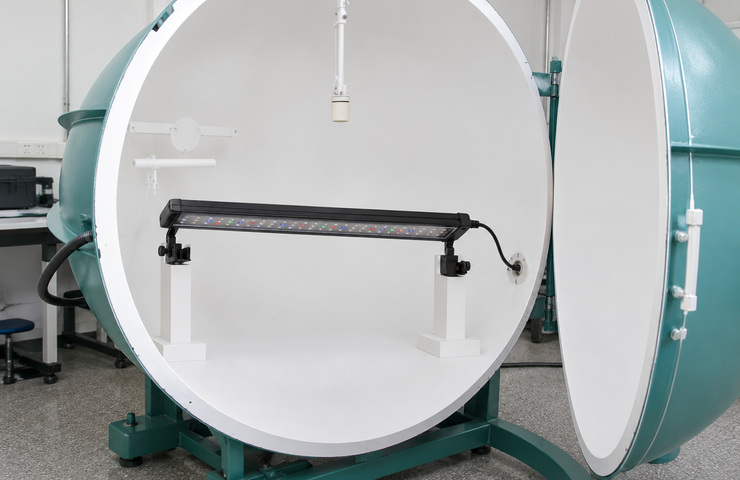
Source spectral assessment
Purpose: Identify the light produced by the selected LED source arrangement.
Method: Use applicable spectral instrumentation and a suitable integrating-sphere setup for the representative assembly.
Acceptance criteria: Evaluate the measured spectral characteristics against the project target.
Evidence: No aquarium-source spectral report is attached. Records depend on the sample evaluation performed.
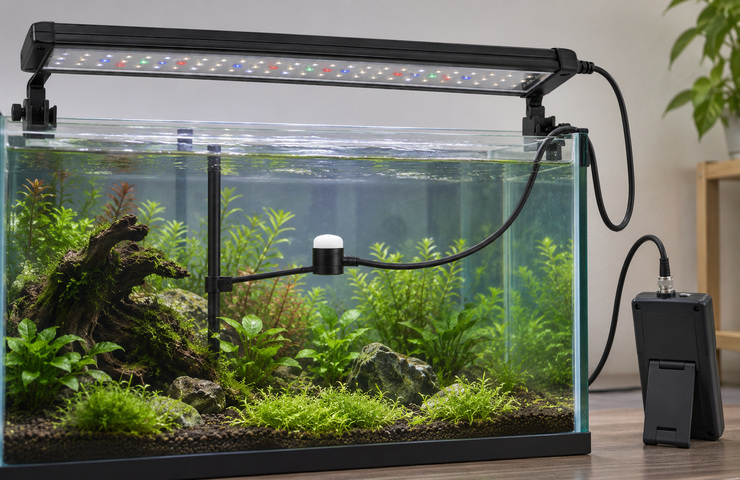
Underwater PPFD coverage evaluation
Purpose: Examine photon distribution at the defined aquatic positions.
Method: Use a quantum sensor suited to the source spectrum and underwater measurement, following its model-specific immersion instructions. Record water depth, fixture position and operating settings.
Acceptance criteria: Compare the underwater grid with the specified lighting task.
Evidence: Record sensor model, calibration status and any built-in immersion correction. Follow that model’s instructions without applying correction twice. Results cover the tested geometry and source settings, not biological suitability.
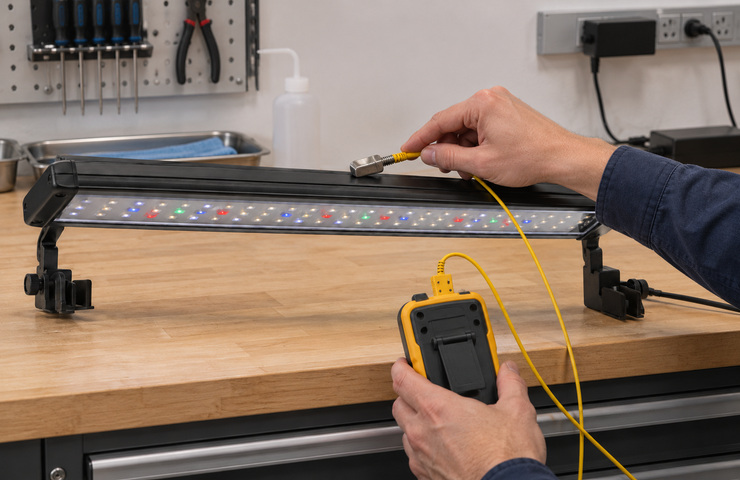
Housing thermal behavior
Purpose: Check heat rejection in the proposed above-water mounting position.
Method: Operate the enclosed assembly and measure selected housing locations with contact temperature probes.
Acceptance criteria: Evaluate component margins under the agreed ambient and operating conditions.
Evidence: Thermal records apply to the tested housing, mounting and electrical state.
Control and restart functions
Purpose: Reduce uncertainty about timing, adjustment and power restoration.
Method: Exercise the selected power supply and controller through the required operating states.
Acceptance criteria: The actual fixture follows the defined switching and adjustment behavior.
Evidence: Function evidence covers the evaluated interface, not every external aquarium controller.
Support and enclosure assembly inspection
Purpose: Check secure mounting and the intended protected connection construction.
Method: Inspect the unpowered sample on the selected rim fixture and examine cover seating and cable entry.
Acceptance criteria: Mounts engage properly and the defined enclosure parts remain correctly assembled.
Evidence: Visual inspection does not establish an ingress or corrosion certification.
Documents for tank integration
Tank interface and fixture specification
Project Specific
Specify the mounting, source and power or control components included in the light proposal.
Environmental and optical evaluation records
To Confirm
Set independent water-ingress and salt/corrosion procedures for the complete luminaire, including its mated connector and cable entry. Define exposure and cleaning conditions, leakage, corrosion, electrical safety and operating criteria. Name a qualified laboratory, or VST only where capability is established. Record construction, conditions, observations, post-exposure checks and result scope separately for each method.
Underwater optical evaluation assignment
To Confirm
For custom LED aquarium lights, appoint the capable measurement party before sampling. Specify sensor spectral suitability and calibration, model-specific immersion instructions, depth, grid, fixture height and operating settings. State the agreed criteria and report coverage. Ingress, corrosion and biological evaluations remain separately assigned; underwater sensor use does not classify the above-water fixture for submerged operation.
The mounting discussion included the lid movement, which was easy to miss when we first looked at the tank rim. That made the fixture proposal more useful for our equipment layout.
We wanted display appearance and planted-tank requirements kept separate. The questions about the intended light task helped us explain what we needed without choosing a source mix too early.
Aquatic Systems CompanyR&D Engineer · Canada
Source-task definition
Knowing which power and control parts belonged in the proposed supply helped our team organize the project. It avoided treating the light bar photograph as a description of an entire aquarium system.
Arrange aquarium light development and repeat supply
MOQ approach
For custom LED aquarium lights, the 500-unit light-customization and 1,000-unit high-customization figures are general development references pending a quoted scope. Define the model by source, enclosure, mounting, driver and environmental version. Specify whether one unit is the light assembly alone or a kit including its power, control or mounting parts. The quotation must state whether freshwater, marine or other variants meet quantity thresholds separately or jointly. Model availability and final minimums remain project-specific.
Sampling support
VST supports samples of the candidate aquarium LED assembly with processing charges. New enclosure parts or dedicated resources may also need tooling or mold charges. Eligible sample expenditure can be returned or credited against a later production order. Set the amount and method in the quotation or order terms, with specialist aquatic evaluations specified separately.
Lead-time factors
Light customization normally needs 15 to 25 working days for samples and 20 to 30 for bulk production. High customization generally needs 30 to 50 working days for samples and 25 to 35 for bulk production. Timing begins after necessary technical information and applicable sample fees, tooling fees, deposit or other order conditions are complete. Reserving key materials can shorten later scheduling where demand is stable. Plan environmental evaluations separately when needed.
Tooling / NRE
A new end-cap mold, optical window, mounting part or dedicated source PCB may incur tooling or NRE charges. Eligible tooling or mold charges can be credited against payment for a later production order. Specify the method, amount and qualifying order in the commercial terms. Later enclosure changes are not automatically covered by the original charge.
Supply stability
VST coordinates suppliers and repeat-production controls for the specified assembly. Stable-demand orders can prepare materials against forecasts or reserve agreed key materials. Check enclosure and source specifications when considering substitutes; a similar exterior can conceal construction changes. Material reservation supports continuity without guaranteeing finished fixture stock.
Packaging & logistics
Customize packaging, labels, carton marks, barcodes, brand artwork, instruction sheets and user manuals to identify the fixture and its use limits. Protect the optical cover, mounting feet and cable during handling. Shipment coordination is available. State tank and controller inclusion, carton details, transport terms and transit schedules separately in the supply agreement.
Aquarium assembly specification and acceptance planning
Use these general procurement resources to separate the assembly, accessories and required evaluation records in a proposal for custom LED aquarium lights. Optical, environmental and biological evidence still belongs to the appointed project evaluations.
Reducing after-sales risk in bulk LED product procurement starts with clear specifications, verified testing, controlled samples, and documented acceptance criteria before mass production or…
Managing mixed LED product orders means coordinating different LED strips, linear lights, modules, drivers, accessories, and control parts under one clear technical and commercial…
Aquarium lighting questions beyond the visible fixture
Custom LED aquarium lights need decisions about the fixture supplied, the tank environment and the evidence for underwater light delivery. Display appearance alone cannot answer those questions. These answers cover biological suitability, marine and freshwater versions, immersion limits and the system components included. Contact VST about tank conditions or requirements that remain unresolved before choosing a configuration.
Can custom LED aquarium lights be selected by appearance alone?+
Appearance helps assess a display. Aquatic light delivery and biological suitability need their own evidence. When choosing custom LED aquarium lights, use each type of assessment for the question it can answer. A tank photograph alone cannot establish every aspect of performance.
Decision
Relevant evidence
Display appearance
Viewed tank installation
Underwater light delivery
Applicable quantum measurements
Biological suitability
Species and environment evaluation
Is a marine tank version interchangeable with a freshwater version?+
Freshwater and marine versions of custom LED aquarium lights are not automatically interchangeable. Water conditions, spectrum needs and exposure can change the construction or evaluations required. Identify the version and intended use even when the housing looks alike. A freshwater display concept establishes neither corrosion resistance nor reef suitability or a proven marine specification.
Does above-water installation allow accidental immersion?+
Above-water use and an optical cover do not establish immersion capability. Agree water exposure and cleaning conditions, then commission separate ingress and salt/corrosion evaluations for a marine proposal. Results cover only the tested construction and conditions. Assembly inspection cannot establish an ingress rating, corrosion resistance or classification for underwater use.
What does an aquarium LED lighting system quotation include?+
Use the quotation component list to establish what is supplied. The fixture, power supply, controller, suspension and tank are separate items, with included interfaces and responsibilities listed explicitly. Custom LED aquarium lights do not automatically include filtration, livestock or a complete aquatic environment, even when the concept image shows an installed system.