
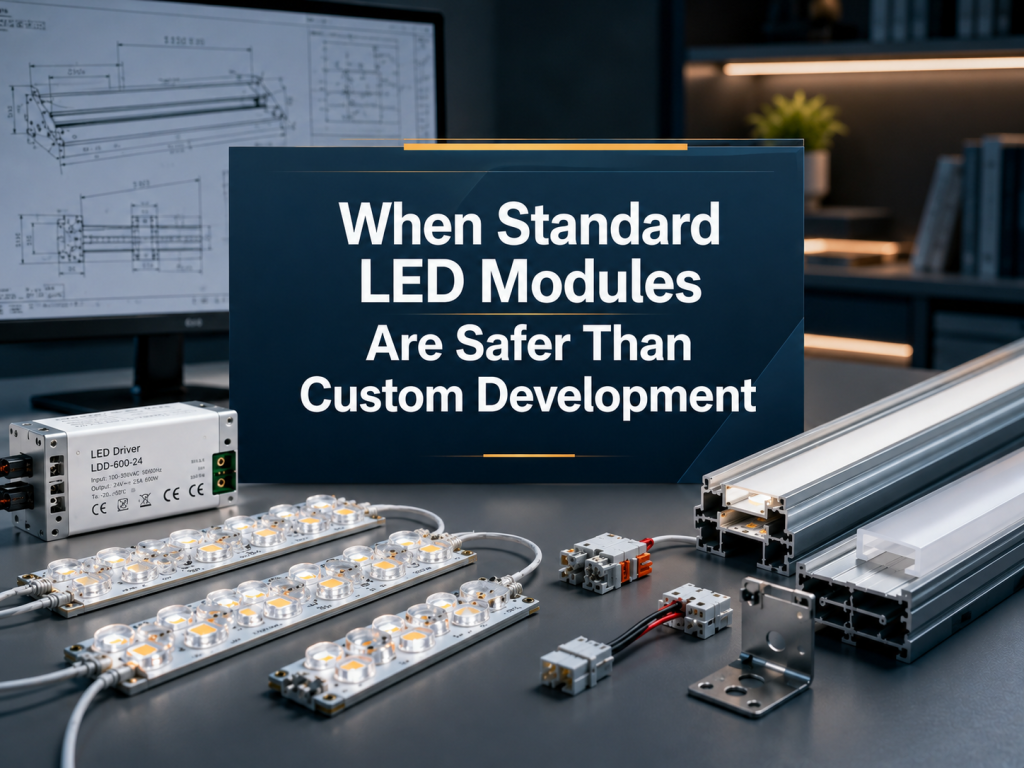
This standard-module comparison guide explains why standard LED modules can feel like a compromise when you are building a new product, especially if your team wants every part to look purpose-built. The problem is that custom development can add delay, testing uncertainty, and rework. The safer path is sometimes to use an existing module that already meets the real requirements.
Standard LED modules are safer than custom development when they already meet the main size, brightness, CCT, power, wiring, and mounting needs without forcing major product compromises. In that case, the decision is not “standard versus custom.” The real question is how much launch risk, rework, testing time, and development cost the project can afford.
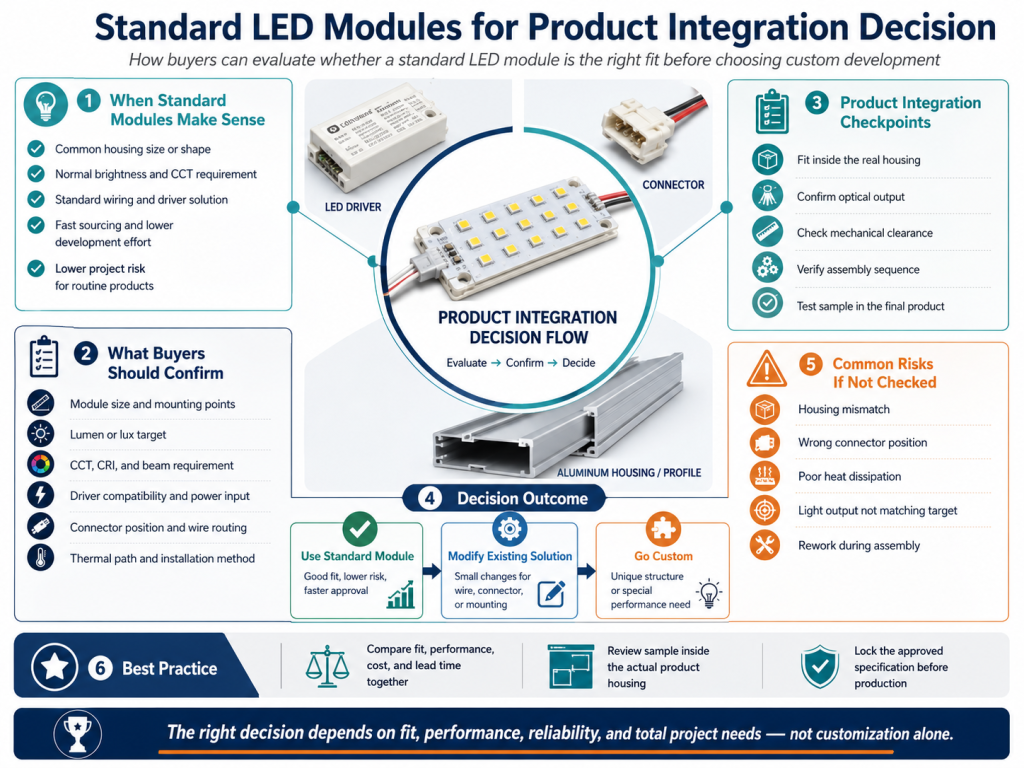
I often see this question during early presales discussions with product managers, founders, and engineers. A custom module may sound more professional. However, a standard module may reduce variables and help the team move faster if the lighting function is important but not the product’s main differentiator.
When Do Standard LED Modules Reduce Project Risk?
Standard LED modules reduce project risk when the available module already fits the product structure, electrical design, light output target, and installation method. The risk appears when a team chooses customization before confirming whether the existing option is good enough for the real use case.
Standard LED modules are often the lower-risk choice when they meet the main technical requirements with only minor adaptation. They reduce new tooling, thermal uncertainty, connector changes, wiring redesign, and sample iterations. This can help buyers protect launch timing, especially when lighting is not the core feature that defines the final product.
Why “More Tailored” Does Not Always Mean “Safer”
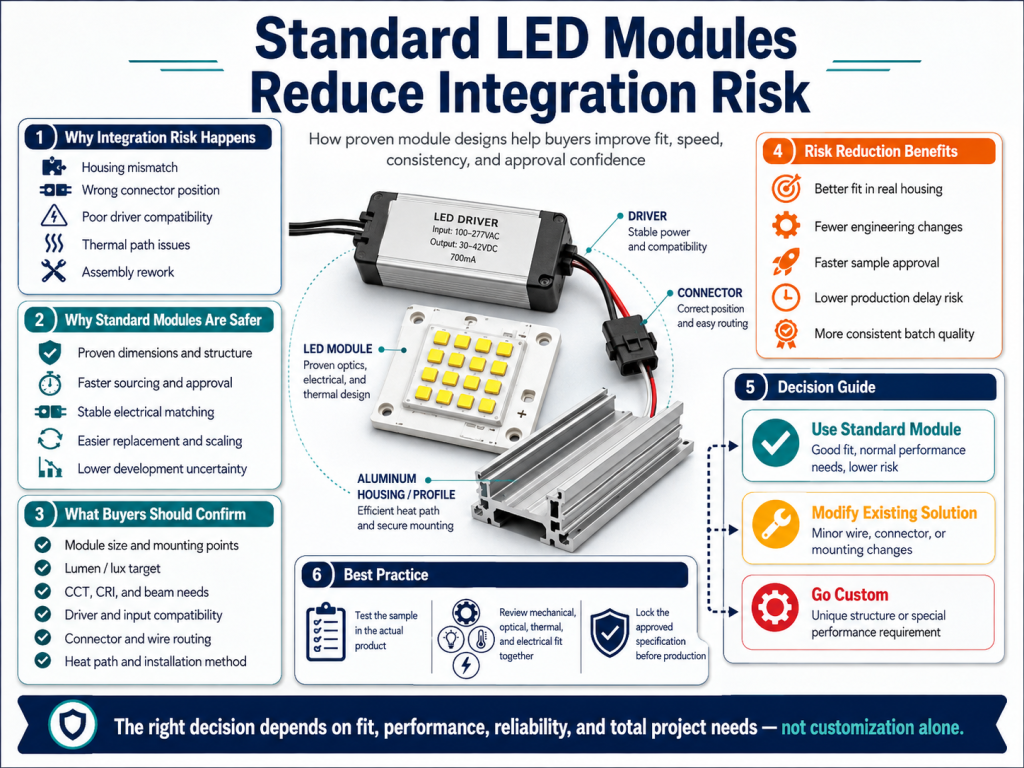
Many product teams start with a reasonable assumption: if the module is custom, it should fit better. That is true in some cases. But from a manufacturer’s perspective, custom development usually adds variables such as structure, heat dissipation, power supply, connectors, wiring, and mounting method.
Each variable needs confirmation. Each confirmation can create another round of drawings, samples, tests, or internal discussion.
A standard module has one major advantage: it already exists as a known design. That does not mean it is perfect. It means fewer things need to be created from zero.
For product-integration customers, the safer choice often depends on these questions:
- Does the standard module fit the available space?
- Does the brightness meet the application requirement?
- Does the CCT match the product experience?
- Does the CRI meet the visual expectation?
- Does the wattage match the power budget?
- Does the mounting method work without redesigning the housing?
- Does the wiring or connector fit the assembly process?
- Does the heat level remain acceptable in the final enclosure?
- Does the supplier have stable production control for this module?
If the answer is mostly yes, custom development may not reduce risk. It may increase it.
A Practical Risk Comparison
| Decision Factor | Standard LED Modules | Custom LED Module Development |
|---|---|---|
| Initial sample speed | Usually faster | Usually slower |
| Design uncertainty | Lower if already proven | Higher during early stages |
| Mechanical fit | Good if dimensions match | Better if structure needs exact fit |
| Thermal validation | Still required in final product | More variables to verify |
| Tooling or setup cost | Usually lower | Often higher |
| Launch timing risk | Usually lower | Usually higher |
| Appearance control | Limited by existing design | Stronger flexibility |
| Long-term optimization | Moderate | Stronger if volume justifies it |
The Key Point Is Not Standard Versus Custom
I prefer to frame the decision differently. The question is:
“Which option creates the fewest unknowns while still meeting the product requirement?”
For a cabinet light, showcase light, parasol light, furniture light, or equipment light, the LED module may support the user experience without being the main selling point.
If the customer is buying the final product for furniture design, mechanical performance, software features, or brand aesthetics, then the lighting module should work reliably without slowing everything else down.
In that situation, standard LED modules may be safer because they keep the project moving. The buyer can focus validation effort on the complete product rather than spending too much time redesigning a component that already has an acceptable solution.
What Requirements Must Standard LED Modules Meet First?
Standard LED modules must meet the non-negotiable requirements before they can be considered safe. A module that almost fits but creates assembly trouble, heat buildup, poor light distribution, or certification concerns is not a low-risk choice. It is only standard on paper.
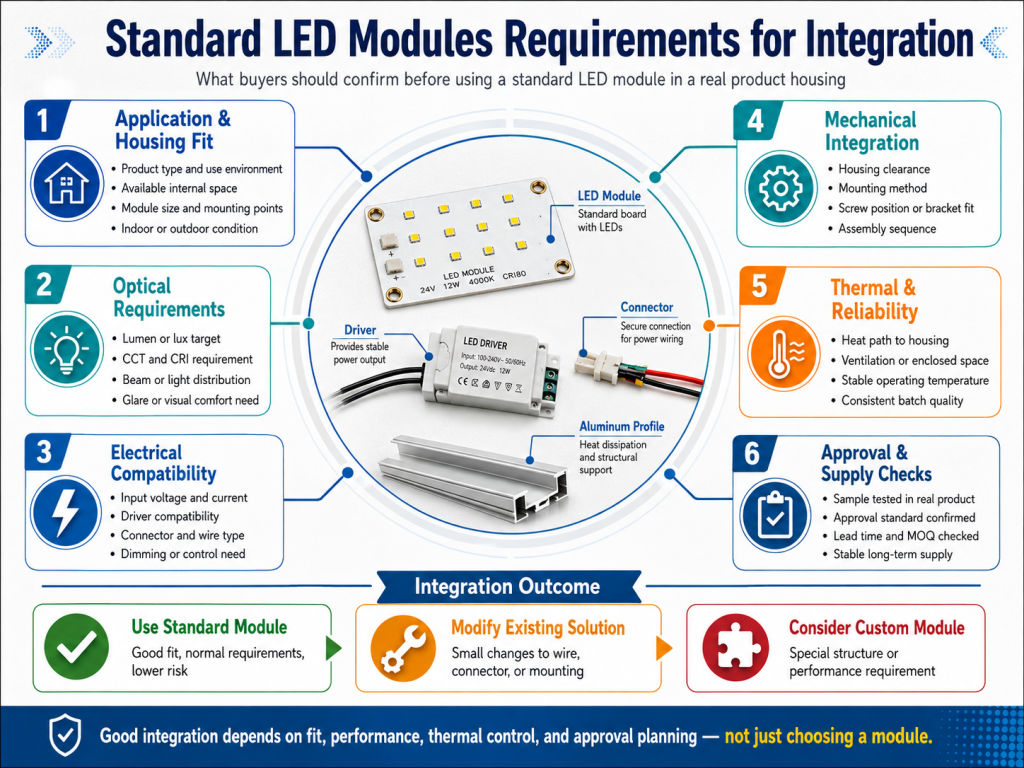
A standard module should meet the main requirements for size, brightness, CCT, power input, mounting, wiring, heat management, and appearance. Buyers should also verify supplier documentation, product consistency, and compatibility with the final product environment before choosing it over custom development.
The First Filter: Physical Fit
The first question is simple: does the module fit?
However, “fit” is more than length, width, and height. Product managers and engineers should check:
- Available internal space
- Screw hole or clip position
- Cable exit direction
- Connector clearance
- Diffuser or lens distance
- Heat path to the product body
- Tolerance between plastic, metal, and lighting parts
- Assembly sequence on the production line
A module can look suitable in a drawing but become difficult during assembly. For example, a connector on the wrong side may force cable bending. A cable bending issue can slow production or create strain near the solder point.
This is why I usually ask for drawings, photos, or samples before giving strong advice.
The Second Filter: Lighting Performance
The module must also create the right lighting effect. A product-integration buyer should define the lighting target before comparing modules.
Key parameters include:
- Lumen output
- CCT, such as 2700K, 3000K, 4000K, or 6500K
- CRI, such as Ra80 or Ra90
- Beam angle
- LED spacing and dot visibility
- Diffuser effect
- Uniformity
- Glare control
- Dimming requirement
A standard LED module may meet the brightness target but fail the visual expectation. For example, the product may need soft, continuous light instead of visible LED points. In that case, the issue may not be the module alone.
The diffuser distance, cover material, and internal reflection all affect the final result.
The Third Filter: Electrical and Thermal Compatibility
The electrical design must be practical for the whole product. Buyers should confirm:
| Item | Why It Matters |
| Input voltage | Must match the product power system |
| Current control | Affects brightness stability and LED life |
| Driver selection | Influences safety, dimming, and certification route |
| Power consumption | Affects battery, adapter, or system load |
| Connector type | Affects assembly and serviceability |
| Cable length | Affects installation and internal routing |
| Heat dissipation | Affects reliability and appearance over time |
Heat deserves special attention. A standard module tested in open air may behave differently when placed inside a tight plastic housing, metal channel, mirror frame, or outdoor fixture. The final product structure changes the thermal environment.
This does not mean standard LED modules are unsafe. It means buyers should still test them in the final product. A standard design reduces development variables, but it does not replace application-specific evaluation.
When Is Custom LED Module Development Better Than Standard LED Modules?
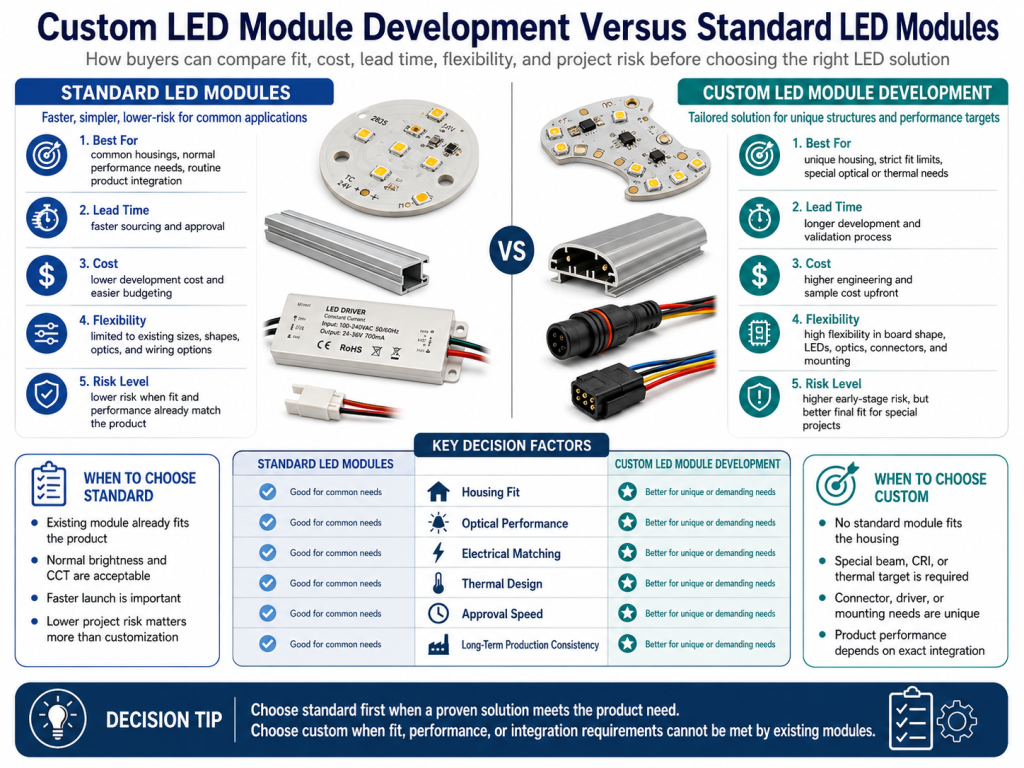
Custom LED module development is better when the product structure, appearance, function, certification path, or long-term production plan cannot be supported by an existing module. A standard part should not be forced into a design if it damages the product’s user experience or creates hidden assembly problems.
Custom development is the better route when no existing module can meet the required dimensions, mounting method, optical effect, power design, wiring layout, or appearance standard. It also makes sense when order scale, product lifecycle, and brand positioning justify the extra development, testing, and production investment.
Custom Is a Higher-Commitment Choice
I do not see custom development as a bad choice. In many projects, it is the correct choice. But it is a higher-commitment choice.
Custom work can include:
- PCB size and shape changes
- LED layout changes
- Different wattage or lumen output
- Specific CCT or CRI selection
- Connector redesign
- Cable length or wiring harness changes
- Housing or aluminum profile development
- Lens or diffuser matching
- IP rating changes
- Mounting structure changes
- Packaging and branding changes
Each change can be small by itself. Together, they create a new product path.
That path may require sample review, internal fitting tests, thermal checks, electrical tests, reliability checks, packaging tests, and certification document review. Buyers should also consider whether the supplier can repeat the approved sample consistently in mass production.
When the Product Leaves No Room for Standard Options
A custom module is often justified when the product structure is fixed. For example, a product may have a very narrow internal channel, a curved housing, a special cable exit, or a visible lighting surface that must align exactly with the industrial design.
In these cases, standard LED modules may create compromises such as:
- Uneven light
- Poor cable routing
- Extra brackets
- Larger housing size
- Visible dark spots
- Assembly difficulty
- Heat concentration
- Appearance mismatch
If the lighting is visible to the end user, appearance becomes more important. A lighting module inside a machine may be judged mainly by function. A lighting module inside a premium mirror, retail fixture, furniture product, or sunshade may also be judged by how clean and integrated it looks.
When Scale and Lifecycle Justify Development
Custom development becomes more reasonable when the product has enough volume and lifecycle stability. If the product will be sold for several years, a custom module may reduce assembly time, improve appearance, and support brand differentiation.
Before starting custom work, I suggest buyers define:
- Estimated annual quantity
- Target launch date
- Expected product lifecycle
- Required sample approval process
- Testing requirements
- Certification needs
- Allowed tooling or development budget
- Change control process after approval
A custom LED module should be treated as part of the product platform, not just a small accessory. If the product will change again in two months, custom development may create unnecessary rework. If the design is stable and the volume is meaningful, the investment may be justified.
How Should Buyers Compare Standard LED Modules and Custom Options?
Buyers should compare standard LED modules and custom options by looking at risk, timing, total cost, and product fit. The cheapest quotation or most tailored drawing does not always represent the safest decision. A good comparison includes both technical performance and project execution risk.
Buyers should compare standard and custom LED module options through a decision matrix covering fit, brightness, thermal behavior, electrical compatibility, mounting, supplier capability, sample timing, testing needs, certification documents, and mass production stability. The best option is the one that meets requirements with acceptable risk.

A Simple Decision Matrix
I like using a practical scoring method during early discussions. It does not need to be complicated. The goal is to make assumptions visible.
| Evaluation Item | Weight | Standard Module Score | Custom Module Score | Notes |
| Mechanical fit | High | Does it fit without housing changes? | ||
| Light effect | High | Is brightness and uniformity acceptable? | ||
| Thermal performance | High | Must be checked in final product | ||
| Electrical compatibility | High | Voltage, driver, dimming, wiring | ||
| Launch timing | High | How much delay can the project accept? | ||
| Appearance | Medium/High | Depends on product visibility | ||
| Sample cost | Medium | Includes shipping and review cycles | ||
| Certification route | Medium/High | Documents should be verified | ||
| Production stability | High | Can the supplier repeat the approved design? | ||
| Long-term supply | Medium | Is the module lifecycle suitable? |
This matrix helps buyers avoid emotional decisions. It also helps teams explain the choice internally.
For example, a product manager may prefer a custom module because it feels more aligned with the product concept. An operations manager may prefer a standard module because it protects the launch schedule. An engineer may want more testing before choosing either option. A decision matrix helps all three viewpoints meet in one place.
Questions I Ask Before Recommending a Direction
In presales discussions, I usually try to understand the project before suggesting standard or custom. Useful questions include:
- What is the final product application?
- Is the lighting visible or hidden?
- Is the light a core selling point or a supporting function?
- What are the available dimensions?
- What voltage and power system does the product use?
- Does the product need dimming or sensor control?
- What CCT and CRI are expected?
- What is the target market?
- Are certifications or test reports required for the project?
- What is the launch schedule?
- What quantity is expected after approval?
- Can the customer provide drawings, samples, or installation photos?
These questions are not just technical. They connect the lighting decision to launch risk.
Total Cost Is More Than Unit Price
A standard module may have a slightly higher unit price than a theoretical custom design. Or a custom design may become more cost-effective at volume. The unit price alone is not enough.
Buyers should consider:
- Engineering time
- Sample rounds
- Testing cost
- Tooling or fixture cost
- Certification document review
- Assembly labor
- Rework risk
- Delay cost
- Inventory risk
- Supplier change cost
The safest option is not always the lowest-cost option. It is the option with the best balance between performance, timing, and control.
What Supplier Evidence Should Buyers Verify Before Choosing Standard LED Modules?
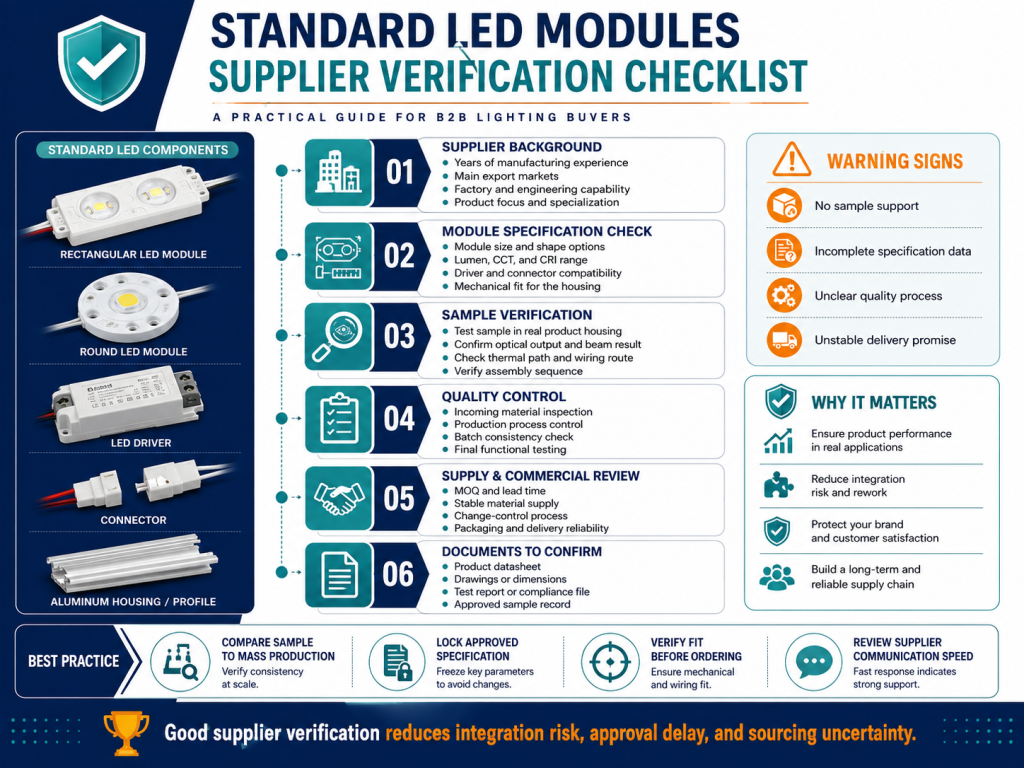
Standard LED modules become safer only when the supplier can support consistent quality, clear communication, and practical integration review. Buyers should verify more than a product photo or datasheet. The supplier’s process matters because the module must perform consistently inside the buyer’s finished product.
Buyers should verify drawings, specifications, sample quality, material consistency, electrical test results, aging test process, packing method, and relevant certification documents before choosing standard LED modules. They should also confirm whether the supplier can support minor customization, stable mass production, and clear communication after sample approval.
Documents and Samples to Request
A buyer does not need to overcomplicate the first step. However, the buyer should request enough information to judge whether the module is suitable.
Useful items include:
- Product datasheet
- Dimension drawing
- LED specification information
- CCT and CRI options
- Power and voltage details
- Wiring or connector description
- Mounting method
- Material information
- IP rating information if relevant
- Packing details
- Certification documents if required
- Sample for fitting and testing
Certifications should be treated as documents to verify, not assumptions to accept. Depending on the product type and market, buyers may need CE, RoHS, REACH, CB, UL/ETL, SAA, or other project-specific requirements. The exact need depends on the final product, target market, and applicable standards.
Buyers should involve qualified compliance professionals when the certification path affects market access.
Quality Control Questions
For LED module sourcing, quality control is not only about final inspection. It starts with materials and continues through production.
Helpful questions include:
- How are incoming materials inspected?
- How are LEDs, PCBs, drivers, wires, and connectors controlled?
- What electrical tests are done during production?
- Is aging testing performed?
- How is appearance checked?
- How is packing verified?
- How is the approved sample controlled in mass production?
- How are engineering changes communicated?
At VST Lighting, our typical manufacturing quality control can include incoming material inspection, production process monitoring, electrical and functional testing, appearance inspection, aging tests, final inspection, and packing verification. I mention this not as a universal claim for every supplier, but as a practical example of the kind of process buyers should ask about.
Communication Is Part of Risk Control
A technically good module can still create problems if communication is slow or unclear. Product-integration projects often involve drawings, samples, small changes, and repeated confirmation. A buyer should evaluate how well the supplier understands the final application.
Good supplier communication usually includes:
- Clear answers to technical questions
- Fast feedback on drawings or photos
- Practical suggestions instead of only selling stock items
- Clear sample lead time
- Clear mass production lead time
- Written confirmation of specifications
- Change control after approval
- Support for shipping and documentation
For product managers and founders, supplier responsiveness can directly affect the development schedule. If a standard module is selected because it should save time, the supplier also needs to support that speed with organized communication.
Frequently Asked Questions About Standard LED Modules
Are standard LED modules always cheaper than custom LED modules?
Standard LED modules are often cheaper at the sample and early production stage because they avoid new design work, tooling, and repeated sample rounds. However, custom modules may become cost-effective at higher volume if they reduce assembly labor, improve material efficiency, or support a stable long-term product platform.
Can I modify a standard LED module without full custom development?
Yes. Many projects use light customization instead of full custom development. This may include cable length, connector type, CCT, CRI, wattage, packaging, or branding changes. This middle path can reduce risk when the core module design already fits the product.
How do I know if heat will be a problem inside my product?
You should test the LED module inside the final product structure, not only in open air. Housing material, enclosure space, airflow, diffuser design, and mounting surface all affect heat. For critical applications, buyers should seek qualified engineering evaluation and define acceptable temperature limits.
When should I start custom LED module development?
You should start custom development when standard options cannot meet the structure, appearance, optical effect, electrical design, or mounting needs without serious compromise. It is also more justified when the expected order volume, product lifecycle, and launch plan can support the extra development and testing work.
What information should I send to an LED module supplier first?
You should send drawings, photos, available space dimensions, voltage, wattage target, brightness target, CCT, CRI, mounting idea, cable or connector needs, target market, and expected quantity. If you have a physical sample or rendering, it can help the supplier judge whether standard LED modules are suitable.
Conclusion: When Standard LED Modules Are Safer
Standard LED modules are safer than custom development when they meet the real integration requirements and help protect launch timing. Custom development remains valuable when the product structure, appearance, scale, or lifecycle justifies the extra work.
The best decision comes from comparing fit, lighting effect, thermal behavior, electrical design, supplier capability, and project risk.
If you are evaluating LED modules for a product integration project, share your drawings, samples, or application requirements with our team at VST Lighting so we can help you compare standard and custom options practically.
