
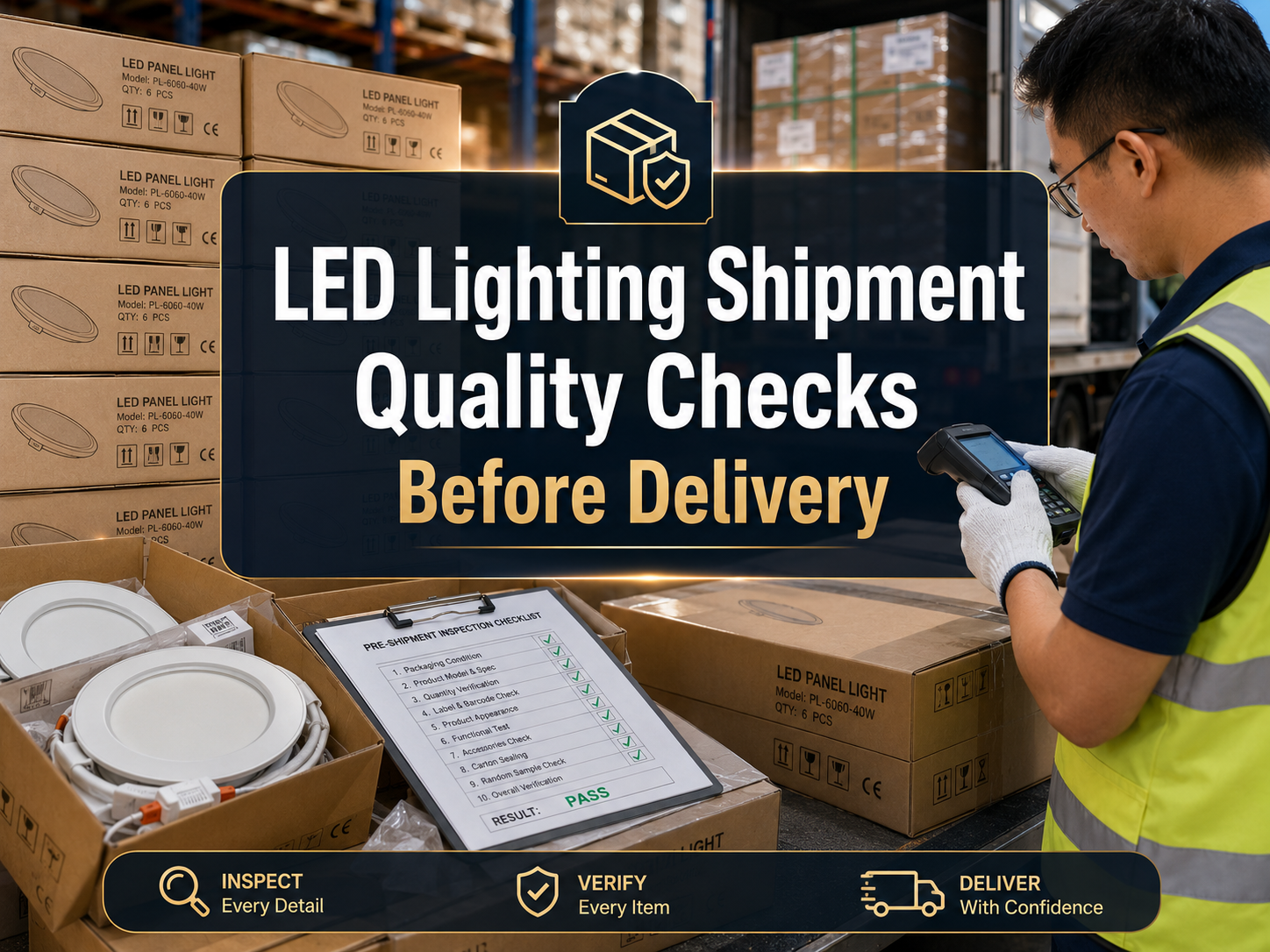
Before LED lighting shipment, quality checks should confirm electrical safety, optical performance, mechanical condition, driver and dimming function, environmental protection, labeling, documentation, and packaging strength. These checks matter because a lighting product that passes production but fails during installation can cause project delays, replacement labor, compliance questions, and avoidable warranty cost.
What Pre-Shipment Quality Checking Means
Pre-shipment quality checking is the final verification stage before LED luminaires, LED strips, modules, drivers, or lighting kits are released for delivery. It does not replace in-process quality control. Instead, it confirms that finished goods still match the approved order after assembly, aging, labeling, packing, and carton preparation.
Specifically, shipment inspection connects engineering specifications with commercial delivery. A project may require a 24V LED strip with 9.6 W/m power, 3000K CCT, CRI 90, IP67 protection, 3-step SDCM color consistency, and a specific carton label. If any one of these details is wrong, the product may still light up but fail project acceptance.
That matters because installation teams usually discover defects at the most expensive time. The goods are already on site, electricians are scheduled, scaffolding may be in place, and replacement lead time is difficult to absorb. Consequently, shipment quality control is both a technical process and a cost-control process.
A good pre-shipment inspection should answer four practical questions:
- Does the product match the approved specification and sample?
- Does the product operate safely and consistently under expected electrical conditions?
- Will the product survive handling, storage, and transport without damage?
- Can the installer identify, wire, mount, and maintain the product correctly?
Key Terms and Parameters Used in LED Shipment Inspection
Several technical terms appear repeatedly in shipment quality checking. They should be clearly understood before inspection results are approved. In contrast, vague comments such as “good quality” or “normal brightness” are not enough for professional acceptance.
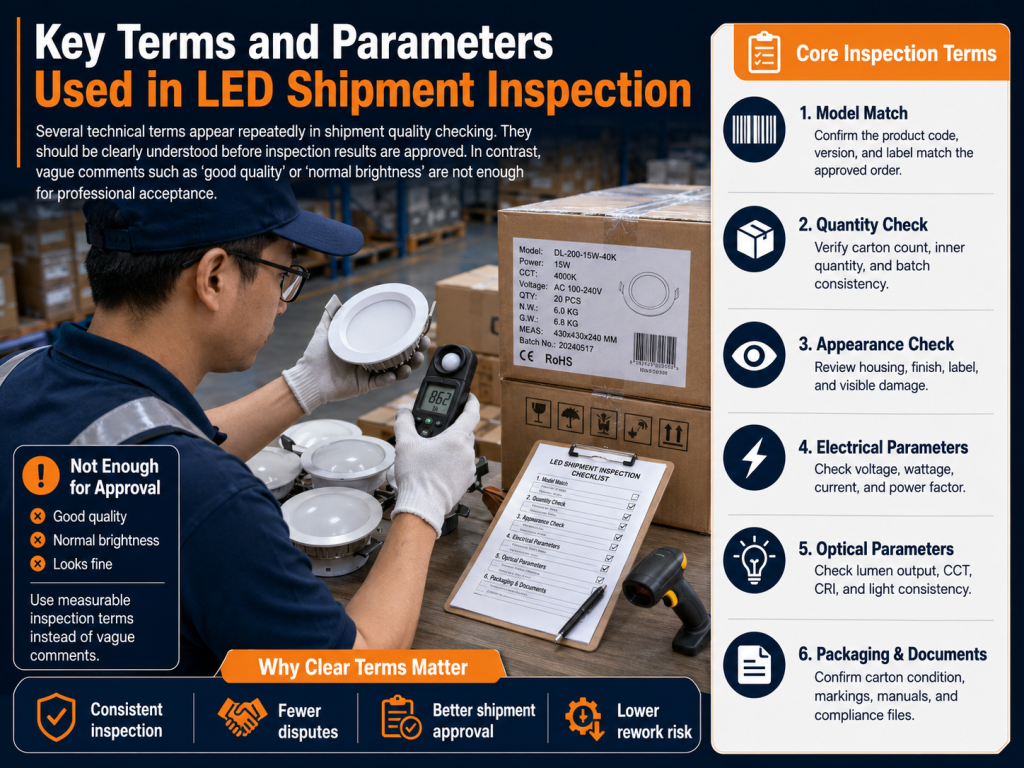
| Parameter | What It Means | Why It Matters Before Shipment |
|---|---|---|
| Input voltage | The rated voltage required by the fixture or driver, such as 12V DC, 24V DC, 120V AC, or 220-240V AC. | Incorrect voltage can cause failure, overheating, flicker, or unsafe installation. |
| Wattage | The electrical power consumed by the product under rated operating conditions. | Wrong wattage affects energy calculation, driver sizing, heat load, and project compliance. |
| Current | The electrical flow through the LED circuit or driver output. | Abnormal current can indicate wrong LED binning, driver mismatch, or assembly defects. |
| Luminous flux | The total visible light output, usually measured in lumens. | Low lumen output can fail lighting level requirements even if the product turns on. |
| Luminous efficacy | Light output per watt, usually expressed as lm/W. | It affects energy performance, rebate eligibility, and operating cost. |
| CCT | Correlated color temperature, such as 2700K, 3000K, 4000K, or 6500K. | Wrong CCT creates visible mismatch across rooms, stores, facades, or production batches. |
| CRI | Color rendering index, commonly specified as CRI 80, CRI 90, or higher. | Low CRI can affect retail displays, hospitality lighting, museums, offices, and visual inspection areas. |
| SDCM | Standard deviation of color matching, used to describe color consistency. | High SDCM variation can create visible color differences between fixtures. |
| IP rating | Ingress protection level against dust and water, such as IP20, IP65, IP67, or IP68. | Incorrect sealing can cause outdoor, wet-location, or dusty-area failure. |
| Driver compatibility | The ability of the driver to work with the LED load, input supply, and control method. | Mismatch can cause flicker, dimming instability, noise, overheating, or early failure. |
These parameters should be compared with the purchase order, approved datasheet, sample record, drawing, and test standard. However, tolerances should also be defined in advance. For example, a small wattage variation may be acceptable if it is within the agreed production tolerance and does not affect safety or light output.
Core Technical Principles Behind Shipment Quality Checks
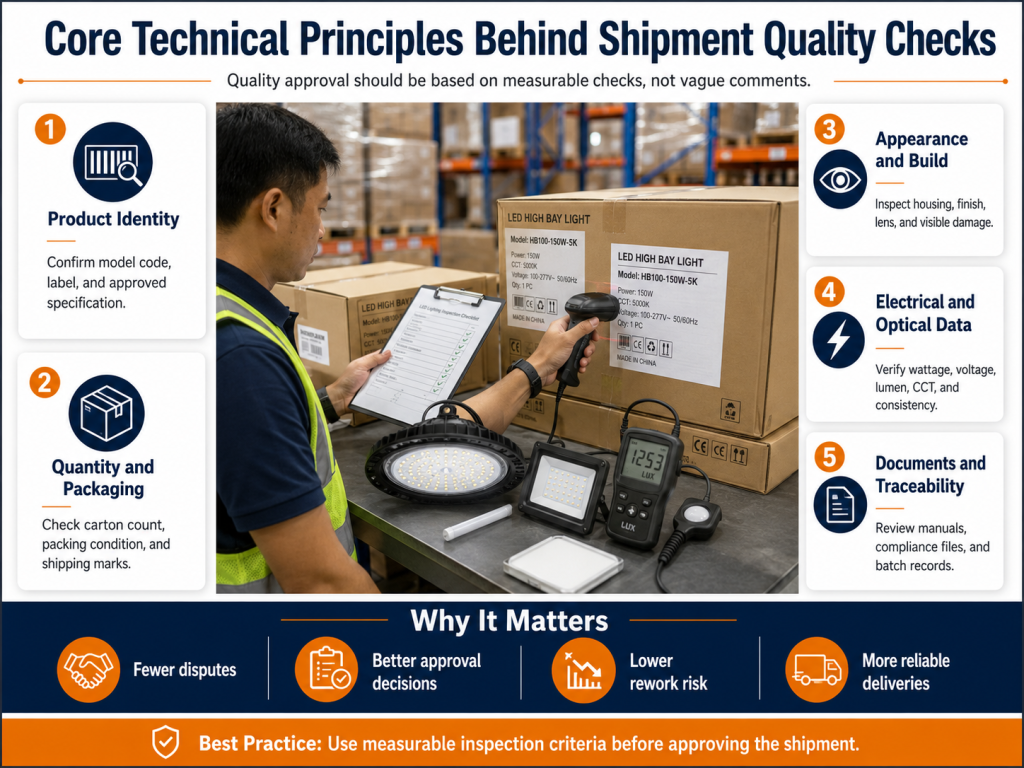
Electrical checks protect safety and field reliability
Electrical inspection confirms that the product is safe to energize and operates within the rated electrical range. Common checks include input power, current, voltage, grounding continuity, polarity, insulation resistance, dielectric strength, and driver output stability.
For low-voltage LED strip or module systems, polarity and voltage drop are especially important. A 24V strip may pass a short bench test but show dimming at the far end if cable length, copper width, or connection method is not suitable. For AC fixtures, grounding and insulation checks become more critical because the fixture connects directly to mains voltage.
Driver inspection is also essential. LED drivers convert input power into controlled output suitable for LED loads. If the driver is constant voltage, it is usually used for LED strips and modules with built-in resistors or control circuits. If it is constant current, it must match the LED module current and voltage range. Consequently, using the wrong driver type can damage LEDs even when the connector physically fits.
Optical checks confirm that the project will look as specified
Optical testing verifies what the user will actually see. Important checks include luminous flux, beam angle, CCT, CRI, SDCM, diffuser uniformity, glare condition, and visible color shift. These can be checked using integrating spheres, goniophotometers, colorimeters, or controlled comparison against approved samples.
For many projects, color consistency is more important than maximum brightness. A retail shelf, hotel corridor, cabinet, or facade may look poor if fixtures from different cartons have visible CCT variation. Therefore, batch control and LED binning records should be part of the shipment review when color-critical lighting is supplied.
Mechanical checks prevent installation and maintenance problems
Mechanical inspection covers housing dimensions, mounting holes, clips, brackets, screws, connector fit, lens position, cable outlet, finish quality, and deformation. These checks are practical. A hole that is 2 mm off can stop a mounting bracket from fitting. A loose lens can create water ingress. A sharp metal edge can damage wiring during installation.
Thermal structure also belongs in mechanical inspection. LEDs are temperature-sensitive devices. Poor contact between the LED board and heat sink can raise junction temperature, reduce lumen maintenance, and shorten service life. Therefore, inspectors should check heat sink contact, thermal pad placement, screw torque, ventilation path, and blocked cooling surfaces where relevant.
Packaging checks protect the product after quality approval
A fixture can pass every electrical and optical test and still arrive damaged if packaging is weak. Packaging inspection should confirm carton strength, internal protection, drop-test suitability, moisture protection, pallet height, carton labeling, and accessory separation.
This is especially important for long linear fixtures, aluminum profiles, glass lenses, high-bay lights, outdoor luminaires, and large panels. However, small LED modules also need packaging control because connectors, solder points, and lenses can be damaged by pressure or vibration during transport.
Technical Factors to Check Before LED Lighting Shipment
The inspection plan should match the product type and application environment. A decorative indoor linear light does not need the same checks as a floodlight used in coastal outdoor conditions. Specifically, the risk profile changes according to voltage, installation location, mounting method, control system, and maintenance access.
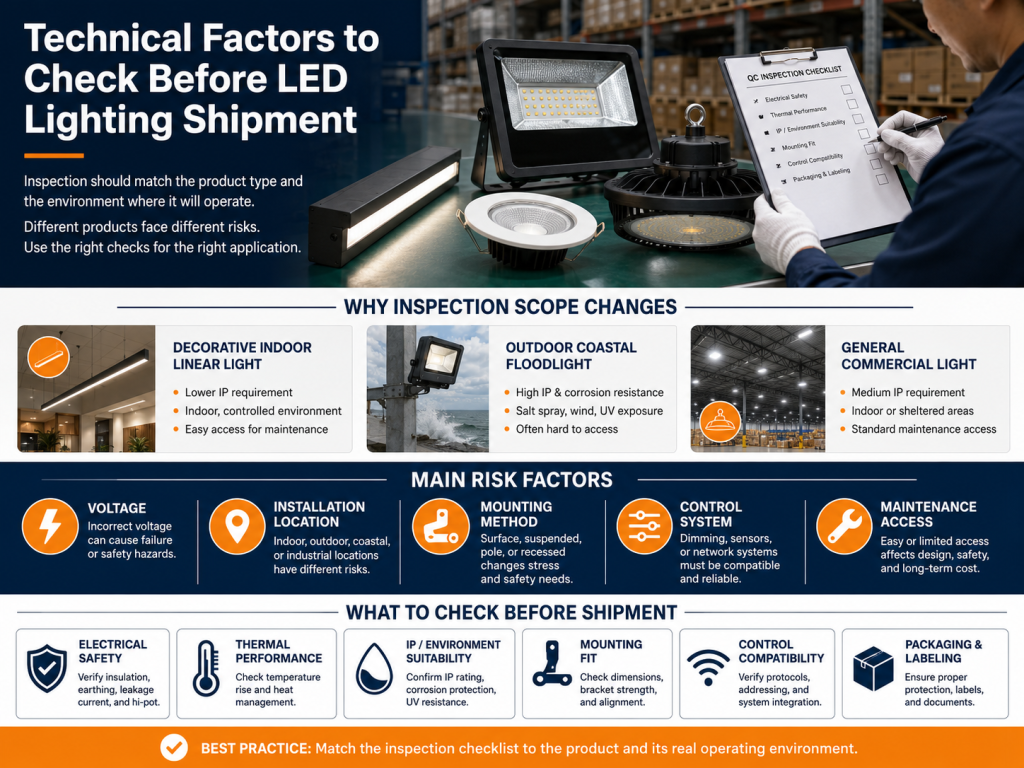
| Check Area | Typical Inspection Method | Applicable Products | Risk If Missed |
|---|---|---|---|
| Visual appearance | Inspect finish, scratches, dents, contamination, lens defects, and color difference under controlled lighting. | All LED products | Customer rejection, poor project appearance, and rework before installation. |
| Electrical performance | Measure voltage, current, wattage, power factor, and driver output under rated load. | Fixtures, drivers, strips, modules | Overheating, flicker, low output, circuit failure, or safety concern. |
| Optical performance | Test lumen output, CCT, CRI, beam angle, and color consistency by sample or full inspection when required. | Downlights, panels, linear lights, strips, floodlights | Wrong lighting effect, color mismatch, and failed project acceptance. |
| Dimming and control | Test dimming range, flicker, control response, minimum load, and compatibility with specified dimmers or controllers. | DALI, 0-10V, TRIAC, DMX, PWM, smart lighting systems | Dimming instability, buzzing, flicker complaints, and commissioning delays. |
| Ingress protection | Inspect gaskets, seals, cable glands, potting, end caps, and drainage design where applicable. | Outdoor, bathroom, facade, landscape, industrial, and wet-location products | Water ingress, corrosion, short circuit, and premature failure. |
| Mechanical fit | Check dimensions, hole spacing, brackets, clips, connector engagement, and accessory compatibility. | All mounted lighting systems | Installation delays, site modification, and extra labor cost. |
| Labeling and traceability | Confirm product labels, carton marks, batch codes, ratings, wiring marks, and documentation. | Project orders, OEM supply, export shipments | Wrong installation, customs delay, inventory confusion, and warranty traceability gaps. |
| Packaging | Review carton structure, inner protection, palletization, moisture control, and accessory packing. | Export orders and fragile or heavy fixtures | Transit damage, missing parts, and replacement cost. |
Not every order requires 100 percent testing for every item. However, safety-related checks, functional tests, and high-risk parameters should be clearly controlled. Sampling methods may follow internal quality plans or recognized approaches such as AQL sampling, depending on order size and buyer requirements.
How Quality Checks Affect Specification, Installation, and Cost
Shipment inspection is often treated as a factory routine, but it directly affects project execution. When the specification is accurate, installers work faster and commissioning is simpler. When the shipment contains mixed CCT, wrong accessories, or incompatible drivers, the cost moves from the factory to the jobsite.
Specification accuracy
For project lighting, the approved datasheet is the reference point. The shipment should match the agreed voltage, wattage, lumen output, CCT, CRI, beam angle, dimming method, IP rating, mounting method, finish color, cable length, plug type, and accessory list. Inaccurate specification control can cause visible inconsistency or technical failure even when the product is not defective in a general sense.
For example, a 4000K LED panel and a 5000K LED panel may both be functional products. However, if they are mixed in the same office project, the ceiling will look inconsistent. The issue is not only quality. It is specification mismatch.
Installation efficiency
Installers rely on consistent dimensions, labeled wiring, complete accessories, and clear polarity or input markings. Missing clips, wrong drivers, short cables, and unclear labels can slow installation even when the fixture itself works. Consequently, shipment checks should include accessory count, instruction sheet review, and carton identification.
Mounting method should also be verified. Surface-mounted, recessed, suspended, magnetic, adhesive, and clip-in systems all have different installation risks. For LED strips, inspectors should check reel length, solder joint position, adhesive backing, connector compatibility, and cutting mark accuracy when relevant.
Reliability and maintenance cost
Many LED failures are related to heat, moisture, driver stress, poor soldering, or wrong installation conditions. Pre-shipment checks cannot predict every field condition, but they can remove obvious risk before the goods leave the factory. Aging tests, thermal checks, sealing inspection, and driver load verification all reduce early failure probability.
That matters because the fixture price is only one part of total cost. Replacement labor, lift rental, site access, business interruption, and customer complaint handling can exceed the cost of the product. For warehouse high bays, facade lights, road lighting, or ceiling systems in occupied buildings, maintenance access is often expensive.
Compliance and documentation
Shipment inspection should verify that product markings and documentation are consistent with the required market and project documents. Depending on the destination and product category, buyers may request references to UL, ETL, CE, RoHS, IEC standards, EMC testing, LM-79 photometric testing, LM-80 LED package data, TM-21 lumen maintenance projection, DLC listing, or local electrical code requirements.
However, a label should never imply a certification that does not apply to the exact product configuration. Certification scope can depend on voltage, driver model, housing, wiring method, and component changes. Therefore, compliance checking should confirm both the document and the product configuration.
Application Scenarios and Inspection Priorities
Different lighting applications require different shipment inspection priorities. A uniform checklist is useful as a baseline, but project-specific risk should guide the inspection depth. In contrast, checking only appearance may miss the technical issue that matters most for the actual installation.
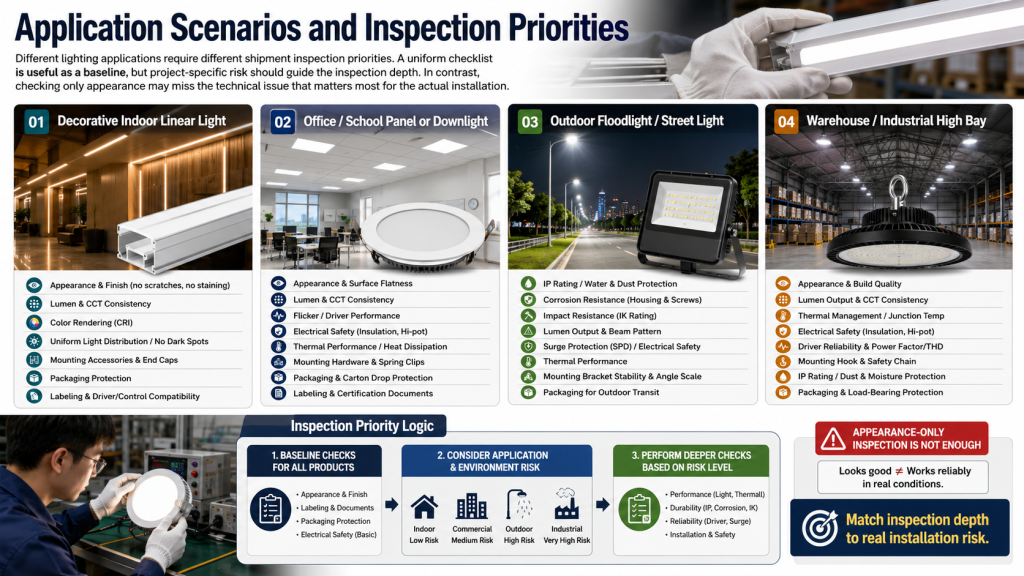
| Application Scenario | Critical Shipment Checks | Reason for Priority |
|---|---|---|
| Retail shelf and display lighting | CCT, CRI, SDCM, diffuser uniformity, mounting accessories, and connector fit. | Visible color mismatch affects merchandise appearance and brand presentation. |
| Office panels and linear lights | Lumen output, UGR-related optics when specified, driver flicker, dimming compatibility, and carton labeling. | Comfort, consistency, and commissioning efficiency affect project acceptance. |
| Outdoor floodlights and facade lighting | IP rating structure, cable gland sealing, corrosion resistance, grounding, surge protection, and beam angle. | Water, dust, wind, and access difficulty increase failure and maintenance risk. |
| Warehouse high bay lighting | Wattage, lumen output, thermal management, suspension hardware, driver reliability, and safety chain accessories. | High mounting height increases replacement cost and safety requirements. |
| LED strip for architectural coves | Voltage, wattage per meter, reel length, CCT binning, solder joint quality, adhesive backing, and voltage drop risk. | Long continuous runs expose brightness drop, color shift, and connection problems. |
| Industrial luminaires | IK rating when specified, vibration resistance, operating temperature, driver protection, wiring safety, and housing strength. | Harsh environments require stronger mechanical and electrical reliability controls. |
For large projects, it is useful to define a golden sample or approved reference sample before mass production. The final shipment can then be compared against that reference for finish, color temperature, light distribution, mechanical fit, connector type, cable color, label format, and packaging style.
Common Myth vs Reality
Myth: If every LED product turns on, the shipment quality is acceptable
Reality: A simple power-on test only confirms basic function at one moment. It does not confirm correct wattage, thermal performance, color consistency, dimming compatibility, insulation safety, IP sealing, accessory completeness, or packaging strength.
Myth: Optical performance is only important for premium projects
Reality: Optical mismatch is visible in many ordinary installations. Offices, retail stores, hotels, cabinets, warehouses, and outdoor facades all suffer when CCT, beam angle, or brightness differs from the approved design.
Myth: Certification documents alone prove shipment quality
Reality: Certification documents are important, but they must match the product configuration being shipped. If the driver, housing, wiring, or input voltage changes, the compliance status may need review.
Myth: Packaging is a logistics issue, not a quality issue
Reality: Packaging is part of product quality because transport damage can create electrical, mechanical, and cosmetic defects before the goods reach the site.
8. What This Means in Practice
In practice, LED lighting shipment quality checks should be planned before production finishes, not after cartons are sealed. The inspection team should know the approved specification, inspection level, sample size, acceptance criteria, and documentation requirements before the final production batch is completed.
For a small repeat order, inspection may focus on visual appearance, electrical function, label accuracy, quantity, and packaging. For a complex project order, the inspection should include optical testing, dimming verification, driver model confirmation, environmental sealing review, accessory matching, and batch traceability.
Consider a commercial linear lighting project using 24V LED modules with remote drivers. The shipment check should verify module wattage, current draw, connector polarity, CCT bin, cable length, driver output voltage, dimming protocol, and carton grouping by installation zone. If these details are not controlled, the installer may connect the wrong driver, create voltage drop, or mix color bins in the same ceiling area.
Now consider outdoor wall washers for a facade. The priority shifts to IP sealing, cable glands, lens bonding, grounding, surge protection, bracket strength, beam angle, CCT consistency, and corrosion-resistant finish. The cost of missing these checks is high because replacement may require lifts, night work, and re-commissioning.
The practical goal is not to make inspection complicated. The goal is to make it targeted. Each check should reduce a real project risk.
Recommended Pre-Shipment Inspection Workflow
A structured workflow helps avoid missed details. The exact process can vary by factory, product type, and order requirement, but the logic should remain consistent.
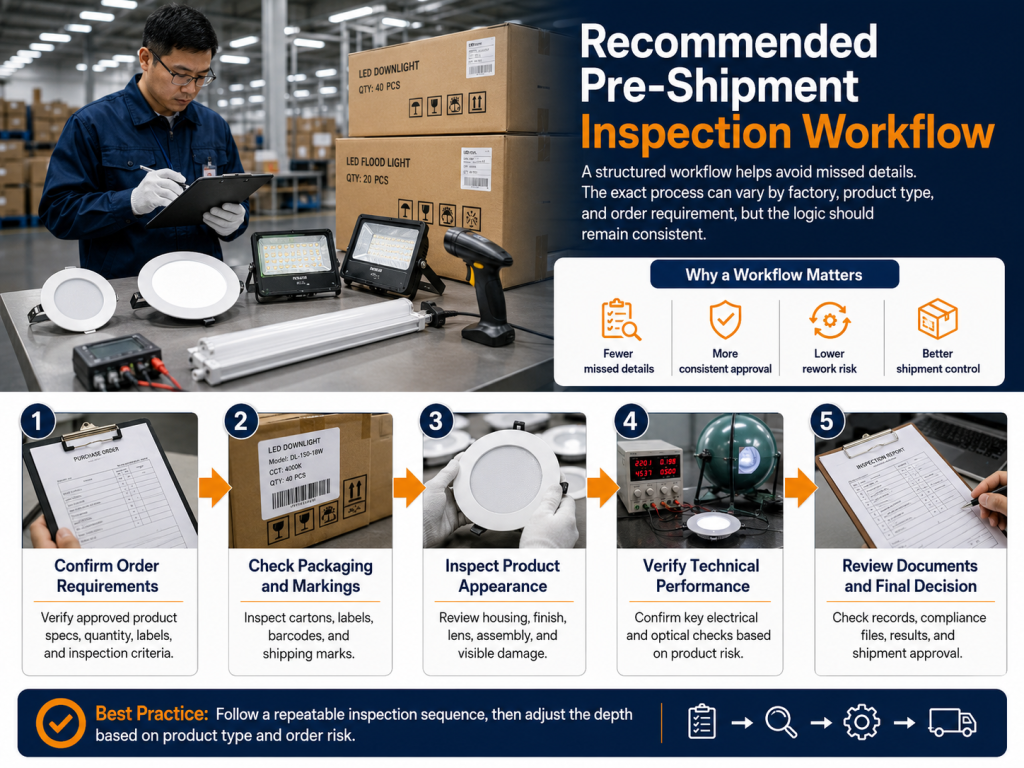
| Inspection Step | Main Action | Output Record |
|---|---|---|
| Document review | Compare purchase order, approved drawing, datasheet, sample record, BOM, and packaging instruction. | Specification confirmation sheet. |
| Finished goods sampling | Select samples from completed cartons or production lots according to agreed inspection level. | Sampling record with carton or batch references. |
| Visual and mechanical inspection | Check finish, dimensions, accessories, cable exits, mounting parts, labels, and assembly quality. | Visual inspection checklist and defect photos if needed. |
| Electrical and functional testing | Measure power, current, voltage, driver output, dimming function, polarity, and grounding where applicable. | Electrical test record. |
| Optical verification | Check lumen output, CCT, CRI, SDCM, beam angle, or sample comparison according to project requirements. | Photometric or color test record. |
| Aging or burn-in review | Confirm operating test duration, abnormal failures, driver temperature, flicker, and restart behavior. | Aging test summary. |
| Packaging inspection | Check carton strength, inner protection, labels, accessory bags, palletization, and moisture protection. | Packaging approval record. |
| Final release | Review nonconformities, corrective actions, accepted deviations, and shipment documents. | Shipment release approval. |
Acceptance criteria should be defined before inspection. For example, a project may allow a specified wattage tolerance, require CCT within a defined bin, or reject any visible housing scratch on exposed surfaces. Without clear criteria, inspection decisions become subjective and difficult to defend.
Pro Tip / Field Experience
Field experience: Always inspect at least some samples from sealed production cartons, not only from a display table prepared by the factory. Carton-level checking often reveals mixed labels, missing accessories, wrong cable lengths, or packaging pressure that a bench test will not show. For project shipments, keep photos of carton marks, product labels, driver labels, and test readings for traceability.
Risk Control Checklist for Shipment Approval
The final decision should combine technical test results, commercial order accuracy, and transport readiness. A shipment may fail release because of a technical defect, but it may also fail because documentation, labels, accessories, or carton marks do not match project requirements.
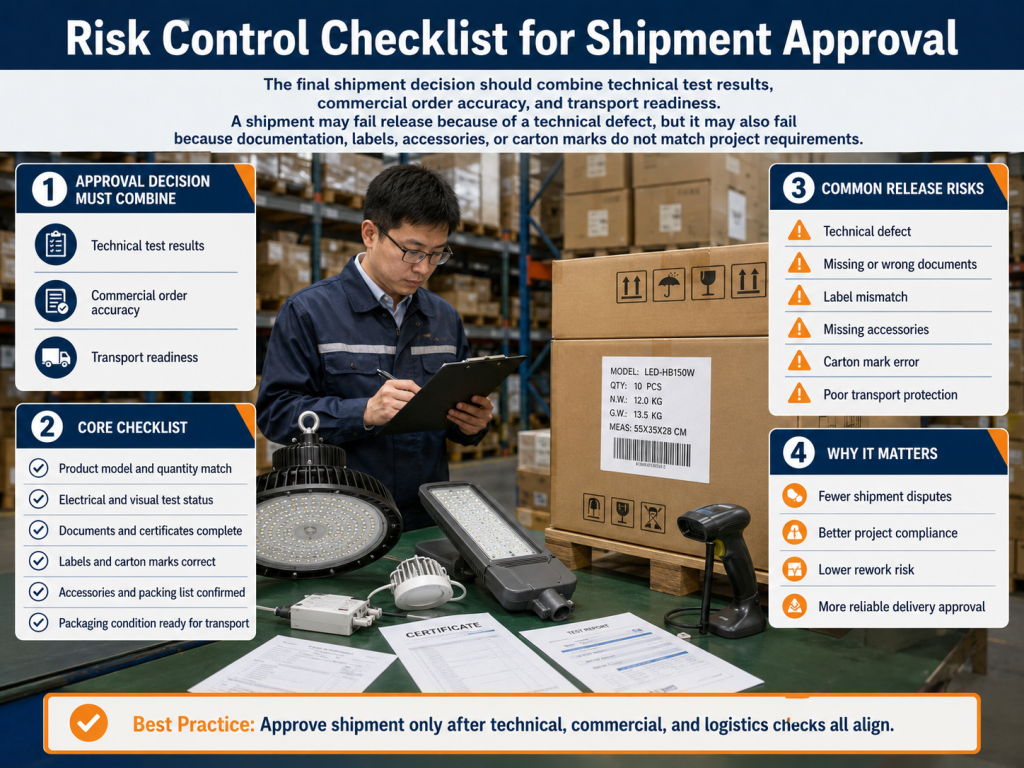
| Risk Area | What to Verify | Recommended Control |
|---|---|---|
| Wrong product configuration | Model number, voltage, wattage, CCT, CRI, optics, finish, and mounting method. | Compare against approved datasheet and order confirmation. |
| Mixed batches | CCT bin, LED batch, driver batch, housing finish, and carton grouping. | Use batch codes and clear carton identification. |
| Dimming failure | Driver type, dimming protocol, minimum dimming level, and compatible controller. | Test with specified control equipment where possible. |
| Moisture failure | Seals, gaskets, cable glands, potting, end caps, and housing closure. | Inspect sealing structure and test according to product requirement. |
| Transport damage | Carton strength, internal foam, edge protection, pallet height, and stacking method. | Approve packaging before loading and record pallet photos. |
| Compliance mismatch | Certification scope, rating label, test report reference, and market requirement. | Verify documents against the exact product configuration. |
| Installation delay | Accessories, wiring marks, screws, brackets, instructions, and mounting templates. | Check accessory bags and installation-related parts during sampling. |
If a defect is found, the response should depend on severity. Critical safety issues require shipment hold and corrective action. Major functional or specification issues may require rework, sorting, or replacement. Minor cosmetic issues may be accepted only if they are within agreed limits and do not affect project appearance or performance.
You can contact a technical team to confirm inspection criteria when the project includes special voltage, color tolerance, dimming control, outdoor sealing, private labeling, or compliance documentation requirements.