

Separate plant lighting from lighting for people
A useful greenhouse lighting plan starts with the job each light must do. You may need to read seed labels at a potting bench, add light to a propagation area or keep a visitor space pleasant after sunset. Those requests can share a building without sharing the same fixture arrangement or operating schedule.
Growth support, day-length control and visual tasks
Supplemental plant lighting adds to the light the crop receives. Photoperiod lighting addresses the timing or perceived length of the day for a particular production objective. Work lighting lets people see a surface or route. Separating these purposes makes it easier to choose the correct information: plant-light delivery for a crop zone, or useful visual illumination for a human task.

What an evening-use idea is meant to achieve
Decorative strings or portable lights can be appropriate to an evening seating area. Their appearance does not establish that they can serve a cultivation requirement. Equally, light reaching production plants after sunset needs to be considered in the crop plan. Keep the pleasant evening view and the growing requirement visible as separate decisions.
Use daylight and the greenhouse structure as the starting point
Covering, shading and seasonal light
A greenhouse receives daylight through a covering and a structure. Roof members, shade systems, nearby obstructions and conditions on the covering change how much of that light reaches the growing area. A bright view through the door leaves unanswered what reaches a particular bench throughout the day.
Virginia Tech’s introduction to daily light integral explains why the available light and production objective need to be considered together. Use that relationship when discussing supplementation. Do not start by applying the same wattage to every square foot of greenhouse floor.
Beds, benches and the moving crop canopy
The surface being lit changes with the crop and its stage. A tray at bench level, a taller canopy and a vertical growing arrangement present different geometry. Mark the intended growing surface and its likely movement on the zone plan, along with the access needed for handling plants.
| Zone or task | Requirement to describe | Input still needed |
|---|---|---|
| Propagation bench | Usable tray area and intended plant-light delivery | Crop plan, canopy position and applicable fixture report |
| Larger crop zone | Coverage over the actual growing surface | Daylight contribution, obstructions and crop requirements |
| Potting bench | Visibility of hands, tools and labels | Working position and surface arrangement |
| Evening visitor area | Preferred appearance and operating hours | Spill toward production plants and independent control |
Keep seasonal and structural changes separate in the zone record. Seasonal daylight may change while the bench stays in place. A shade screen, hanging pipe or another shelf can change the local light path within the same season. This helps identify whether the next decision concerns operating time, fixture distribution or an obstruction.
Where historical daylight data supports early planning, retain its location and period. It describes the recorded outdoor or measured conditions, not automatically the light under every greenhouse covering. Use it to frame the question while keeping the actual inside conditions as a separate input.
Arrange linear light above propagation benches
Shallow trays and a changing crop height
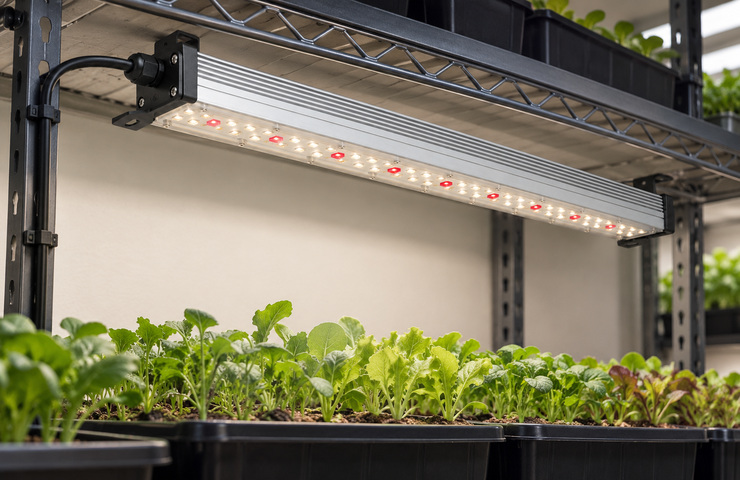
Linear fixtures can be a useful form above a defined bench. They allow the source arrangement to follow the tray area, making them worth comparing where compact mounting space and repeated bench sections matter. The actual fixture distribution still determines how the arrangement serves the crop plane.
Look beyond the first tray position. Plants can grow toward the fixture, and tray carriers may change the working height. A layout that is convenient when empty may become difficult to use later. Define the operating positions the fixture and support need to accommodate instead of selecting a universal source-to-plant distance.
Access to trays and support above the work
Keep the tray route clear. A light fitted directly across the lifting path can interfere with daily handling even if the illuminated area looks suitable on a drawing. Consider how a fixture is reached for cleaning and replacement, and whether another loaded shelf or bench obstructs it.
For equipment manufacturers, the bench and fixture can be developed together. Bar length, retained support points and a service opening become specific design inputs. This is more useful than requesting an unspecified “grow light bar” and trying to fit the resulting part around the equipment afterward.
Choose overhead coverage for wider crop zones
Rows, open beds and larger canopies
An overhead arrangement is a candidate when a broader growing area needs coverage and the structure allows an appropriate mounting position. It can keep equipment above ordinary crop-handling activity. That advantage needs to be weighed against available height, structural obstructions and the ability to service the fixtures.
Use the actual rows and working paths in the comparison. Covering an empty floor uniformly is a different task from reaching plants in separated beds or beneath parts of the structure. A fixture located for a visually regular ceiling pattern may not serve those growing surfaces efficiently.
Why edge coverage and obstructions affect the arrangement
Compare a report that describes the same evaluation area and mounting conditions as the proposed use. A central high reading can coexist with weaker edges. Likewise, a report for a smaller footprint does not answer the performance question for a larger zone.
The PPF versus PPFD guide explains those quantities and report comparisons in more detail. For this layout decision, the question is whether the supplied evidence describes the area and crop position you intend to serve. Fixture count follows that assessment rather than a generic floor-area rule.
Pay attention to the fixture body as an obstruction too. Placing equipment above a crop also places material in the daylight path. A compact source arrangement may have a different trade-off from a larger assembly at the same location. Compare the physical envelope with the structure and growing surface, alongside the light report.
Access can decide between otherwise plausible positions. A fixture that cannot be reached during production may require a planned interruption for maintenance. Moving it into an accessible position can change coverage again. Develop those requirements together so the service plan does not undo the lighting layout later.
Consider within-canopy light only for a crop that needs it
An additional layer among taller plants
Within-canopy or interlighting arrangements place an additional source closer to parts of a taller crop that may receive less light from above. It is a different physical position from toplighting, with its own crop, support and maintenance questions. Treat it as an option for a defined cultivation reason, rather than a feature every greenhouse should add.
Ask what part of the plant and production objective the extra layer would serve. That answer should come from the crop plan and relevant specialist evidence. A photograph of light between rows cannot establish a yield improvement or the correct exposure for another crop.

Access, support and the cultivation-system constraint
Equipment among plants needs space that remains available during tending, harvesting and cleaning. Retention, lead routing and contact conditions become part of the arrangement. A source placed neatly in a diagram can obstruct a worker or become difficult to reach once the crop fills the zone.
| Arrangement | Condition that makes it worth comparing | Constraint to resolve |
|---|---|---|
| Linear bench light | A defined tray area with limited overhead space | Crop-height changes and tray handling |
| Overhead zone light | A broader crop area and suitable structural position | Coverage evidence, obstructions and service reach |
| Additional within-canopy light | A crop-specific reason to add another light layer | Plant interaction, access and the supported operating plan |
For a new system, establish the reason for that additional layer before developing its mechanical detail. It can then be evaluated as part of the cultivation arrangement instead of an isolated lamp purchase.
Keep movable trays and temporary racks adaptable
Changing tray levels and service routes
A greenhouse used for more than one production arrangement benefits from a lighting plan that acknowledges those changes. Identify the supported tray positions, the maximum occupied space and the route used to move the equipment. A fixture serving one level should not silently become an assumed solution for every future level.
A movable rack also changes the relationship between light, plants and its surroundings. If the source moves with the rack, the completed assembly needs that movement accounted for. If the source stays on the building, the rack positions become inputs to the coverage decision.
Separate supported zones instead of a fixed visual grid
Independent zones can be useful when bench use changes at different times. They allow the operating plan to follow the actual production arrangement, provided the chosen control and fixture system supports the required behavior. Avoid grouping unrelated tasks merely because the fixtures are close together.
Service access deserves the same attention as normal operation. A replaceable part should be reachable with neighboring benches in their realistic positions. For an OEM assembly, a drawing showing the mounting and removal route can resolve a more important integration question than an extra decorative rendering.
With temporary racks, identify which connections remain fixed and which assemblies move as a unit. This is an interface question for the equipment design. The completed arrangement needs to accommodate the intended movement without leaving a loose lead across the handling route or making tray access depend on dismantling lighting parts.
Add useful light at the potting bench and work route
Light for labels and small tools
A potting bench needs useful light on the work, even when the crop zones have their own lighting. Place the visual task in the design: reading a seed label, sorting small fittings or checking a tray. Choose a light direction that lets those objects be seen from the working position.
Light direction at working hands
If the source is behind the person, their body and hands can shade the surface. A suitable local direction can be more useful than increasing a distant overhead source. Check shelves above the bench too; they can block a light path that looks clear on an empty elevation drawing.

Spill into the production zone
Keep the effect on adjacent plants in the discussion. A work light can remain on when the cultivation lights are off, so its direction and operating period matter. This is a reason to coordinate the work zone with the crop plan, not a reason to leave a needed working surface unlit.
Environmental suitability also belongs to the complete selected installation. Cleaning, condensation and moisture near connections need specific attention. A fixture photograph or a generic ingress label does not define every greenhouse exposure condition.
Make evening ambience a separately controlled choice
Decorative light in a visitor or seating area
For a greenhouse used partly as an evening retreat, low-output decorative light can create a different atmosphere from work lighting. Choose it for that experience: a seated view, a visible pathway within the visitor area or a restrained glow around a non-production feature.
A portable or solar product may be convenient where permanent power is impractical. Its output, available operating time and environmental suitability must suit that specific use. It should not become the assumed power source for a crop-lighting system simply because it works for an occasional evening visit.
Light reaching photoperiod-sensitive production zones
Keep decorative operation separate where the crop plan requires a particular light-dark pattern. The relevant question is how much of that light reaches the plants, its spectral character and when it operates. Avoid a universal claim that ordinary work or decorative lamps are too weak to matter.
| User task | Useful location and control | Production interaction to resolve |
|---|---|---|
| Occasional potting after dark | Local work light with an accessible control | Spill and operating time beside crop zones |
| Evening seating | Restrained decorative light controlled separately | Whether the selected area is also used for production |
| Regular cultivation supplementation | A supported crop-lighting and control arrangement | Delivered light and the crop operating objective |
A separate control makes the intended use easier to manage. It still needs to belong to the chosen electrical system and does not by itself establish a suitable crop schedule.
Choose operating control from the lighting purpose
Supplementing daylight and meeting a crop plan
Daylight changes, while a crop-lighting objective may be defined over a day or a production period. Supplemental operation therefore needs both the available-light information and the intended crop requirement. The University of New Hampshire supplemental-lighting worksheet makes those inputs explicit.
A timer can provide a defined operating period. A supported daylight-responsive or DLI-based system can use additional information to manage operation toward a specified objective. Those are different functions, so describe which behavior is required before choosing the control interface.
A separate work-light switch
People may need the potting bench when the cultivation zones should remain in another state. A separate work-light control can address that use without changing the entire greenhouse schedule. Position it where the user can reach it through the normal work route.

What a dimming interface actually supplies
Dimming capability means the fixture can accept a supported change in output. Automatic daylight response also needs an appropriate control system, information source and operating objective. A dimmable fixture alone supplies none of those decisions.
Likewise, adjustable spectral channels require the corresponding source, driver and controller arrangement. If spectrum selection is central to the project, the grow light spectrum guide explains what to read in the source data. Keep the control discussion tied to the actual configuration.
Describe the behavior through a normal operating day: which crop zone follows a defined objective, which changes with bench use, and which light a person needs afterward. That description can be evaluated against a proposed controller. A list of interface names alone does not show that the required combination of operating states is supported.
Develop one greenhouse zone plan
The given benches, taller crop zone and work area
Consider a hypothetical greenhouse containing a propagation bench, a separate area for taller plants and a potting work surface near the entrance. The bench trays need frequent handling. The taller zone has a larger growing surface, and the workbench is sometimes used after the other zones finish their operating period.
In this example, the crop requirement and fixture output remain inputs for the next design step. The layout can still establish which physical arrangement to develop for each zone. Model selection then uses the relevant crop and fixture data, rather than treating the drawn source positions as a completed performance result.
Chosen arrangements and the limits still to resolve
Develop a linear route above the propagation bench, with its supports outside the tray-handling path. Compare an overhead arrangement for the taller zone using the intended canopy area and structural position. Give the potting surface its own covered work light and accessible control, with spill toward the production zones considered in the operating plan.
Do not add within-canopy light to this example unless the crop plan establishes a reason for it. If evening seating is later added, treat its decorative light as another controlled use rather than attach it to the crop schedule.
The resulting plan identifies source positions, the separate jobs and the remaining crop and fixture inputs. It leaves actual performance, mounting design and environmental suitability to the defined equipment and installation. A drawing with these distinctions can guide a meaningful design discussion without pretending to be a completed buildable scheme.
Compare fixture forms for maintenance, environment and useful light
Support, cleaning exposure and service reach
Compare the fixture forms against normal greenhouse use. Can a part be reached without disrupting neighboring trays? Does the chosen support preserve the working route? Which surfaces and connections are exposed during cleaning? These questions can change the practical choice even when two source arrangements appear similar on paper.
Keep environmental evidence attached to the actual assembly. Housing, cover, cable entry and connection details can all affect the result. Changing one of those details requires a corresponding review; selecting a similar body does not transfer another fixture’s test evidence.

| Zone decision | Fixture form to develop | Information needed before selecting a model |
|---|---|---|
| Light the propagation bench | Supported compact linear arrangement | Tray area, operating canopy positions and applicable output data |
| Serve the wider crop zone | Conditional overhead arrangement | Crop objective, daylight contribution and matching coverage evidence |
| Support evening potting work | Covered local task fixture | Working view, exposure and independent operation |
| Preserve access | Reachable supply and service parts | Actual structure, support and replacement path |
What a development request should describe
For an OEM discussion about custom LED grow lights, start with the zone plan, source positions, crop-plane information and intended control behavior. VST’s current page describes project development rather than a universal crop-lighting specification. Those concrete inputs allow a proposed assembly to be assessed for the greenhouse task you actually need to solve.