
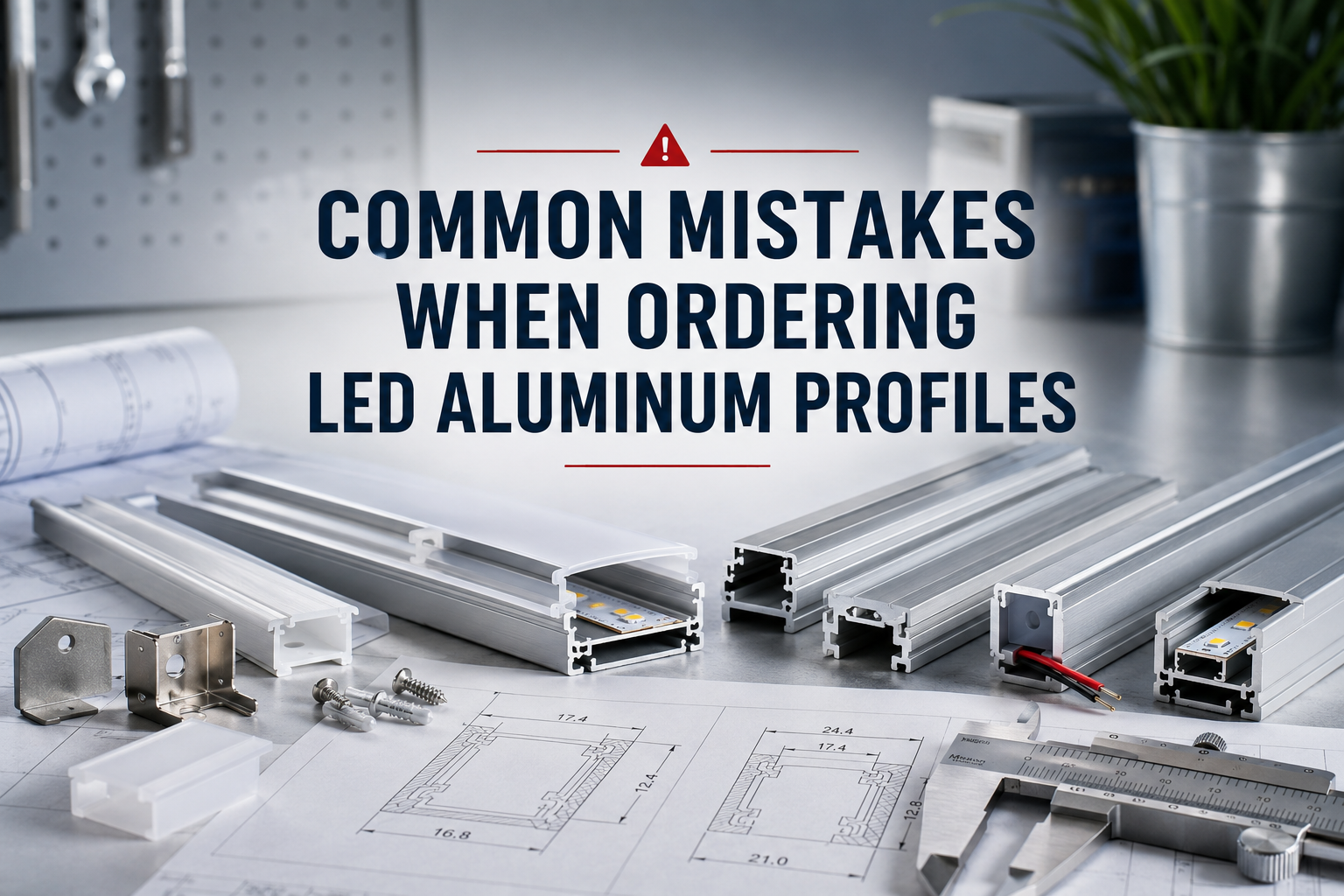
Most bulk ordering mistakes with LED aluminum profiles come from incomplete specifications. The profile, diffuser, LED strip, accessories, mounting method, packing, and installation environment all need to match before production starts.
Product Selection Questions
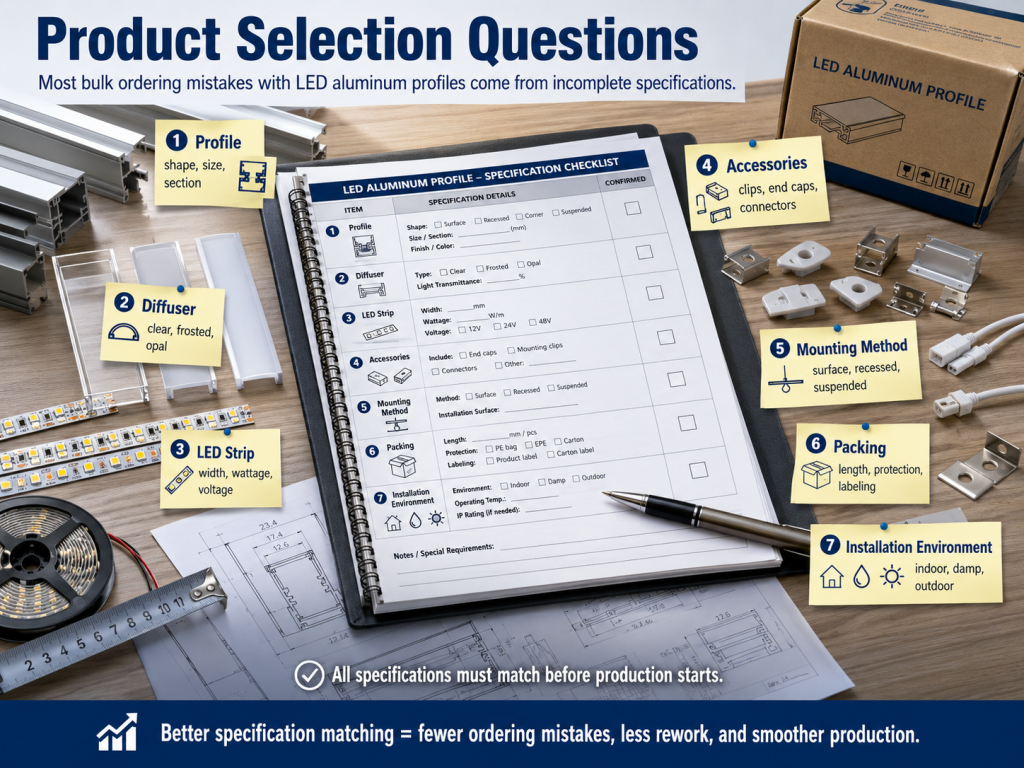
What is the most common mistake when ordering LED aluminum profiles in bulk?
The most common mistake is ordering by profile appearance only. A drawing or catalog image is not enough for bulk procurement. You also need to confirm the inner width, outer size, diffuser type, compatible LED strip width, installation method, finish, cutting tolerance, and accessory set.
This matters because many profiles look similar but perform differently. A 10 mm LED strip may not fit a profile with a 9.6 mm internal groove after anodizing tolerance. A diffuser may look acceptable in a sample but create visible LED dots at the required installation distance. These issues become expensive when they affect hundreds or thousands of meters.
Why is LED strip width often missed during profile selection?
LED strip width is often missed because buyers focus on the aluminum channel size instead of the usable internal space. The internal PCB slot must fit the strip, solder joints, connectors, and any protective coating.
For example, a nominal 12 mm profile does not always accept a 12 mm strip. You need to check the actual inner width, diffuser locking structure, and cable exit space. If the project uses solderless connectors, they may require more width and height than the strip itself. Confirming this early prevents assembly delays and field modification.
Is it a mistake to choose the cheapest diffuser for a bulk order?
Yes, choosing the cheapest diffuser can be a mistake if it does not match the required light output and visual effect. Diffusers affect transmission, glare control, LED dot visibility, beam angle, and color appearance.
Clear diffusers deliver higher luminous flux but may show LED points. Milky diffusers improve uniformity but reduce light output. Opal or frosted covers can soften the beam but may require higher wattage to reach the same illumination level. For retail shelving, wardrobe lighting, and architectural coves, diffuser choice directly affects appearance and customer acceptance.
| Parameter | What to Check | Why It Matters |
|---|---|---|
| Profile inner width | LED strip PCB width, connector width, solder pad space | Prevents fitting problems during assembly |
| Profile depth | LED pitch, diffuser distance, dot-free requirement | Improves visual uniformity and reduces glare |
| Diffuser material | PC, PMMA, transparency, UV resistance | Affects light transmission, durability, and appearance |
| Surface finish | Anodized silver, black, white, custom color | Controls visual consistency across installation areas |
| Accessories | End caps, clips, suspensions, screws, cable exits | Reduces installation delays and missing part claims |
| Cutting length | Standard length, custom cut length, tolerance | Improves site fit and reduces cutting labor |
Specification and Quotation Questions
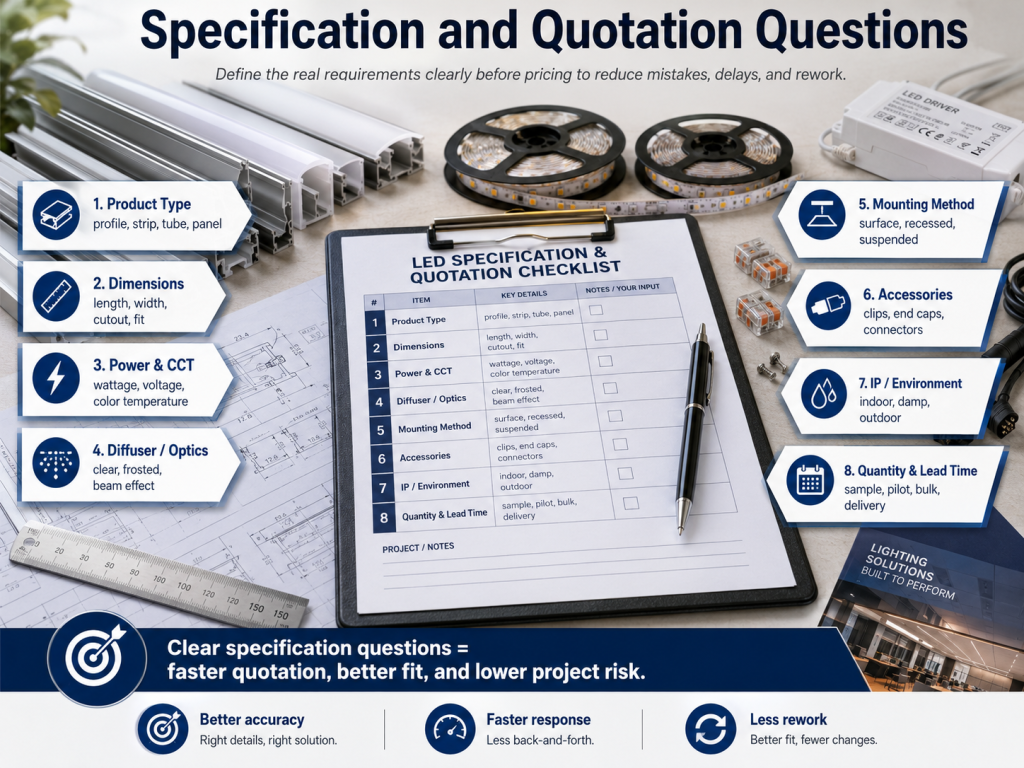
Why should I not request a quote with only profile length and quantity?
You should not request a quote with only length and quantity because the final cost depends on more than aluminum extrusion volume. Diffuser type, end caps, mounting clips, cutting, drilling, finish, packing, labeling, and custom processing can all change the price.
A quote for “1,000 meters of aluminum profile” may not include the complete kit needed for installation. If accessories are added later, the budget and lead time may change. For accurate procurement, specify whether you need bare profile, profile with diffuser, full kits, pre-cut sets, or assembled lighting modules.
What drawing details should be confirmed before mass production?
The production drawing should confirm all functional dimensions, tolerances, materials, finishes, and accessory interfaces. A simple cross-section image is not enough for repeatable bulk production.
Important details include outer width, inner width, height, diffuser lock position, wall thickness, cutting length, hole positions, end cap fit, clip engagement, and cable outlet location. If the profile will be recessed into millwork, furniture, equipment, or architectural grooves, confirm both profile dimensions and installation cavity dimensions. Small tolerance errors can cause profiles to sit unevenly or fail to clip in place.
How do surface finish and anodizing affect bulk LED profile orders?
Surface finish affects appearance, corrosion resistance, touch quality, and batch consistency. Anodized aluminum is common for LED profiles, but finish color and surface texture should still be specified clearly.
Silver, black, white, and custom colors may have different minimum order quantities and lead times. Black anodizing can highlight scratches more than silver. Powder coating may be preferred for certain decorative applications, but coating thickness can affect accessory fit. For visible architectural lighting, confirm finish samples before approving mass production.
Why is packing specification important for bulk profiles?
Packing is important because long aluminum profiles and plastic diffusers are easy to scratch, bend, or mix during transport. Bulk orders should define bundle quantity, protective film, carton strength, pallet size, labeling, and accessory grouping.
Poor packing can create hidden project costs. Installers may spend extra time sorting parts, cleaning surfaces, or rejecting damaged diffusers. For project shipments, it is often better to pack profiles, diffusers, end caps, and clips by room, fixture type, or installation zone when the site schedule requires fast distribution.
| Ordering Mistake | Typical Result | Prevention Method |
|---|---|---|
| Confirming only profile shape | LED strip or connector does not fit | Check internal width, depth, and accessory clearance |
| Ignoring diffuser transmission | Lower lumen output or visible LED dots | Test clear, frosted, and opal diffusers with the actual strip |
| Forgetting end caps and clips | Installation stops due to missing parts | Specify a complete accessory bill of materials |
| No cutting tolerance agreement | Profiles do not align on site | Confirm custom length and acceptable tolerance before production |
| No packing requirement | Scratches, bending, or mixed components | Define protective packing, labels, and pallet method |
Installation and Application Questions
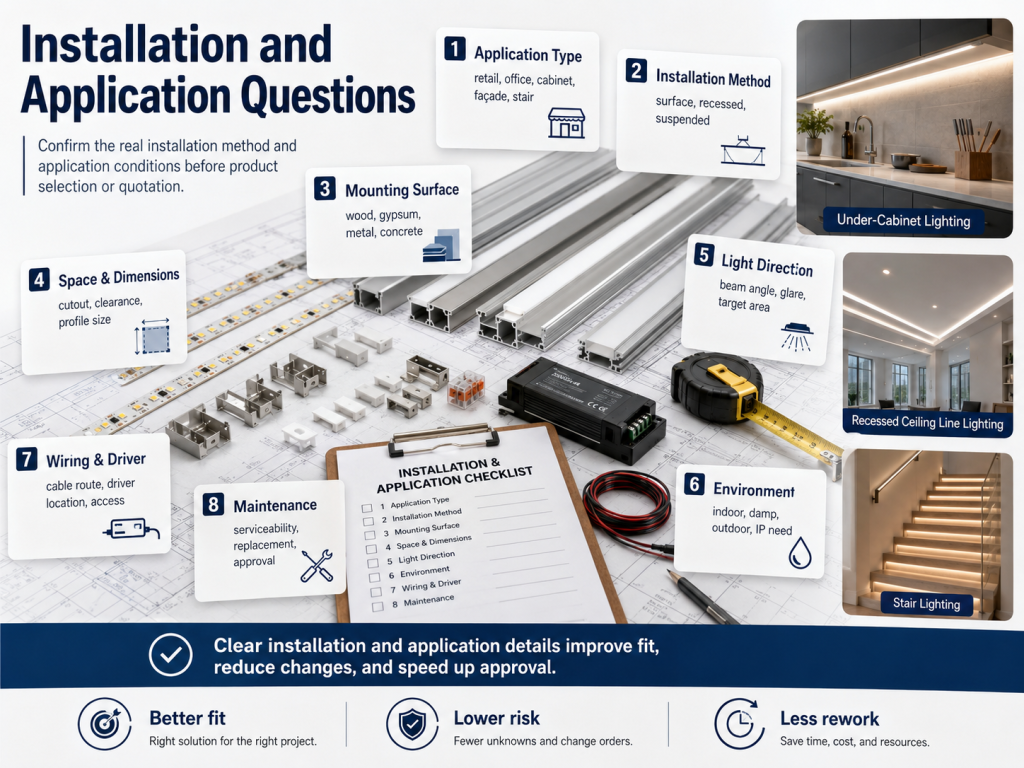
Why does the installation environment matter when ordering profiles?
The installation environment matters because it affects profile type, diffuser material, IP rating, mounting hardware, and corrosion resistance. Indoor cabinet lighting has different requirements from outdoor facade lighting or humid retail refrigeration areas.
For dry indoor spaces, a standard recessed or surface-mounted profile may be enough. For bathrooms, exterior signage, kitchens, or wet cleaning areas, you may need a higher IP rating, sealed end caps, silicone protection, or compatible LED strips. Temperature, dust, moisture, vibration, and UV exposure should be discussed before selecting the profile system.
Is it safe to use the same profile for recessed, surface-mounted, and suspended installations?
No, the same profile is not always suitable for every mounting method. Recessed, surface-mounted, corner, and suspended profiles have different mechanical and optical requirements.
A recessed profile needs flange width and cavity tolerance. A surface-mounted profile needs proper clips or screws. A suspended profile needs compatible hanging kits and cable load capacity. A corner profile changes the beam direction and may require a different diffuser. If the mounting method changes after ordering, accessories and dimensions may no longer match the site.
How does profile depth affect dot-free linear lighting?
Profile depth affects dot-free lighting because greater distance between LED chips and diffuser improves light mixing. Shallow profiles are compact but more likely to show LED points, especially with high-brightness strips or wide LED spacing.
Dot-free performance depends on LED pitch, diffuser opacity, profile depth, and viewing distance. A 120 LEDs per meter strip may look smooth in a shallow profile, while a 60 LEDs per meter strip may show dots. Always test the actual strip, diffuser, and viewing angle instead of judging from profile size alone.
Pro Tip: Before approving a large order, build one complete installation sample using the real LED strip, driver, diffuser, end caps, cable exit, and mounting hardware. Check it under the expected viewing distance and ambient light. Many profile problems appear only after assembly, especially LED dot visibility, connector clearance, clip tightness, and diffuser color shift.
Electrical, Thermal, and Compatibility Questions
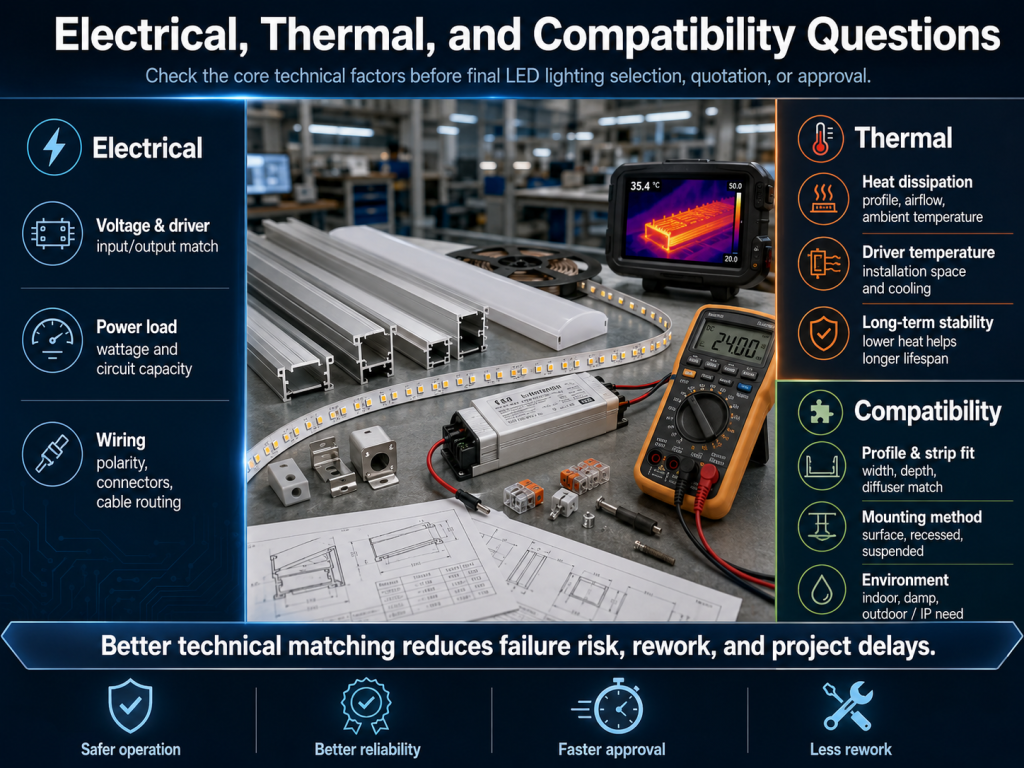
Can an LED aluminum profile replace proper thermal design?
No, an LED aluminum profile helps heat dissipation, but it does not replace proper thermal design. The strip wattage, profile mass, air circulation, mounting surface, and operating temperature all affect thermal performance.
High-wattage LED strips generate more heat. If they are installed in a narrow, enclosed, or insulated space, the aluminum profile may not dissipate heat fast enough. Excess heat can reduce lumen maintenance, damage adhesive backing, shift color, or shorten component life. For higher power designs, confirm profile size, heat path, and operating temperature limits.
Why should driver, voltage, and current still be considered when ordering profiles?
Driver, voltage, and current should be considered because the profile must allow safe routing, connection, and maintenance of the LED system. The aluminum profile itself is not the driver, but it affects how the strip and wiring are installed.
Long runs may create voltage drop, especially with low-voltage LED strips. Larger cable size, multiple feed points, or segmented circuits may be needed. If the profile does not have enough space for cable exits or connectors, installers may drill on site or bend wires sharply. That can increase labor and reliability risk.
Do dimming requirements affect the aluminum profile order?
Yes, dimming requirements can affect the profile order when they change the LED strip, wiring layout, driver position, or maintenance access. Common dimming methods include PWM, 0-10 V, DALI, triac, and DMX, depending on the full lighting system.
The profile should support the selected control design. For example, RGBW or tunable white strips need more conductors than single-color strips. That may require larger cable exits, more space behind the end cap, or different connector planning. Dimming compatibility should be checked as part of the full system, not after profile production.
Technical Factors to Check
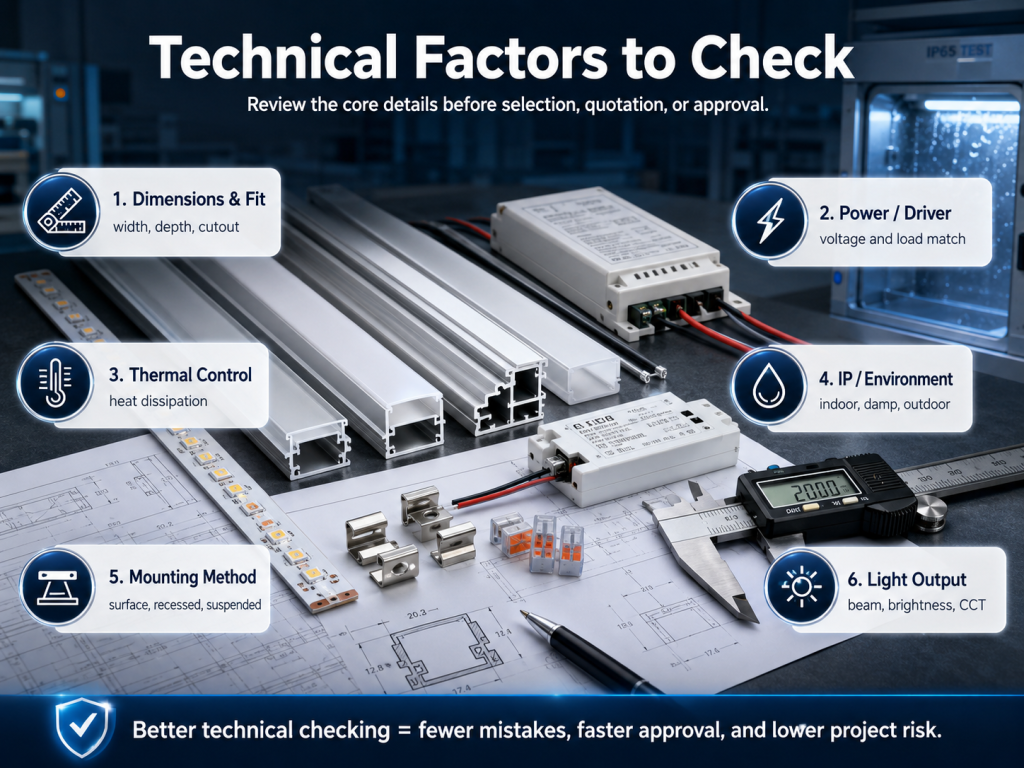
What technical factors should be checked before approving a bulk profile order?
You should check mechanical fit, optical result, thermal capacity, installation method, environment, accessories, and packing before approval. These factors determine whether the profile works as a complete installation system.
For professional projects, do not rely only on catalog codes. Confirm samples, drawings, accessory quantities, and test results where needed. If the project has compliance requirements, ask for relevant material documents or reports such as RoHS declarations, material data, photometric files for completed luminaires, or IP test information when applicable.
- Check the LED strip width, connector size, and solder pad clearance against the profile inner width.
- Check the diffuser type, transmission, beam effect, and LED dot visibility with the actual strip.
- Check the profile depth, aluminum mass, wattage per meter, and expected operating temperature.
- Check mounting clips, screws, suspension kits, end caps, and cable exit design before confirming accessories.
- Check cutting length, drilling position, anodizing color, surface tolerance, and batch finish consistency.
- Check packing method, labeling, project grouping, and protection for long profiles and diffusers.
Should I request samples before placing a bulk order?
Yes, samples should be requested when fit, finish, diffuser effect, or accessory compatibility affects the project outcome. A sample is especially important for custom lengths, special colors, recessed installations, and dot-free lighting requirements.
Sample approval should include physical fit, visual appearance, diffuser locking strength, clip installation, end cap alignment, cable outlet position, and light output with the actual LED strip. For repeat orders, samples may still be needed if the finish, supplier, diffuser material, or accessory design has changed.
What quality checks are useful before shipment?
Useful pre-shipment checks include dimensional inspection, surface finish inspection, diffuser fit testing, accessory count verification, and packing inspection. These checks reduce the risk of receiving unusable or incomplete materials.
For custom-cut profiles, measure sample pieces from different cartons. Check cutting burrs, straightness, anodizing scratches, diffuser engagement, and end cap fit. If the profiles are part of a finished luminaire, additional electrical and photometric testing may be required under the relevant project standard or local electrical code.
Procurement, Compliance, and Project Risk Questions
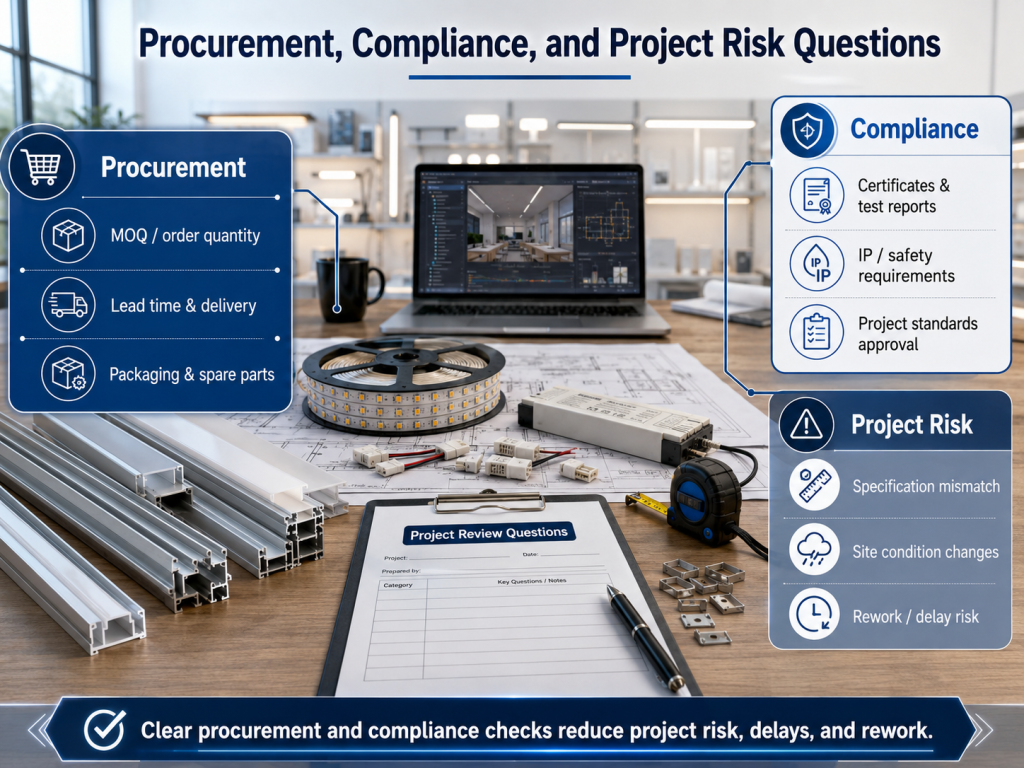
What compliance details can affect LED aluminum profile procurement?
Compliance details can affect procurement when the profile is part of a certified luminaire or installed in a regulated environment. The aluminum extrusion alone may not carry the same certification as a complete LED fixture.
Depending on the market and application, you may need to consider CE, RoHS, UL, ETL, EMC, local electrical code, IP rating, or material restrictions. If the profile is used in a listed luminaire, changing the profile, diffuser, wire path, or assembly method may affect the approved construction. Confirm documentation requirements before production.
How can bulk order mistakes increase total project cost?
Bulk order mistakes increase total cost through rework, site delays, replacement parts, extra freight, and installation labor. The lowest unit price is not always the lowest project cost.
A missing clip can stop installation. A wrong diffuser can require replacement across all visible areas. A profile cut 2 mm too long may need manual trimming on site. A weak packing method can create scratches that are not found until installation. Good specification control protects both procurement budget and project schedule.
What should be included in a complete LED aluminum profile purchase request?
A complete purchase request should include profile model, length, finish, diffuser, accessories, installation method, packaging, tolerance, and project-specific requirements. It should also identify whether the order is for raw profiles, profile kits, or assembled LED lighting modules.
For clearer communication, attach drawings, photos, installation notes, and sample references. Include quantity by item, not only total meters. If the project needs specific labeling, carton marking, phased delivery, or spare accessories, add those details at the quotation stage. You can contact the technical team to confirm project details before locking the final bill of materials.