
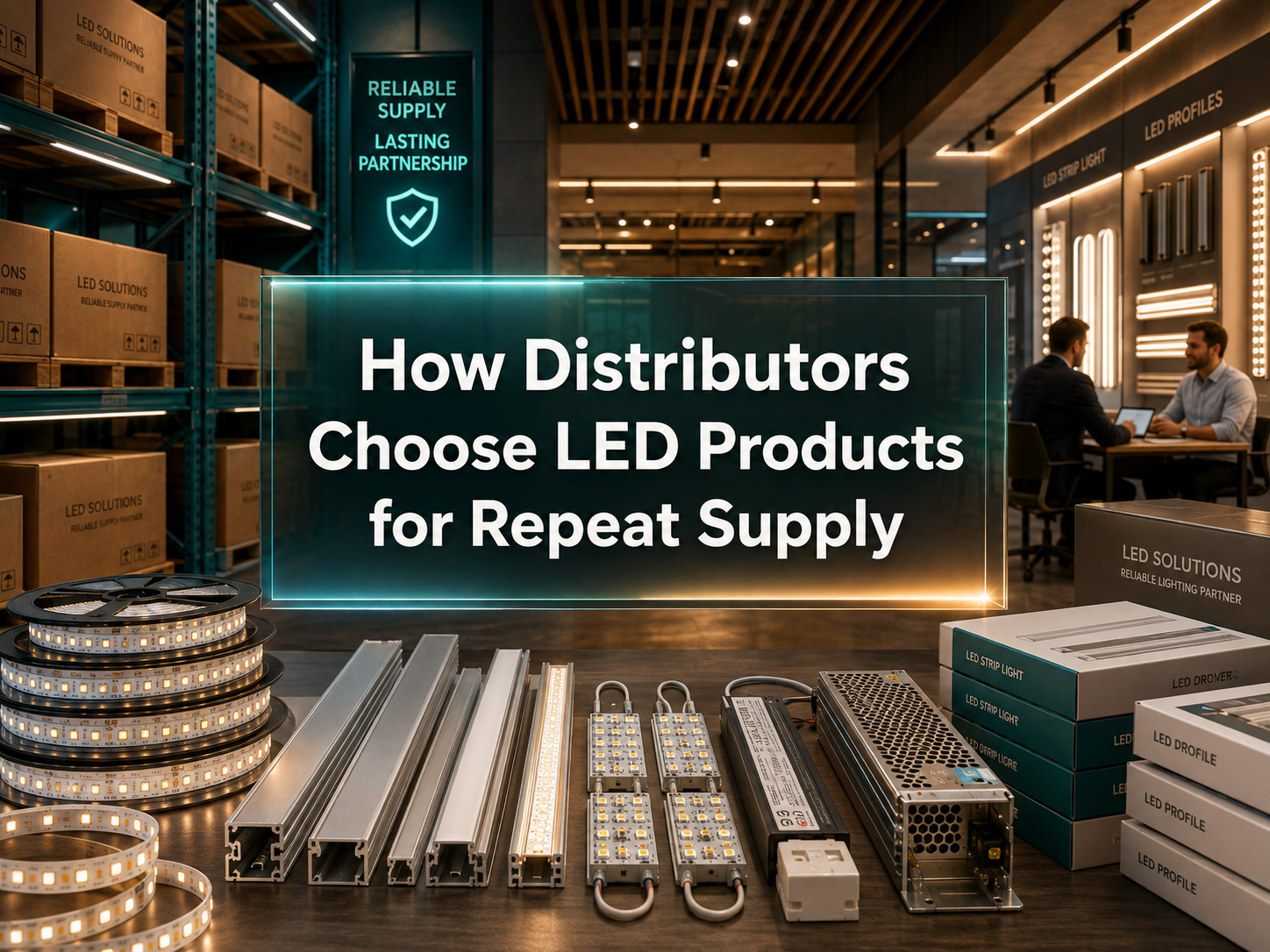
Distributors should choose LED products for repeat supply by combining market demand, stable technical specifications, reliable manufacturing control, and clear project suitability. A good repeat supply product is not only bright or inexpensive. It must be consistent across batches, simple to quote, practical to install, and supportable after delivery.
This guide explains how to evaluate LED products before making them part of a regular supply range. It focuses on technical parameters, commercial repeatability, installation impact, quality checks, and risk control. The goal is to help you avoid products that look acceptable in one sample order but become difficult to manage after several replenishment cycles.
What Repeat Supply Means for LED Product Selection
Repeat supply means a product can be purchased again and again with predictable specifications, appearance, performance, packaging, and documentation. In LED lighting, this is more complex than simply reordering the same model number. LED chips, drivers, lenses, housings, PCB materials, and packaging may change if the supplier does not control the bill of materials.
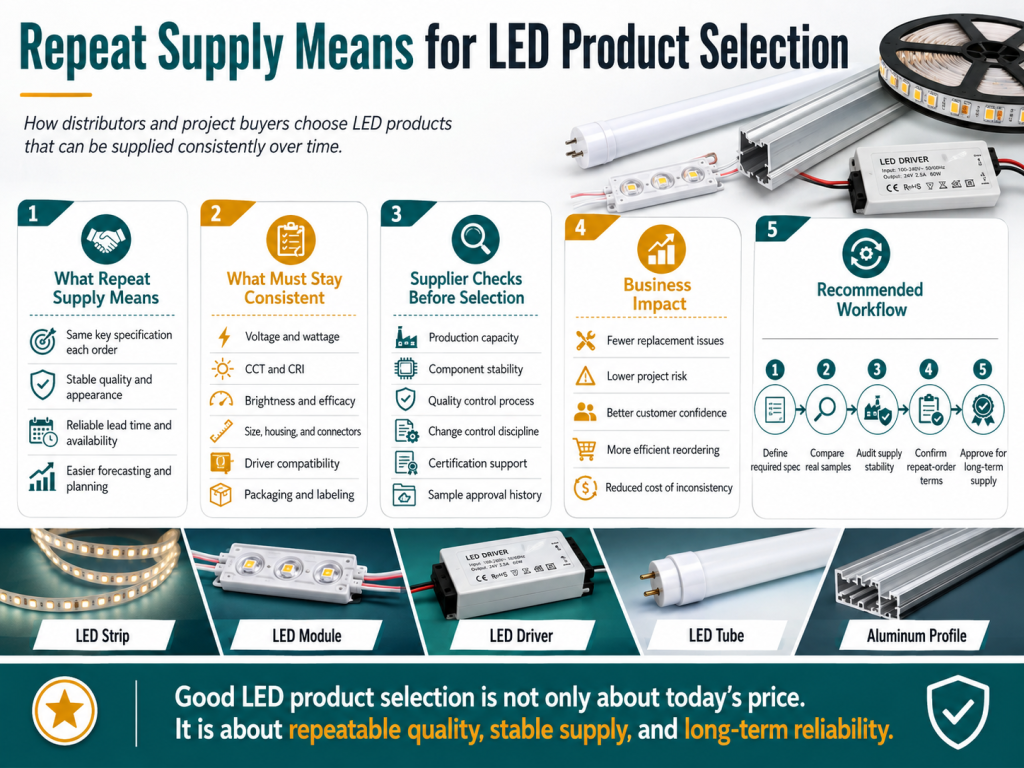
For a distributor, repeat supply affects quotation accuracy, project delivery, warehouse planning, installer confidence, and after-sales cost. If the CCT shifts from one batch to another, customers may notice color mismatch on the same ceiling or retail shelf. If a driver changes without notice, dimming performance may fail on a previously approved control system. If the mounting clip or cable length changes, installers may lose time on site.
Consequently, product selection for repeat supply must combine engineering review and commercial planning. You need to confirm what the product does, where it can be used, how it is tested, how it is packed, and how stable it will remain over time.
When this guide applies
This guide is useful when you are building or refreshing a distributor product range for commercial lighting, retail lighting, industrial lighting, office lighting, cabinet lighting, LED strip lighting, linear lighting, downlights, panels, floodlights, high bays, or outdoor luminaires. It also applies when you plan framework orders, annual supply agreements, private label supply, or replacement products for existing stock.
However, it is less suitable for one-off custom engineering projects where each product is designed for a single installation. In that case, the selection process should focus more on project-specific design approval and less on stock repeatability.
Key Terms and Parameters You Must Define First
Before comparing LED products, the technical language used in specifications and quotations should be clearly defined.
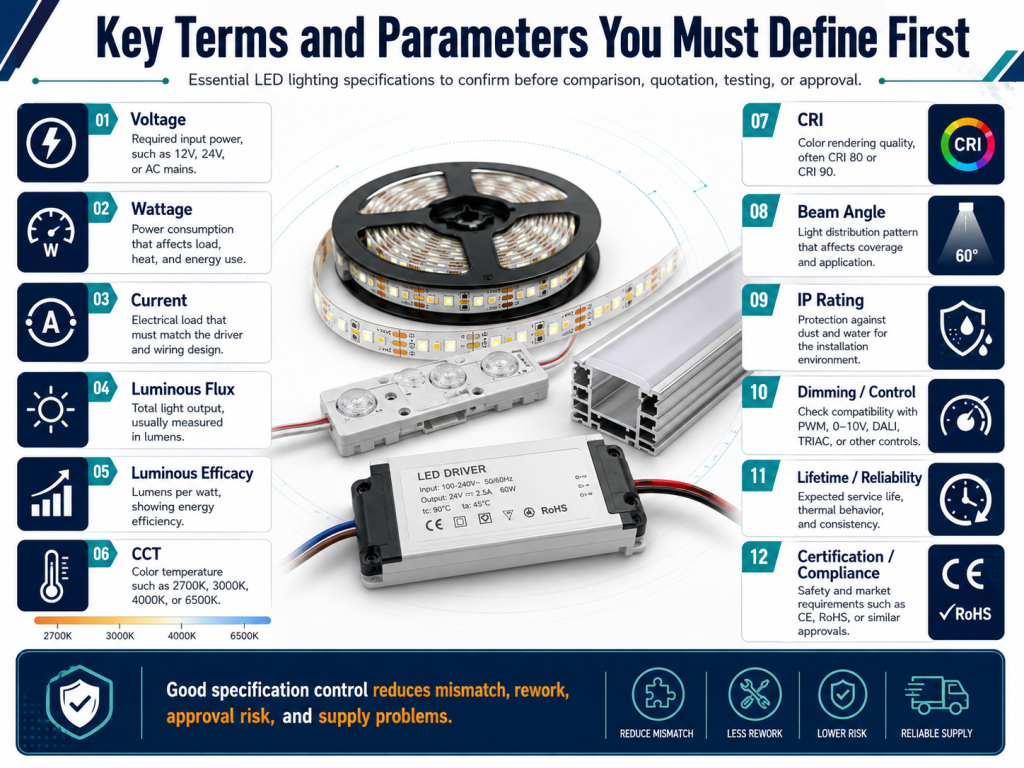
Two products may look similar on paper, but differences in test conditions, tolerances, driver settings, optical design, or measurement methods can produce different results in real use. For repeat supply, these details become especially important because future batches need to match the original approved product.
Voltage
Voltage is the electrical input required by the LED product or driver.
Common examples include 12 V DC, 24 V DC, 120 V AC, and 220–240 V AC.
The specified voltage must match the installation and power system. An incorrect voltage can cause startup problems, unstable operation, product damage, or electrical safety risks.
For repeat orders, the voltage range should remain consistent with the approved product rather than being changed only because another driver is available.
Wattage
Wattage is the amount of electrical power consumed by the LED product.
It may be stated as watts per fixture, watts per module, or watts per metre for linear products.
Wattage affects driver sizing, circuit loading, heat generation, energy consumption, and quotation comparison.
However, wattage should not be used as the only performance indicator. A replacement product with the same wattage may still produce a different lumen output or operating temperature.
Current
Current is the electrical flow required by the LED product or module.
It affects driver loading, cable size, connector rating, voltage drop, and thermal behaviour.
For repeat supply, current should remain within the approved operating range because even a small driver-current change can affect brightness, LED temperature, and long-term reliability.
Luminous Flux
Luminous flux is the total visible light output and is measured in lumens.
It provides a more direct way to compare brightness than wattage alone.
For repeat orders, the supplier should define the acceptable lumen range rather than only provide one typical value. This helps prevent noticeable differences between the original product and future batches.
Luminous Efficacy
Luminous efficacy describes how much light the product produces for each watt of power consumed. It is expressed in lumens per watt, or lm/W.
This value affects energy performance, operating cost, and in some markets or projects, energy-efficiency program eligibility.
However, efficacy should be compared under similar test conditions. A higher lm/W figure is not automatically better if CRI, optical performance, thermal limits, or reliability have changed.
Correlated Color Temperature
CCT describes the apparent warmth or coolness of the light.
Common values include 2700 K, 3000 K, 4000 K, and 5000 K.
Color mismatch is one of the most visible repeat-supply problems. Two batches may both be labelled 4000 K but still look different if the allowed chromaticity range is too wide.
For this reason, the target CCT should be supported by an acceptable tolerance and, where needed, an SDCM requirement.
Color Rendering Index
CRI describes how accurately colors appear under the light.
Typical specifications include Ra 80, Ra 90, or higher.
CRI is especially important in retail, hospitality, displays, offices, and other applications where materials, products, or skin tones need to appear natural.
For repeat supply, the minimum CRI should be fixed. A replacement batch should not use a lower-CRI LED simply because the CCT and wattage remain the same.
Standard Deviation of Color Matching
SDCM indicates the level of color consistency between LED products.
Lower SDCM values generally provide tighter visual consistency.
This matters for projects where many fixtures are installed together or where replacement sections need to match earlier batches.
A product can meet the target CCT while still showing visible color differences if the SDCM control is too loose.
Beam Angle
Beam angle describes how widely the light spreads from the luminaire, lens, or optical system.
It affects fixture spacing, glare, shelf illumination, vertical lighting, and overall visual uniformity.
For repeat supply, a change in lens, diffuser, reflector, or LED position can alter the beam even when wattage and lumen output remain similar.
Therefore, the optical distribution should be treated as part of the approved product specification.
IP Rating
The IP rating defines the level of protection against dust and water.
Common examples include IP20, IP44, IP65, and IP67.
The required rating depends on whether the product is used in a dry indoor area, damp location, wet environment, or outdoor installation.
For repeat orders, the sealing method, housing construction, cable entry, and connectors should remain consistent with the approved IP design.
Driver Compatibility
Driver compatibility means that the LED load, driver output, dimming method, and control system operate correctly together.
The review should include voltage, current, wattage, output range, dimming protocol, protection features, and control compatibility.
An incompatible replacement driver can cause flicker, unstable dimming, buzzing, startup problems, or premature failure even if the rated wattage looks correct.
Define Nominal and Guaranteed Values Separately
One of the most important sourcing details is the difference between a typical value and a guaranteed production limit.
For example, a datasheet may show 1000 lm typical, but actual production may allow a defined variation above or below that value.
The same issue applies to wattage, CCT, CRI, efficacy, and other performance parameters.
For repeat supply, I prefer to define:
- Target value
- Minimum or maximum acceptable value
- Production tolerance
- Test condition
- Measurement method where necessary
A product with a slightly higher nominal specification is not always the better sourcing choice.
For long-term supply, tighter and clearly controlled tolerances are often more valuable than a higher typical number. They help future batches match the approved product in brightness, color, electrical behaviour, and installation performance.
Core Technical Principles for Repeatable LED Supply
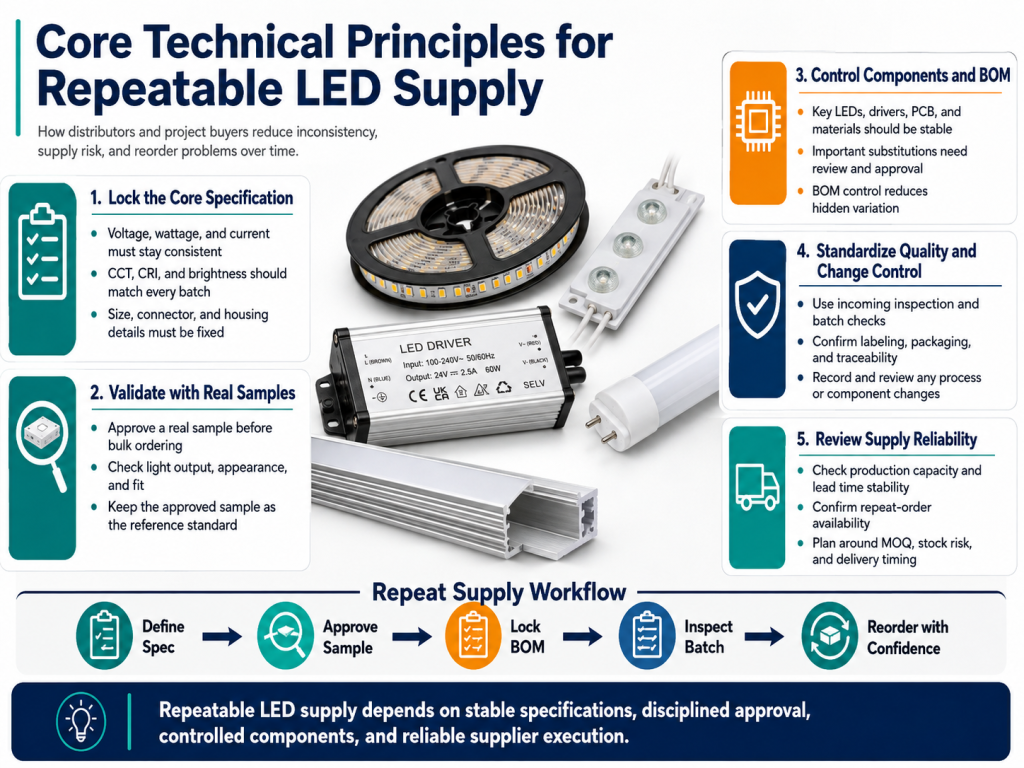
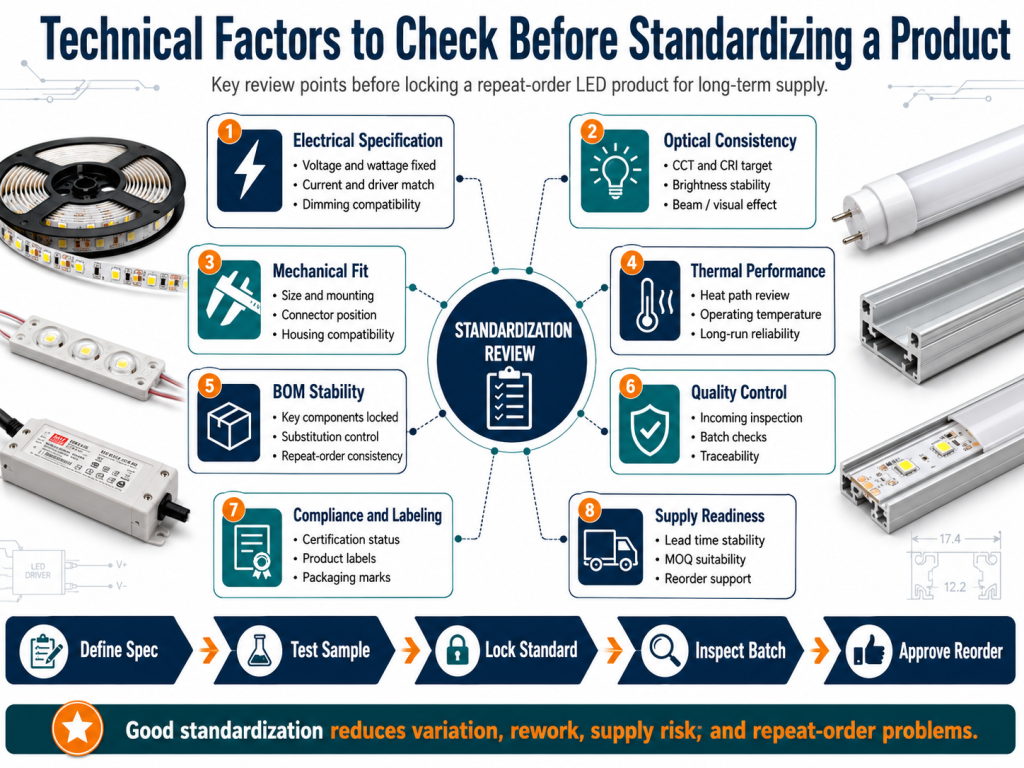
Stable bill of materials
The bill of materials, often called BOM, is the list of components used to make the product. For LED lighting, it may include LED package, PCB, driver, heat sink, lens, diffuser, housing, connector, cable, gasket, screw, label, and packaging. If the BOM changes without control, the product may still look similar but perform differently.
That matters because customers often reorder based on previous installation results. If a stocked LED strip changes chip bin, the CCT may shift. If a panel light changes diffuser material, glare or light transmission may change. If a high bay changes driver brand, power factor, surge protection, or dimming behavior may change.
Thermal management
LED performance depends strongly on temperature. Heat affects lumen maintenance, driver life, color stability, and adhesive performance in LED strips. Thermal management includes heat sink design, PCB thickness, aluminum profile selection, ventilation space, and ambient operating temperature.
For repeat supply, avoid choosing products only from room-temperature sample testing. Ask how the product performs in the intended environment. A warehouse high bay may face high ceiling temperatures. A cabinet LED strip may be installed inside a narrow aluminum channel. An outdoor luminaire may face solar heating before it even turns on.
Electrical compatibility
LED products must match the power supply or driver. Constant voltage products, such as many LED strips, need a compatible voltage supply and correct load calculation. Constant current products need drivers with the correct output current and voltage range. AC luminaires need correct mains voltage, frequency, protection, and local installation practice.
In contrast, a product that works during a bench test may still fail in the field if cable length, dimming protocol, load percentage, or inrush current is not considered. Repeat supply products should have clear driver recommendations and tested dimming options.
Optical and color consistency
Optical consistency includes lumen output, beam angle, glare control, diffuser appearance, and color uniformity. In commercial projects, visible inconsistency can become a service issue even when the product is electrically safe.
For applications such as retail shelves, office ceilings, wardrobe lighting, and hospitality interiors, CCT and SDCM control are critical. A 3000 K product from one batch may not visually match another 3000 K product if LED binning is loose. For repeat supply, define acceptable color tolerance before stock commitment.
Step-by-Step Guide to Choosing LED Products for Repeat Supply
A structured selection process reduces guesswork and keeps commercial, technical, and installation teams aligned. Use the following workflow before adding a product to your repeat supply range.
| Step | Action | Key Checks | Decision Output |
|---|---|---|---|
| 1 | Define target demand. | Application type, customer segment, annual volume, reorder frequency, seasonality, and replacement need. | Confirm whether the product deserves stock planning. |
| 2 | Set technical boundaries. | Voltage, wattage, lumen output, CCT, CRI, IP rating, beam angle, size, mounting method, and operating temperature. | Create a minimum acceptable specification. |
| 3 | Review compliance needs. | UL, ETL, CE, RoHS, DLC, IEC, EMC, local electrical code, or project-specific documentation. | Identify required certification or test evidence. |
| 4 | Request samples and datasheets. | Photometric data, driver details, material information, packaging, accessories, and installation instructions. | Prepare sample testing and comparison. |
| 5 | Test practical performance. | Input power, output voltage, current, temperature, dimming, flicker observation, color consistency, and installation fit. | Approve, reject, or request adjustment. |
| 6 | Verify repeatability. | BOM control, LED binning, driver sourcing, batch labeling, quality inspection, and change notification process. | Confirm if the product is suitable for repeat orders. |
| 7 | Confirm commercial controls. | MOQ, lead time, packing, labeling, spare accessories, warranty process, and reorder part number. | Finalize stock SKU and quotation rules. |
Step 1: Define target demand
Start with demand quality, not only demand volume. A product with steady monthly sales and low complaint risk may be better than a product with high occasional volume but frequent customization. For distributors, repeat supply works best when a product fits multiple projects without constant redesign.
For example, a 24 V LED strip with common CCT options, stable adhesive, matching aluminum profiles, and clear power limits may support many cabinet, retail, and display applications. In contrast, a specialty color-tunable strip with unique controller requirements may be profitable but harder to stock broadly.
Step 2: Set minimum specification boundaries
Create a specification floor before comparing prices. Define what must not change. This may include wattage per meter, lumen output range, CRI minimum, SDCM limit, PCB width, cut length, IP rating, driver type, connector style, and packaging format.
Without this boundary, two quotes may appear comparable while using different LED density, copper thickness, driver quality, or optical materials. Consequently, the lowest price may create the highest service cost.
Step 3: Test samples under realistic conditions
Bench tests are useful, but they should reflect field conditions. Measure input voltage under load, current draw, power consumption, visible flicker, driver temperature, LED strip surface temperature, and dimming response. For outdoor products, check sealing structure, cable entry, gasket design, and drainage risk.
When possible, compare sample measurements with datasheet values. Large differences do not always mean the product is unusable, but they require explanation before repeat ordering.
How Product Choice Affects Quoting, Installation, and Maintenance
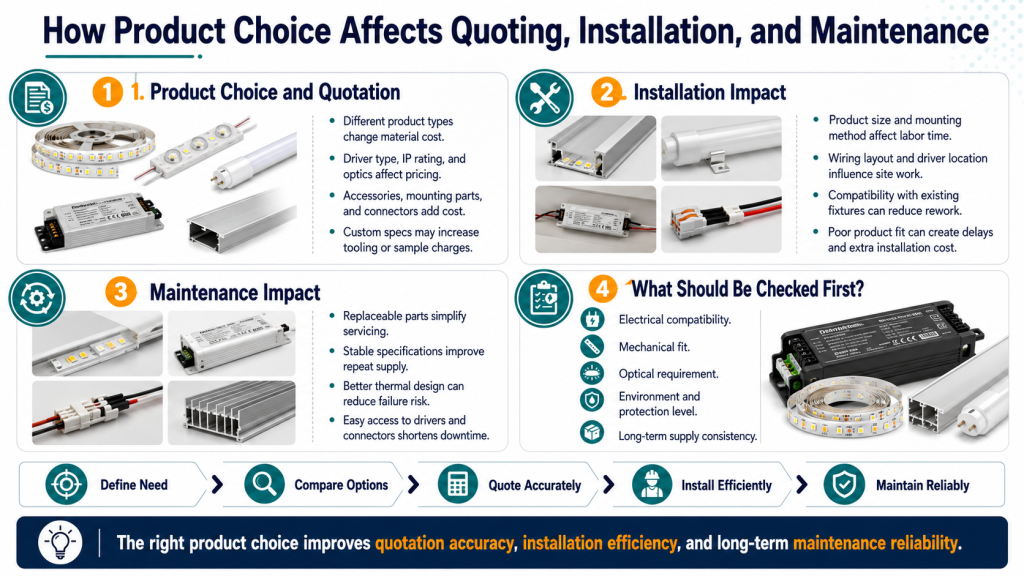
Quotation accuracy
Repeat supply products should be easy to quote with limited ambiguity. The quotation should clearly state model number, input voltage, wattage, CCT, CRI, beam angle, IP rating, housing color, length or size, driver option, dimming method, accessories, packing, and certification requirement.
If these items are unclear, customers may compare unequal products. For example, two LED linear fixtures may have the same length and wattage, but one includes a dimmable driver, suspension kit, and high CRI LEDs while the other does not. The first product may be more expensive but more complete for the project.
Installation efficiency
Installation efficiency depends on product fit and accessory readiness. Installers need consistent dimensions, predictable mounting holes, correct connectors, adequate cable length, suitable drivers, and clear wiring instructions. A low-cost product can become expensive if it requires field modification.
For LED strips, installation impact includes cut interval, solder pad size, connector compatibility, profile fit, adhesive quality, and voltage drop over distance. For outdoor luminaires, it includes bracket adjustment, cable gland quality, surge protection, sealing, and drainage orientation.
Maintenance risk
Maintenance cost is often higher than product cost. Replacement labor, access equipment, customer disruption, and reputation damage can exceed the saving from a cheaper SKU. Therefore, repeat supply selection should consider failure mode, spare parts, replacement compatibility, and batch traceability.
If a distributor stocks a panel light for three years, replacement units should visually match previous batches as closely as possible. If the model is updated, the supplier should provide change notice and replacement guidance.
Realistic Product Selection Scenarios
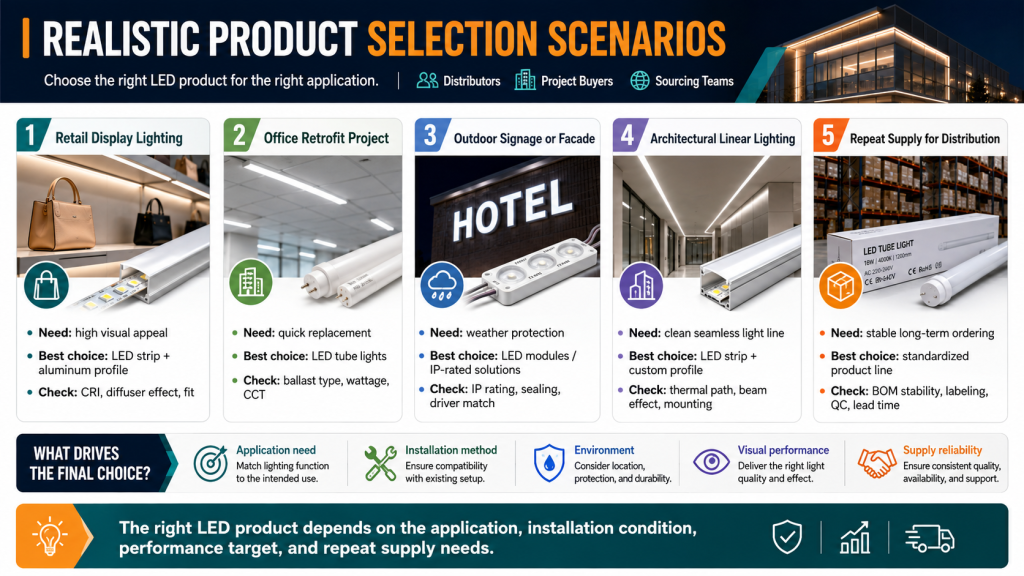
Scenario 1: LED strip for cabinet and retail shelf lighting
A distributor wants one LED strip family for cabinet makers and retail installers. The first decision is voltage. A 24 V strip usually supports longer runs with lower current than a 12 V strip, which can reduce voltage drop. However, driver availability and existing customer habits also matter.
Key checks include watts per meter, cut length, lumen output, CRI, CCT, SDCM, PCB width, copper thickness, adhesive type, IP20 or IP65 requirement, compatible aluminum profile, and maximum run length. If the strip will be used in display areas, Ra 90 and tighter SDCM may be more important than maximum lumen output.
Scenario 2: LED panel light for office projects
For office supply, repeatability depends on size, driver quality, glare control, CCT, CRI, flicker performance, and packaging strength. A small change in diffuser or LED layout may alter visual comfort. A driver change may affect 0 to 10 V dimming or emergency backup compatibility.
When selecting panels, confirm grid ceiling compatibility, suspension options, surface-mount kits, driver output, power factor, total harmonic distortion if required, and local compliance needs. For repeat supply, keep spare drivers and accessories aligned with the stocked model.
Scenario 3: Outdoor floodlight for commercial sites
Outdoor floodlights require more attention to environmental risk. Check IP rating, housing material, corrosion resistance, surge protection, cable gland design, bracket strength, IK rating where impact risk exists, and operating temperature. A product that performs well indoors may fail quickly in rain, dust, salt air, or high heat.
For outdoor repeat supply, packaging must also protect lenses and brackets during transport. Field failure may result from water ingress, poor grounding, insufficient surge protection, or incorrect installation angle.
Common Misunderstandings in Repeat LED Supply
Misunderstanding 1: The same wattage means the same product. Wattage only shows power consumption. It does not define lumen output, efficacy, beam angle, color quality, driver reliability, or thermal design. Two 30 W fixtures can perform very differently.
Misunderstanding 2: A sample approval guarantees future batch quality. A sample confirms only that one unit or one small batch is acceptable. Repeat supply requires BOM control, production inspection, batch labeling, and clear change communication.
Misunderstanding 3: Higher lumen output is always better. More light may increase glare, heat, power consumption, and dimming load. In retail, office, and cabinet applications, uniformity and color quality may matter more than maximum brightness.
Misunderstanding 4: Certification documents always cover every version. Certification may apply only to specific models, ratings, components, or factories. If the driver, housing, voltage, or construction changes, documentation must be reviewed again.
Misunderstanding 5: Low unit price means better margin. Margin can disappear through returns, warranty claims, slow-moving stock, repacking work, inconsistent accessories, and installation complaints. Repeat supply decisions should include total cost of ownership.
Pro Tip / Field Experience
Before approving a repeat supply SKU, test two samples from different production dates if possible. Compare CCT, input power, driver label, connector type, housing finish, accessories, and packaging. Many repeat supply problems appear only after the second batch. A simple batch comparison can reveal uncontrolled component changes before they reach your warehouse or your customer’s job site.
What This Means in Practice
In practice, distributors should treat repeat supply products as managed technical assets, not only catalog items. Each stocked LED product should have a controlled specification sheet, approved accessory list, replacement rule, packaging standard, and quality evidence file.
This approach improves project delivery because sales teams quote consistent configurations, installers receive predictable products, and purchasing teams reorder against clear specifications. It also supports cost control because warranty risk, urgent replacements, and dead stock are reduced.
A practical repeat supply file may include the product datasheet, technical drawing, photometric report, driver specification, installation guide, packaging photo, label artwork, certification document if required, approved sample record, and quotation template. For LED strip products, it should also include maximum run length, recommended power supply margin, voltage drop notes, and compatible profiles or connectors.
However, the file should stay usable. If it becomes too complex, teams may ignore it. Focus on the parameters that affect project success, installation fit, compliance, and customer expectations.
Risk-Control Checklist for Final Approval
Before standardizing an LED product for repeat supply, review both technical and commercial risks. The checklist below helps identify gaps that may cause problems after the first order.
| Risk Area | Question to Ask | Acceptable Control |
|---|---|---|
| Specification drift | Can the supplier change LED chips, drivers, optics, or packaging without notice? | Written change notification process and approved BOM control. |
| Color mismatch | Will repeat orders match previous CCT and SDCM expectations? | Defined binning range, batch records, and sample comparison. |
| Driver failure | Is the driver suitable for load, dimming, temperature, and input voltage? | Driver datasheet, load calculation, dimming test, and thermal review. |
| Installation delay | Are mounting parts, connectors, profiles, and cable lengths consistent? | Accessory list, technical drawing, and packing inspection. |
| Compliance gap | Does the documentation match the exact model and target market? | Model-matched certificates, reports, or declarations where required. |
| Warehouse damage | Can packaging survive normal transport, storage, and handling? | Packaging test, carton marking, pallet plan, and spare accessory control. |
| After-sales uncertainty | Can failures be traced to batch, date, and product configuration? | Batch code, label control, warranty process, and inspection record. |
If several risks remain unresolved, delay the stock decision or limit the first order volume. A controlled trial order is often better than a large initial purchase when the application, supplier, or specification is new.
Documentation and Communication with Suppliers
Clear supplier communication protects repeat supply quality. Do not rely only on model names or catalog images. Send a written specification requirement and ask the supplier to confirm each point. This includes electrical rating, optical performance, color tolerance, materials, driver model, accessories, labels, packaging, and compliance documentation.
For private label or distributor-branded products, confirm label content, carton markings, user manuals, language requirements, barcode format, and spare part identification. These details may not affect lighting performance directly, but they affect receiving, inventory control, installation support, and customer service.
You can contact a technical team to confirm project details when the application involves dimming systems, outdoor exposure, unusual operating temperature, long cable runs, strict color consistency, or market-specific certification. Early confirmation usually prevents expensive changes after purchase orders are released.