

Two integrated lights can look identical and respond to completely different controls. One may work with a specified wall dimmer, while another needs a separate signal or software system. Choose the control method with the light, before a fitting reaches the order schedule.
What makes an integrated LED light dimmable?
Some integrated LED lights are dimmable and others are not. The driver and the complete product version determine how brightness can be changed. Building the LEDs into the fitting does not by itself provide a dimming function.
For a finished luminaire, identify the version being offered and its control information. For an OEM assembly, match the light engine, driver and intended control as a system. A dimming feature is useful when it operates through the method your project will use.
This matters early in a fit-out. If the brief requires keeping a wall control, a product whose brightness changes only through a different software route may create another equipment decision. Establish that requirement before comparing small differences in appearance or price.
The integrated LED lighting explanation covers the choice between a built-in source and a replaceable lamp. The question here is how the chosen integrated light will operate at different brightness settings.
Separate the supply, LED output and dimming command
The supply powers the equipment
The input rating identifies the supply for which the product version is intended. The driver’s output operates the LED light engine. Those two sides of the driver have different requirements, so an input-voltage match cannot answer the light-engine question.
For example, an OEM buyer comparing drivers needs the light engine’s required output as well as the driver’s input rating. A larger power rating does not resolve an output-type or operating-range mismatch. Treat an internal driver replacement in an installed mains fitting as qualified service work.
The command asks for a brightness level
The dimming command tells the electronics what light level to produce. Depending on the product, it can arrive through the controlled supply waveform, a separate analog signal or a digital or software system.
You can describe this requirement in ordinary project language: adjust the room from the existing wall control, select a scene through the building system, or operate it through a named software system. These requests can all involve dimming, but they produce different product shortlists.
A smart control still needs a method the connected light understands. Adding software to the command source cannot make a non-matching driver accept that command.

Phase-cut, 0–10V, digital or software control?
Wall-control and analog routes
With a phase-cut product, a compatible dimmer changes the supply waveform seen by the operating electronics. The selected product and dimmer combination matters. A general “LED dimmer” label does not identify that combination or its permitted load conditions.
In a 0–10V arrangement, the driver receives an analog brightness request through its specified control interface in addition to its operating supply. The buyer needs to know the intended control arrangement and its response, including what happens at the minimum setting.
For either route, identify the quoted version. A family may contain a phase-cut variant and another variant for a separate control signal. Whether the method can be selected in the product, or requires a different driver order, comes from that product’s information.
Digital and software routes
A digital-control project needs equipment for the specified protocol. A DALI requirement, for example, belongs on the product schedule alongside the light itself. The term “dimmable” alone does not identify a DALI version.
Software control is another valid way to change brightness. Select the named system and functions the product provides. A software-controlled fitting may be appropriate when that is the project’s chosen route, while a requirement to retain a conventional wall-control method can lead elsewhere.
| Project requirement | Product information to compare | Practical selection question |
|---|---|---|
| Keep the phase-cut wall-control method | Exact phase-cut version and compatible-dimmer information | Does this offer work through the retained method? |
| Use a 0–10V control | Specified analog interface and response | What light level and off behaviour does the arrangement provide? |
| Use a digital system | Required protocol and system configuration | Is the quoted version the one intended for that system? |
| Use software control | Named product system and available functions | Will the project’s users operate it through that route? |
Match the driver output to the light engine
Output type comes before a power comparison
For product integration, begin with the light engine’s electrical requirements. A constant-current light engine and a constant-voltage load need different operating arrangements. Compare those requirements before selecting a driver by wattage or dimming label.
The control interface answers how brightness is requested. The output specification answers how the light engine is operated. Both need to fit the assembly.
Read the working range of the selected version
For a constant-current arrangement, compare the chosen operating current and the driver’s applicable output-voltage window with the light engine. For a constant-voltage arrangement, compare the specified output voltage and load range. Use the detailed version record rather than the largest power figure in a family brochure.
A driver family can contain different outputs, controls and body forms. This is useful for finding candidates, but the assembly decision needs the version you intend to purchase. Once that version is identified, low-light behaviour can be evaluated for the same driver and LED load.
For an existing complete fixture, its manufacturer-defined service route also matters. A replacement driver needs to meet the assembly’s service requirements as well as the electrical fields. A similar connector or enclosure is insufficient to establish that replacement.

Minimum light, off and startup are different requirements
Define the lowest useful scene
A listed minimum dimming level describes the product or configuration under its stated conditions. Room brightness also depends on distribution, surfaces and other light sources. A percentage on a specification cannot, by itself, describe how the room will look.
Start with the task. A restaurant’s low scene may need comfortable faces and a visible route between tables. A presentation room may need light for notes with less light near the screen. Those descriptions tell a buyer what to evaluate when comparing the proposed system.
Check the transition into and out of that scene
Reaching a low level after dimming down from full output and starting directly into a low scene are separate behaviours to establish. Include both where they affect normal use. Also describe what should happen when the user selects off.
Lutron’s published 0–10V control guidance distinguishes drivers whose minimum is off from those that remain at their minimum light level. Use the selected product’s current response information for the order. A separate off function may be relevant to the intended arrangement.
Keep these behaviours distinct in a specification. A low output, a dark room on an off command and a repeatable startup are three real requirements, not interchangeable meanings of “deep dimming.” None establishes flicker performance without the relevant evidence.
What two manufacturer records tell a buyer
Start with the required control route
Assume a selection brief calls for a 120 V light using phase-cut control. The existing control method is to stay, and the listed 5% dimming level is acceptable for an initial document screen. These are example requirements; the actual dimmer combination and room scene will still need evaluation.
The HALO SMD6 specification PS51879725, dated May 20, 2025, lists 120 V input and dimming to 5% through phase-cut LE/TE operation with compatible dimmers. That record gives the buyer a candidate to keep on the shortlist for this paper brief.
Separate a plausible candidate from a different route
The HALO Home MicroEdge HLB4/HLB6 instructions, document IL518123ML, state software dimming only. For the same retained phase-cut brief, that named family follows a different control route.
| Named record | Relevant published fields | Result for the example brief |
|---|---|---|
| HALO SMD6, PS51879725 | 120 V; phase-cut LE/TE; listed 5% level with compatible dimmers | Keep as a candidate for detailed dimmer and scene evaluation |
| HALO Home HLB4/HLB6, IL518123ML | Software dimming only | Exclude while the phase-cut method remains a requirement |
For this brief, continue with the SMD6 phase-cut candidate. Evaluate its exact dimmer combination, operating limits and performance in the required room scene before choosing a complete configuration.
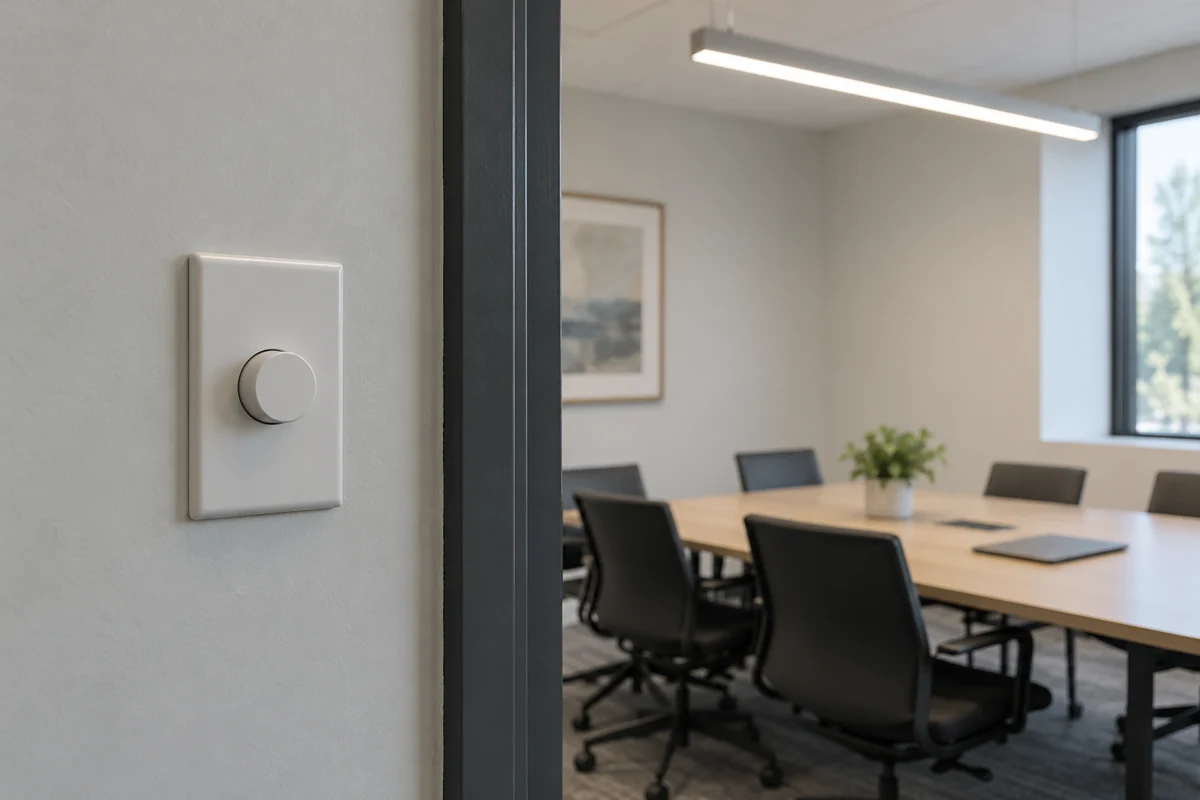
Turn the room task into a usable evaluation
Compare the scene people will use
Describe the low and high tasks together. The low setting might support conversation; the brighter one might support cleaning or room setup. An evaluation can then ask whether the proposed configuration serves both, including the transition between them.
Keep the equipment in the evaluation identifiable. A convincing demonstration with a different driver or control answers a different question from the behaviour of the quoted version. This is particularly relevant when several control variants share the same visible body.
Include the group where lights operate together
For a group of fittings, look at the expected response across positions as well as one light in isolation. Include the intended mix of sources: a decorative fitting and a ceiling light can contribute differently to the same scene.
Applicable quantity and load limits come from the selected equipment. Once those conditions are established, assess whether the group gives users a consistent, usable result. Matching numerical settings alone will not describe the balance of different light distributions in the room.
Keep the chosen version consistent in an order
Identify the light and its control option
Carry the selected fixture or light-engine reference, driver variant and required method into the order. A visually similar on/off version should not enter as an equivalent substitution when the room depends on dimming.
For repeat production or a batch fit-out, evaluate a proposed electronics change against the same output and room requirements. This keeps the order tied to the behaviour that justified the original choice.
Define the replacement function
Later service may involve a complete fitting, a named module or another manufacturer-defined assembly. The replacement needs to preserve the required control method as well as physical fit. Establish the service item for the chosen product instead of assuming every internal part is separately replaceable.

A shortlist you can act on
Put the required functions beside the exact fields that answer them. This exposes a missing control option early and keeps the final decision focused on the room and product you are buying.
| Decision | Evidence needed for the chosen candidate |
|---|---|
| Can it operate on the project supply? | Input rating of the quoted version |
| Can users dim it through the intended method? | Interface and relevant control-combination information |
| Does its output suit the light engine? | Applicable driver and LED-load specifications |
| Will the room scenes work as intended? | Low-level, off and startup behaviour for that configuration |
For an OEM product, the VST integrated-lighting page is a starting point for discussing the light engine and mechanical envelope. Include the intended control method and normal operating tasks in that same brief, so electronics selection and product design develop together.
