
Custom LED Strip Lights for Your Installation
VST develops custom LED strip lights for the run length, PCB width, light appearance and connection in your installation. An existing strip platform may…
View detailsSunshade Frame Lighting Integration
VST develops awning LED lighting around the profile, folding path and protected electrical feed. As your awning LED lighting supplier, we evaluate where the light can sit without becoming a loose cable or an obstacle to movement. An inquiry starts the construction and kit-scope discussion for the actual sunshade system.
An awning-frame photo and approximate lit length can start the discussion, even if the electrical details are not settled.

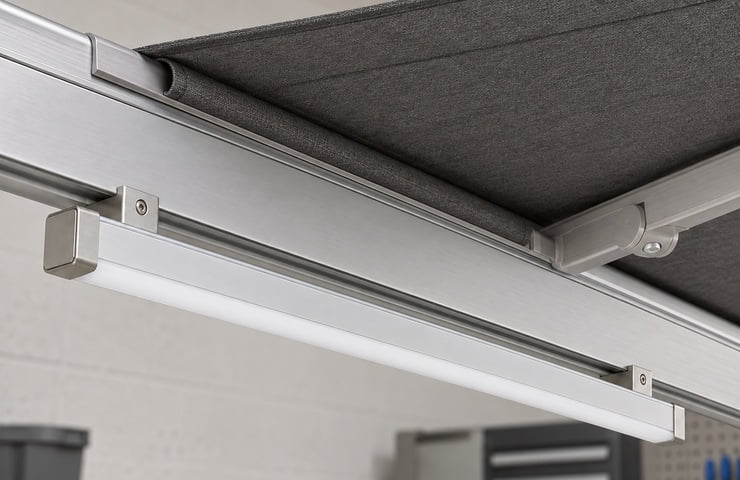
Awning LED lights can illuminate seating or circulation below a canopy. The available frame section and movement determine the mounting route. A fixed installation and a retractable system need different treatment even when the desired appearance is similar.


Purchasing risk: Repeated movement may pinch insulation or pull a connector.
Confirm: Full open and closed frame positions
VST solution direction: Keep the feed on a fixed route where possible; moving sections need a separately evaluated cable path.
Purchasing risk: Water can collect around connections even under a canopy.
VST solution direction: Position entries and retention clear of the host drainage features and evaluate the selected enclosure.
Purchasing risk: A minor electrical repair could require dismantling the awning.
VST solution direction: Provide a reachable service point behind a cover rather than burying the connection in a closed profile.
VST develops profile fit, cable retention and closure construction as your awning LED lighting manufacturer. A suitable existing section may be adapted; a new mating geometry needs development around the actual host frame.
A rigid bar or an awning LED light strip within a supporting profile can follow the fixed rail. Using a suitable section limits development work; a new mating profile or bracket may need dedicated tooling.
End or rear entry can be considered where the frame provides a protected route. Avoiding an exposed lead must not make the connector unreachable; the service cover and cable path need to work together.
Gaskets, end closures and cable glands are selected around exposure and maintenance. No IP rating follows automatically from a silicone coating or sheltered location; the complete chosen assembly requires the appropriate evaluation.
Buyer input: Expected water exposure and cleaning method
White tone, diffusion and a compatible control arrangement can be discussed for LED awning lighting. Diffusion changes optical efficiency and source visibility. Integration with an existing motor remote requires an independently compatible receiver or interface.
Buyer input: Existing control system, where applicable
Start with how often the awning moves and where its cable can travel safely. The simpler route is generally worth evaluating first; moving-arm integration needs evidence from the actual mechanism.
| Decision factor | Fixed rear rail | Moving arm integration | Buyer guidance |
|---|---|---|---|
| Cable movement | Feed can remain on the stationary structure | Lead must accommodate the full mechanical travel | Prefer a stationary feed when it serves the required area. |
| Light position | Illumination begins nearer the building side | Source follows the extended arm position | Choose the position around the surface you need to illuminate. |
| Retraction space | Check fabric and housing clearance at closure | Check arm joints, cable bends and closing envelope | Evaluate both open and fully closed states before release. |
| Service approach | Reachable cover can remain at the fixed end | Access may depend on a safe deployed position | Locate service parts where the system can be isolated and reached. |
Our awning LED lighting factory works from the host profile and its mechanical travel. VST prepares a fit sample, retains the cable inside its route and records the closures. The resulting assembly definition identifies the lighting parts separately from the awning structure.
VST work: Structural engineering seats the light profile against a representative awning rail and checks the mounting surface.
Stage output: Section fit sample identifying mating faces and mounting access.

VST work: The assembly team fits the end closure and cable gland with a continuous gasket at the intended joint.
Stage output: Entry construction showing cable retention and the accessible closure parts.

VST work: The team moves the host mock-up through its intended positions while observing clearance around retained wiring.
Stage output: Cable-route record identifying fixed points and any moving interfaces.

VST work: Production planning groups the selected profile, closures and electrical accessories with instructions for the chosen frame.
Stage output: Lighting kit list separating supplied parts from the host structure.

VST evaluates frame clearance and cable movement as your awning LED lighting supplier, alongside optical and thermal checks. Gasket inspection identifies assembly faults; it does not replace the testing required to support an ingress-protection rating.
Purpose: Avoid interference that appears only when the host is fully closed.
Method: Install the unpowered profile on the host mock-up and inspect clearances in open and closed positions.
Acceptance criteria: Secure mounting with no contact that damages fabric or blocks travel.
Evidence: A project fit record can document the selected mounting position.

Purpose: Identify abrasion, pinching or tension at moving interfaces.
Method: Observe the retained harness through the relevant mechanism travel with power isolated and service covers accessible.
Acceptance criteria: No trapped insulation, connector loading or uncontrolled cable loop.
Evidence: The method and travel range depend on the actual awning mechanism.

Purpose: Check whether the specified protective parts are assembled correctly.
Method: Inspect the unpowered end closure, continuous gasket seating and cable gland compression against the selected build.
Acceptance criteria: No displaced seal or unintended opening at the defined joints.
Evidence: Visual inspection alone does not establish an ingress-protection rating.

Purpose: Assess the diffuser and light engine together before setting output values.
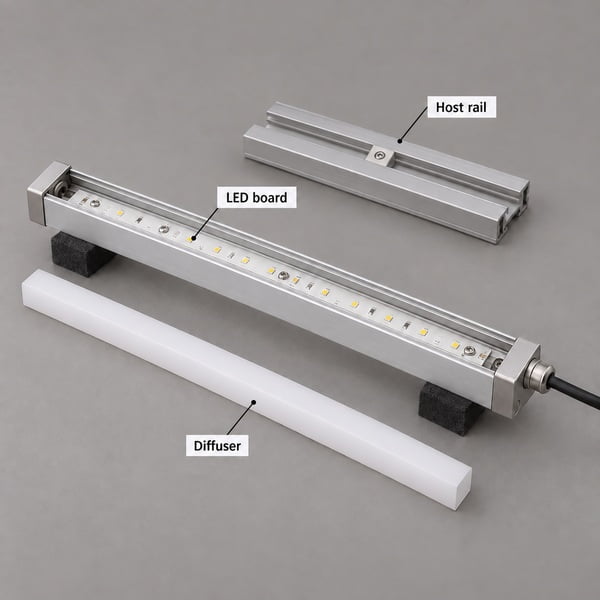
Method: Place a suitably sized assembly on the internal sphere support, route its lead through the feed-through and close the chamber for measurement.
Acceptance criteria: Color and luminous output follow the selected specification.
Evidence: Measurement records apply only to the tested build and conditions.

Purpose: Check heating where the light profile contacts the host rail.
Method: Operate the mounted bar and observe accessible housing surfaces directly after stabilization, accounting for material emissivity.
Acceptance criteria: Housing and component temperatures meet the agreed installation limits.
Evidence: A valid record identifies ambient conditions and the mounting section.
Documents the developed profile interface, retained cable path and accessible closure arrangement for the lighting kit.
Applicable evidence depends on the complete assembly, intended exposure and specifically commissioned tests.
For a single awning LED lighting model, the usual starting MOQ is 500 units with light customization; extensive customization normally starts at 1,000 units. Modifying a suitable profile and leads differs from developing a new mating section or electrical design. The quotation sets the final minimum for the chosen scope.
VST supports sample builds with processing fees and, where needed, charges for new tooling or molds. You can discuss recovering eligible sample costs through a return payment or credit on a later production order. The sunshade project quotation or order terms specify the amount and the applicable settlement method.
Samples for light customization generally need 15-25 working days; bulk production needs 20-30. For extensive customization, sample development is normally 30-50 working days and production 25-35. Timing begins when required technical details are settled and the relevant fees, deposit and other order conditions have been met. Preparing key materials against stable demand can shorten later lead times.
A new rail section, closure mold or dedicated assembly fixture may create tooling or NRE charges. For an eligible expense, VST can apply a credit to the payment due on a subsequent production order. Commercial terms identify the qualifying order, credit amount and method; tooling ownership and unconditional recovery are not implied.
VST coordinates profile, gasket and connector continuity for awning LED lighting supply. With stable demand, agreed key materials can be prepared or reserved against a forecast to support steadier repeat orders. The commitment concerns material availability and scheduling, not guaranteed inventory of completed awning light kits.
Profiles and closure parts can be packed to protect mating surfaces and keep electrical variants identifiable. VST offers customized packaging with barcodes, carton marks and labels, plus your brand artwork. Instruction sheets and user manuals describe the lighting assembly. Shipment coordination is available; freight cost and transit details depend on the actual shipment.
Compare custom LED strip lights with rigid light bars for the fixed sections of your sunshade system. Each provides a different starting construction for profile fit and service access.

VST develops custom LED strip lights for the run length, PCB width, light appearance and connection in your installation. An existing strip platform may…
View details
Custom light bars are rigid, low-profile LED assemblies for display shelves, furniture cavities and equipment enclosures. VST sets the bar length, diffuser, mounting ears,…
View detailsAn awning LED light kit needs to suit the complete sunshade system, including parts that VST may not supply. The remaining questions concern remote controls, installation boundaries and what happens when a frame version changes. Use them to define a workable quotation. If your mechanism or site exposure creates another constraint, discuss it before selecting the lighting construction.
Only if the selected lighting receiver and driver support the existing control system. A motor remote does not automatically operate an LED load. Identify the system before choosing the electrical version. VST evaluates the lighting interface, but compatibility with a named proprietary protocol needs its own supporting information.
The quotation needs an itemized list because kit names do not establish the same contents across projects.
| Part group | Boundary to define |
|---|---|
| Light assembly | Strip, supporting profile, diffuser and closures as specified. |
| Electrical parts | Driver, receiver and harness included or separately supplied. |
| Awning system | Frame, fabric and motor outside the lighting scope unless stated. |
Possibly, if the frame provides a suitable fixing surface, protected feed and service access without interfering with movement. An existing installation needs its own fit evaluation; an awning LED lighting assembly designed for a new frame is not automatically a retrofit accessory. Host-system restrictions also need to be respected.
No. Wind-driven water, condensation and cleaning can still affect sheltered parts. The relevant evaluation depends on exposure and the final assembly. A gasket inspection can identify assembly faults, but it cannot replace the testing needed to support a specified protection rating or suitability claim.
Some components may carry over, but new mating faces, drainage or closure clearances can change fit and cable access. Compare the revised host section before reusing the lighting pack. Recording those changes prevents a physically similar replacement from being treated as interchangeable when its mounting interface has changed.