
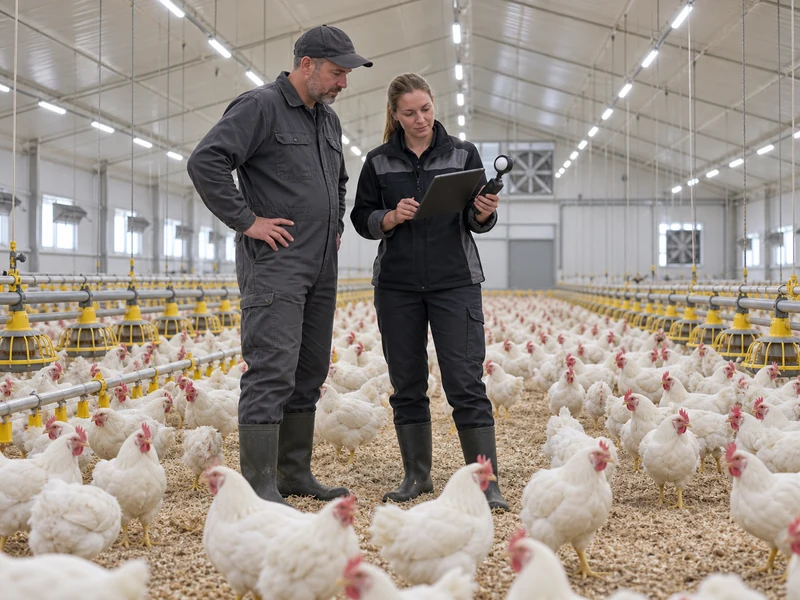
LED lighting for poultry can lower lighting energy use, provide precise dimming and scheduling, improve light distribution, and give producers more control over spectrum when the system matches the flock and barn. Picture a grower entering a long house before dawn: lamps near the controller look bright, distant rows look dull, birds cluster in uneven zones, and an old dimmer makes new lamps flicker. A poultry-rated LED system addresses that problem through coordinated fixtures, drivers, controls, layout, and commissioning rather than a bulb-only swap.
The benefits are practical, but they are never automatic. You need to define bird type, age, production goal, daily light period, target intensity, spectrum, cleaning method, electrical supply, mounting height, and local welfare rules before selecting hardware. That approach turns lighting into a controlled farm input instead of an uncertain maintenance expense.
1. What Are the Main Benefits of LED Lighting for Poultry?
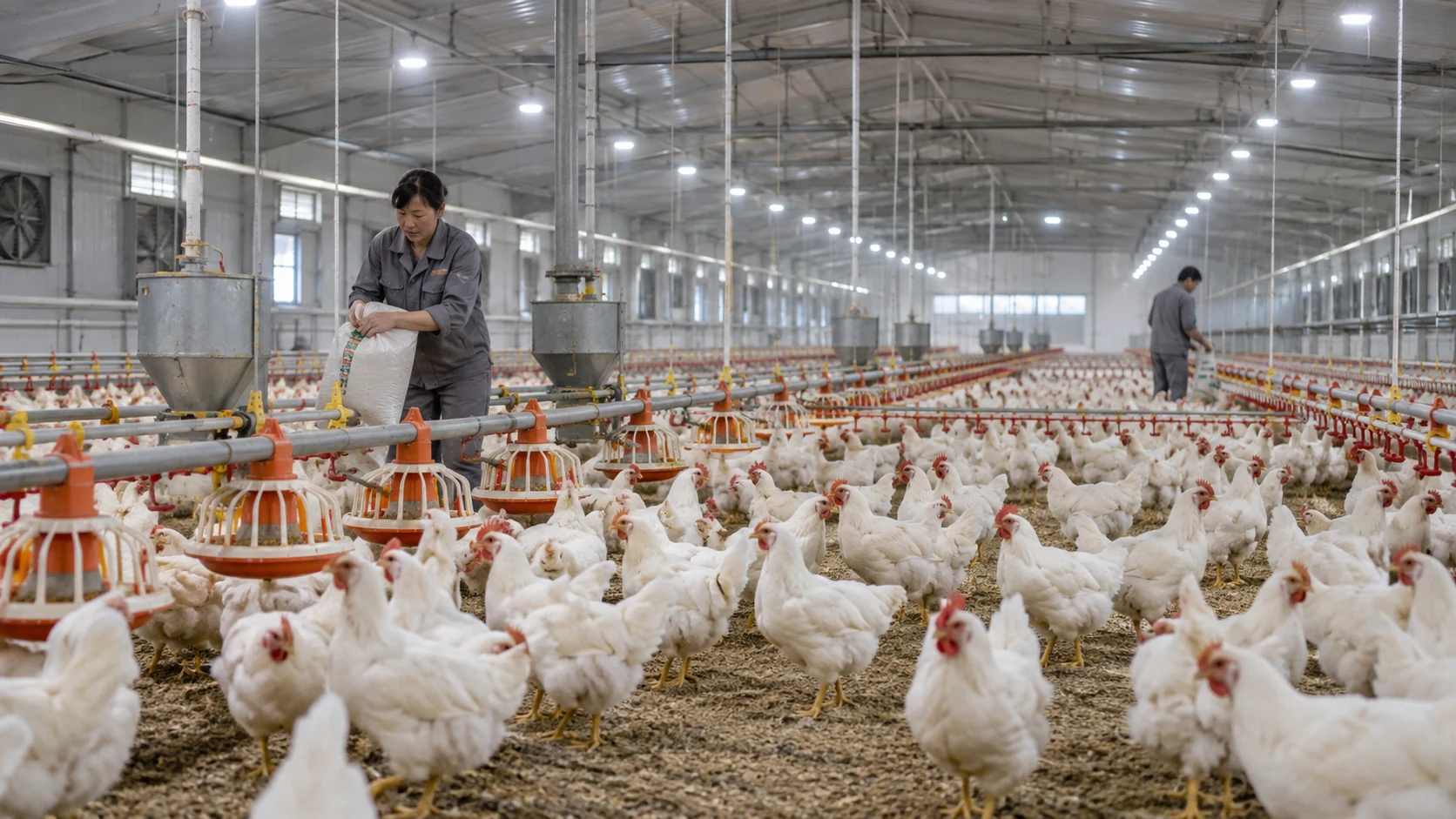
LED lighting for poultry gives you tighter control over energy use, light level, daily schedules, and distribution than many legacy systems. It can also reduce lamp replacement work because a suitable LED fixture has no fragile filament and produces less waste heat than an incandescent lamp. Results still depend on correct product selection, installation, and flock management.
Which operating problems can LED systems address?
Start with the daily problems. A properly designed system lets you adjust light without sending staff through a long barn to change lamps or improvise local fixes. It can address:
- High electricity use from older light sources
- Uneven brightness between feed, water, wall, and floor zones
- Limited control over daily light period and gradual light changes
- Frequent lamp replacement in hard-to-reach locations
Where should a buyer set realistic expectations?
Keep the promise tied to the specification. LED systems do not guarantee better growth, egg output, feed conversion, or welfare by themselves because flock strain, age, housing, nutrition, temperature, and management all affect the result. Your procurement team should treat lighting as one controllable input and confirm:
- The production program and welfare requirements
- The lamp, driver, and dimmer compatibility
- The mounting layout and bird-level measurements
- The environmental rating and cleaning method
| Buyer goal | LED contribution | Approval evidence |
|---|---|---|
| Lower operating load | Efficient source and scheduled output | Wattage and control plan |
| Better control | Dimming, timing, and spectrum options | Demonstrated operating range |
| Lower maintenance | Longer service potential | Rated life, warranty, and field access |
Key Takeaway: You gain the most when energy, biology, controls, and barn conditions are specified as one system. Use this table to turn broad benefits into evidence you can request from a supplier.
2. How Does LED Lighting for Poultry Affect Bird Perception?
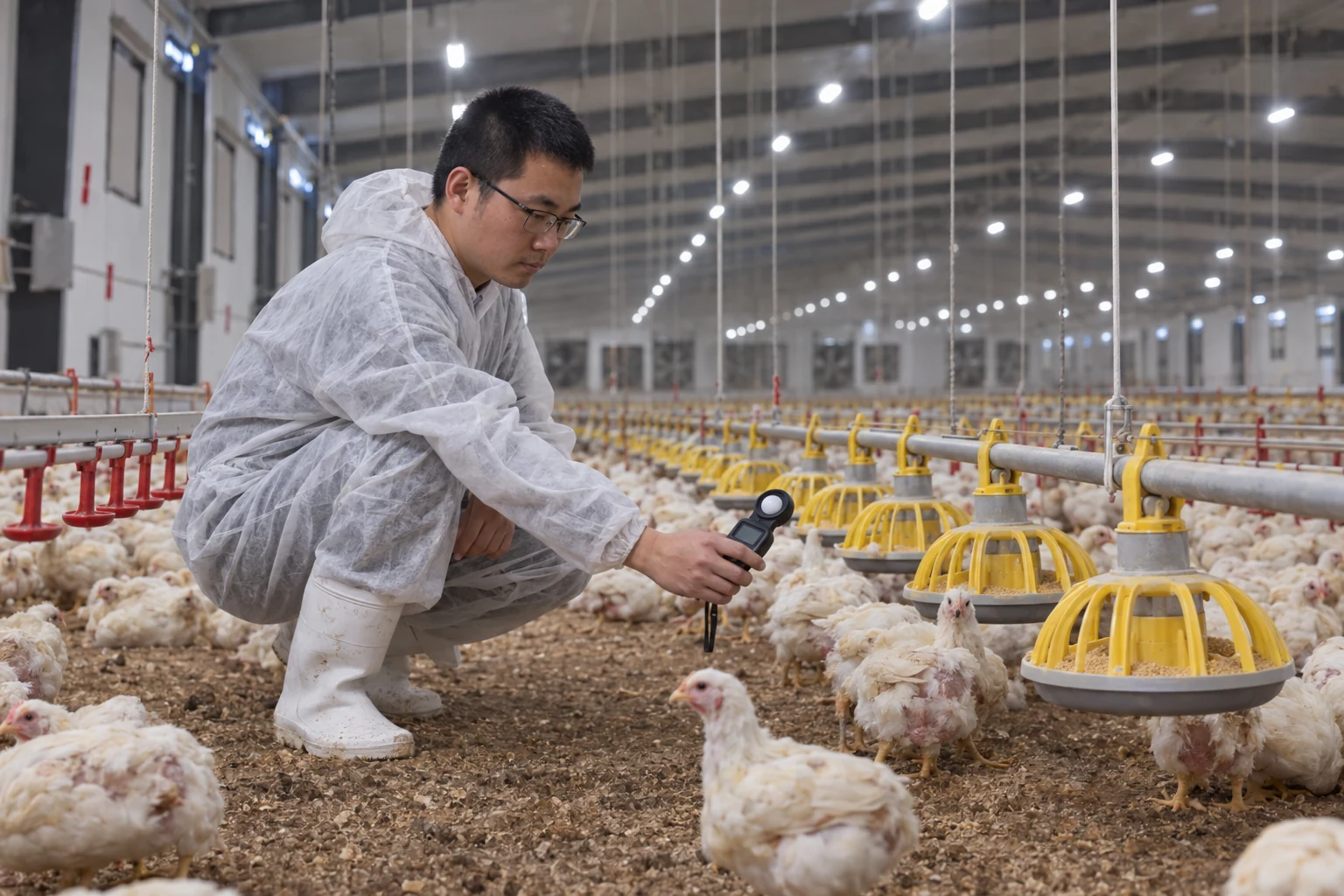
LED lighting for poultry affects birds through a visual system that responds differently from human vision. Chickens can detect a wider spectral range and may experience brightness, color, and flicker differently from a person standing in the same house. A room that looks acceptable to you may therefore need a different measurement and control approach for the flock.
Why does bird vision change the specification?
Look through the bird’s environment. Poultry respond to wavelength, intensity, duration, distribution, and temporal changes in light, so a human-centered lux reading cannot describe every biological effect. Your specification should separate:
- Daily light period, or the hours of light and darkness
- Intensity measured at relevant bird locations
- Spectral power distribution rather than color appearance alone
- Flicker behavior across the full dimming range
How should you measure light at bird level?
Take the meter to the flock. Measure at bird height under fixtures, between fixtures, near walls, around feeders, and at both ends of the house after the system has warmed up. Record:
- Maximum, minimum, and average readings
- Dimmer setting and actual measured output
- Daylight leakage near inlets, doors, or fans
- Changes after cleaning or equipment movement
| Measurement point | What it reveals | Corrective action |
|---|---|---|
| Directly below a lamp | Peak intensity | Adjust output or beam spread |
| Between lamps | Dark zones | Revise spacing or optics |
| Barn edges | Coverage loss or leakage | Adjust layout or block stray light |
Key Takeaway: Bird-level measurements reveal conditions that a wall control setting or eye check can miss. The pattern across the house matters more than one convenient reading.
3. How Does LED Lighting for Poultry Control Color and Spectrum?
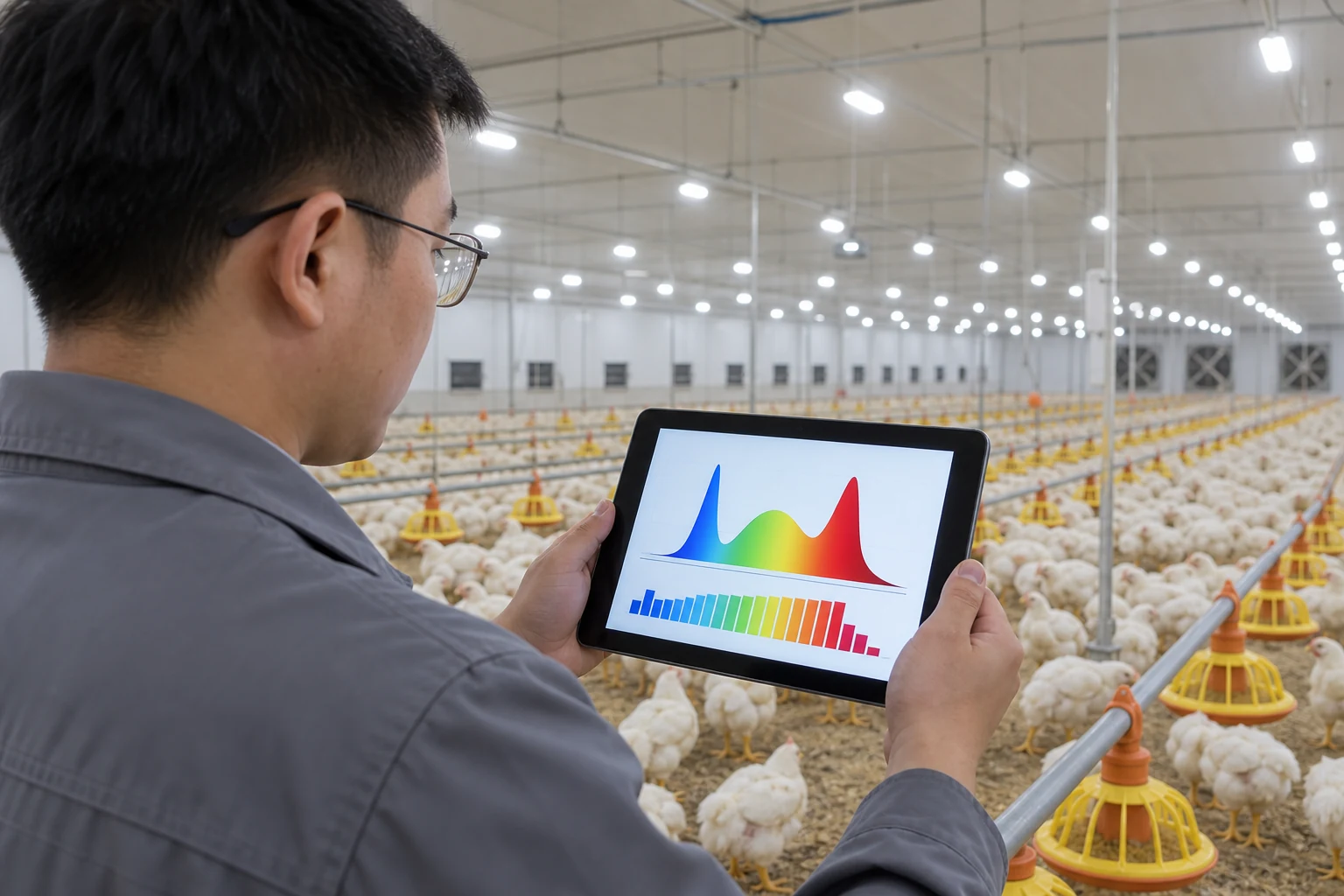
LED lighting for poultry can deliver selected spectral distributions that fixed-output legacy lamps cannot easily provide. Poultry responses can vary with wavelength, flock type, age, intensity, and timing, so a color claim without a complete program has limited value. You should match spectrum decisions to a defined production stage and verify them through documented engineering review, trials, or accepted guidance.
What does research say about different spectra?
Read the conditions behind each result. Studies have reported different behavioral and production responses under red, blue, green, and mixed spectra, yet results cannot be transferred blindly between broilers, pullets, layers, or breeders. Check:
- Bird strain, sex, and age
- Spectrum measurement and intensity basis
- Daily light period and housing conditions
- Sample size, duration, and measured outcomes
How should you choose a spectrum for a flock?
Use a controlled decision path. Start with the farm’s veterinary or production program, then ask the lighting supplier for a measured spectral power distribution and repeatable product specification. Avoid choosing by visible lamp color alone, and review:
- White or tuned spectrum required by the program
- Stage-specific changes during rearing or production
- Compatibility between spectrum settings and dimming
- A small-scale comparison before full installation
| Decision factor | Question for the supplier | Risk if omitted |
|---|---|---|
| Spectrum | Can you provide measured spectral data? | Color labels may hide output differences |
| Flock stage | Which setting applies at each age? | One program may not suit the full cycle |
| Repeatability | How is batch consistency checked? | Replacement lamps may behave differently |
Key Takeaway: A useful spectrum choice links measured output to one flock, one stage, and one operating plan. Treat spectrum as a controlled parameter, not a marketing color name.
4. How Should LED Lighting for Poultry Manage Light Intensity?
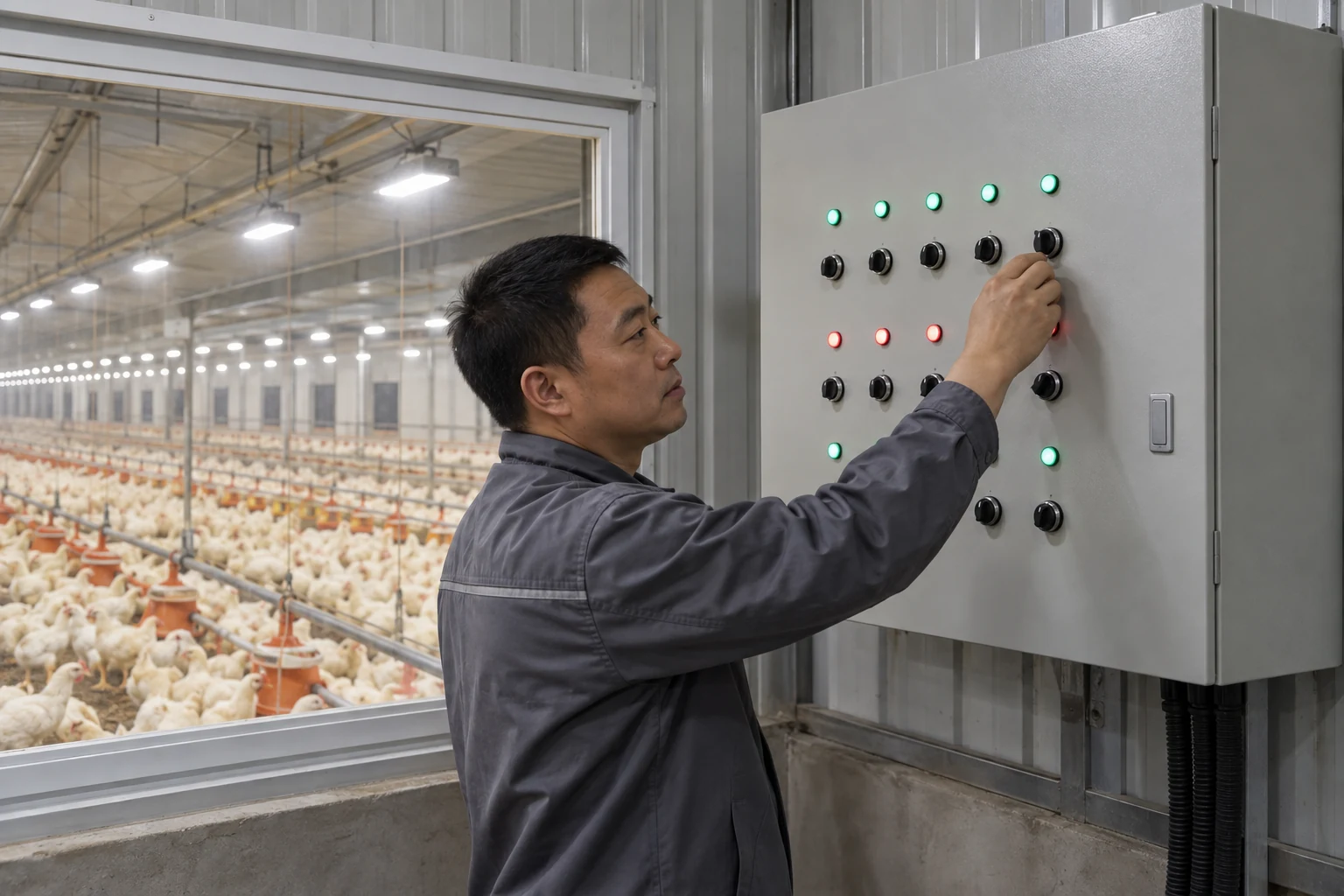
LED lighting for poultry should deliver the required intensity at bird level and maintain smooth, stable output through the usable dimming range. The target should come from the production program, bird type, age, welfare rules, and local regulations rather than a universal number. Commission the system with measurements instead of relying on a dimmer percentage.
Why does dimming range matter?
Test the low end carefully. Poultry programs may require large changes between early and later stages, and some lamp-driver combinations flicker, drop out, or vary between rows at low settings. Ask the supplier to demonstrate:
- Smooth output from maximum to the required minimum
- Stable startup at every programmed level
- No visible flicker, ghosting, or row-to-row mismatch
- Repeatable behavior after power interruption
How do you build an intensity schedule?
Let the flock plan lead. Translate the approved management schedule into timed target settings, gradual transitions, and measured verification points, then restrict unplanned changes. Include:
- Initial settings for placement and early growth
- Planned changes by age or production phase
- Dawn and dusk transitions where required
- A manual override and change log
| Control item | Commissioning check | Record to keep |
|---|---|---|
| Maximum output | Bird-level readings across the barn | Measurement map |
| Minimum output | Stability and uniformity | Dimmer setting and readings |
| Transitions | Smooth rise and fall | Timer program |
Key Takeaway: A measured schedule gives you repeatable conditions while protecting the biological program from casual adjustments. Commissioning connects the written schedule with the light birds receive.
5. How Does LED Lighting for Poultry Support Better Uniformity?
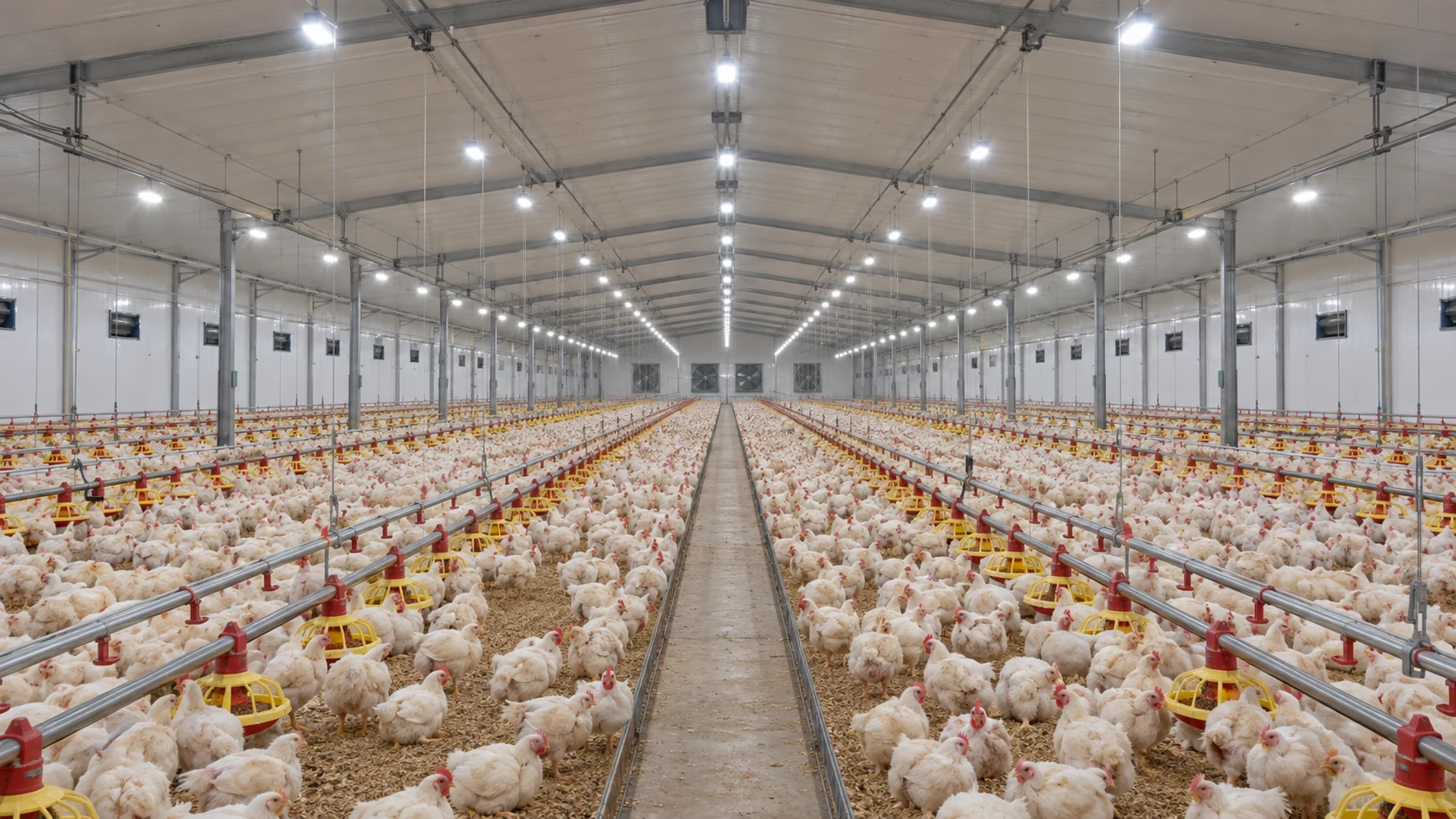
LED lighting for poultry supports better uniformity when fixture spacing, beam angle, mounting height, obstructions, and dimming behavior are engineered together. Consistent distribution can reduce bright hot spots and deep shadow zones around feeders, drinkers, walls, and equipment. A light-distribution plan and lighting test program should be followed by on-site measurements because real barns rarely match an empty drawing perfectly.
What causes dark zones and hot spots?
Follow the light path. Problems often come from wide spacing, unsuitable optics, blocked beams, reflective surfaces, voltage variation, or mixed lamp types. Review:
- Fixture rows and distance between mounting points
- Beam distribution and mounting orientation
- Equipment that moves or blocks light
- Electrical conditions at the far end of each circuit
How should you verify uniformity on site?
Map the house in a grid. Take readings at repeatable bird-level points after installation, at several dimming levels, and after normal equipment is in place. Record:
- Point location and measured intensity
- Maximum-to-minimum variation
- Control setting and operating state
- Corrective changes to aim, spacing, or output
| Uniformity issue | Likely cause | Verification step |
|---|---|---|
| Bright pools | Narrow beam or low mounting | Compare beam and spacing |
| Dark lanes | Excessive spacing or blockage | Measure between rows |
| Uneven dimming | Driver or circuit mismatch | Test several control levels |
Key Takeaway: A measurement map helps you correct the barn as a system instead of chasing isolated complaints. The grid shows whether the problem belongs to layout, optics, controls, or wiring.
6. How Can LED Lighting for Poultry Reduce Energy and Maintenance?
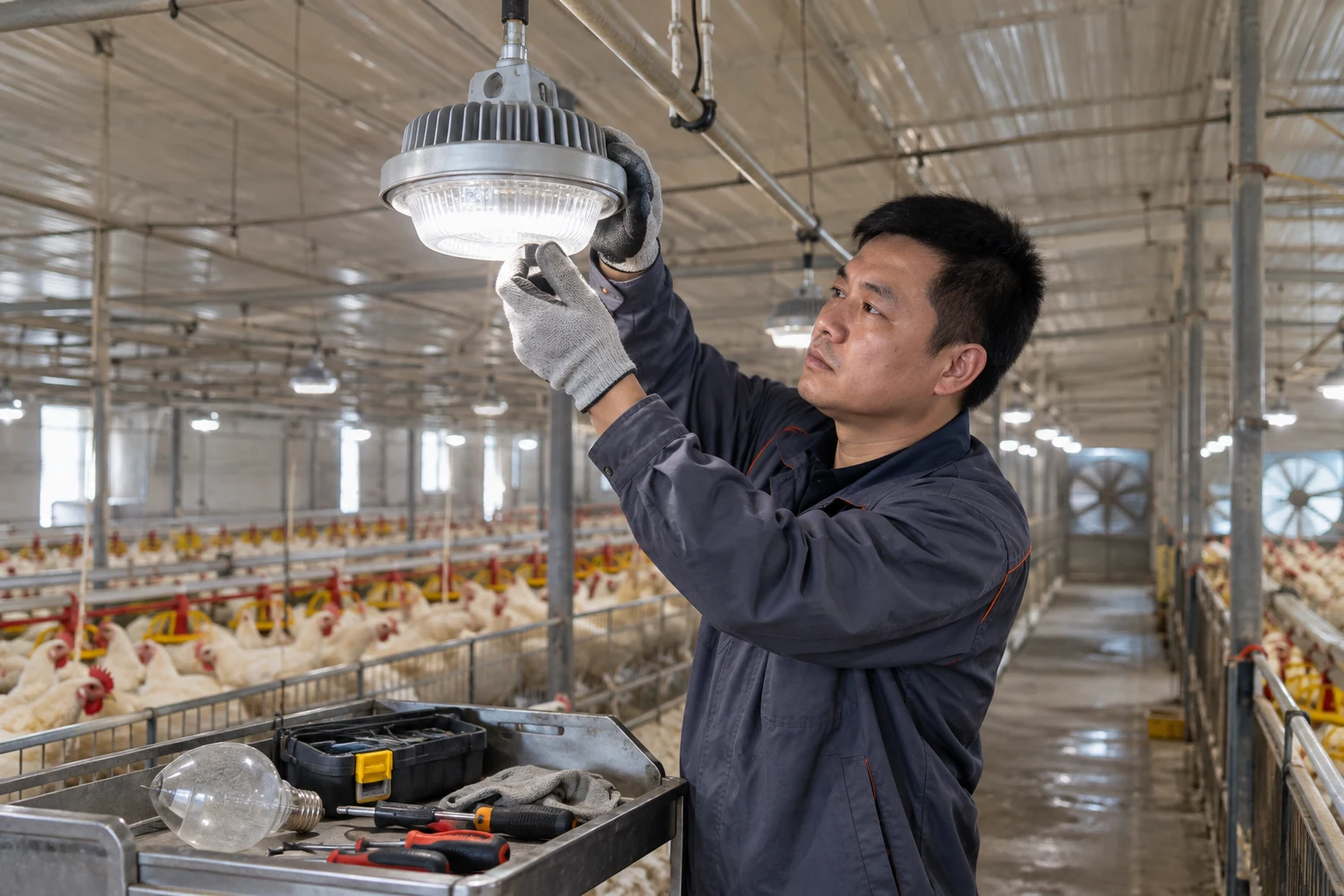
LED lighting for poultry can reduce lighting electricity and routine replacement work when it replaces less efficient sources and runs under a disciplined schedule. The financial result depends on installed wattage, operating hours, electricity price, control strategy, lamp survival, cleaning labor, and access cost. Calculate savings from your own baseline rather than adopting a percentage from another farm.
Where do operating savings come from?
Build the calculation from the panel. Compare existing and proposed connected load, then apply actual daily schedules for each production stage. Include:
- Fixture quantity and measured input wattage
- Hours at each dimming level
- Annual flock cycles and downtime
- Cooling interaction where lamp heat differs
How should you compare service life cost?
Count the work around the lamp. Purchase price is only one line; maintenance access, failed drivers, cleaning, spare stock, downtime, and disposal can alter the result. Our quality-control process provides a useful framework for asking how production and outgoing checks protect repeat orders. Compare:
- Initial fixture, control, wiring, and installation cost
- Expected energy cost under the programmed schedule
- Warranty terms and replacement procedure
- Labor and production disruption from service work
| Cost category | Existing system | Proposed LED system |
|---|---|---|
| Connected load | Record measured watts | Use verified input watts |
| Operating schedule | Record hours and levels | Model programmed levels |
| Maintenance | Use actual failure history | Review warranty and access plan |
Key Takeaway: A service life comparison shows whether the proposed system saves money under your barn’s real operating conditions. The strongest business case uses farm records and supplier evidence in the same calculation.
7. What Controls Should LED Lighting for Poultry Include?
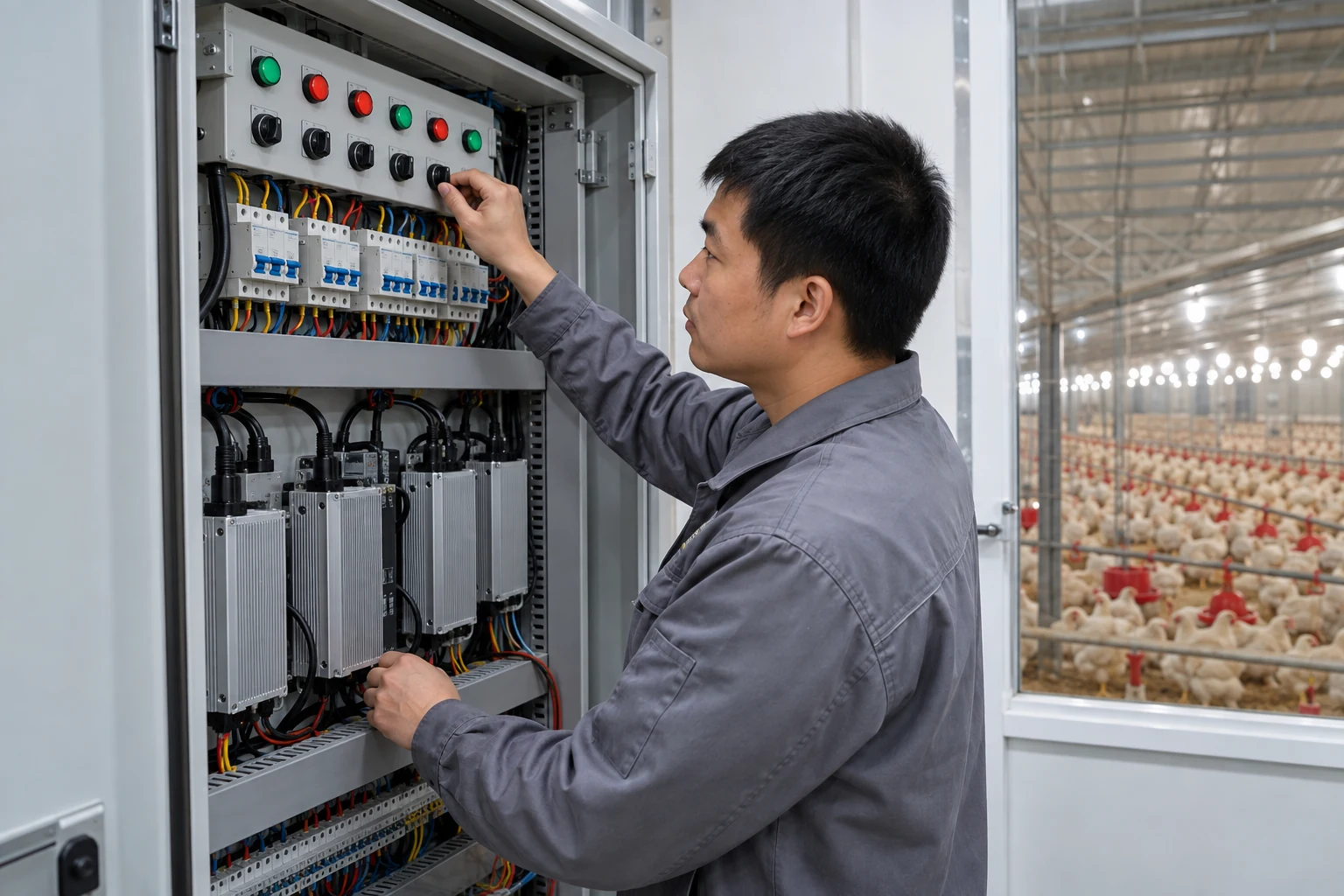
LED lighting for poultry should include compatible dimming, reliable scheduling, gradual transitions, manual override, and clear recovery behavior after a power interruption. Controls must match the LED driver electrically and cover the farm’s required output range. A lamp that works at full power may still fail the project if it behaves poorly at low settings.
Which control functions matter most?
Design for routine use. Farm staff need a control interface they can understand without bypassing the approved program. Specify:
- Daily and stage-based schedules
- Gradual dawn and dusk transitions
- Locked settings or user permissions
- Alarm, override, and restart behavior
How do you avoid lamp and dimmer mismatch?
Test the complete pair. Ask for written compatibility between the fixture driver and proposed dimmer, then operate sample units across every required setting before installation. Confirm:
- Dimming method and wiring topology
- Minimum stable output and startup load
- Flicker and current behavior across the curve
- Performance with the planned number of fixtures per circuit
| Compatibility check | Pass condition | Warning sign |
|---|---|---|
| Full dimming sweep | Smooth and stable output | Dropout or sudden steps |
| Low-level operation | Equal row output | Flicker or ghosting |
| Power recovery | Returns to intended program | Random level or reset |
Key Takeaway: Testing the lamp, driver, dimmer, wiring, and load together prevents field failures that a fixture-only test may miss. Approve the control package only after the complete circuit behaves as specified.
8. How Should LED Lighting for Poultry Handle Barn Conditions?
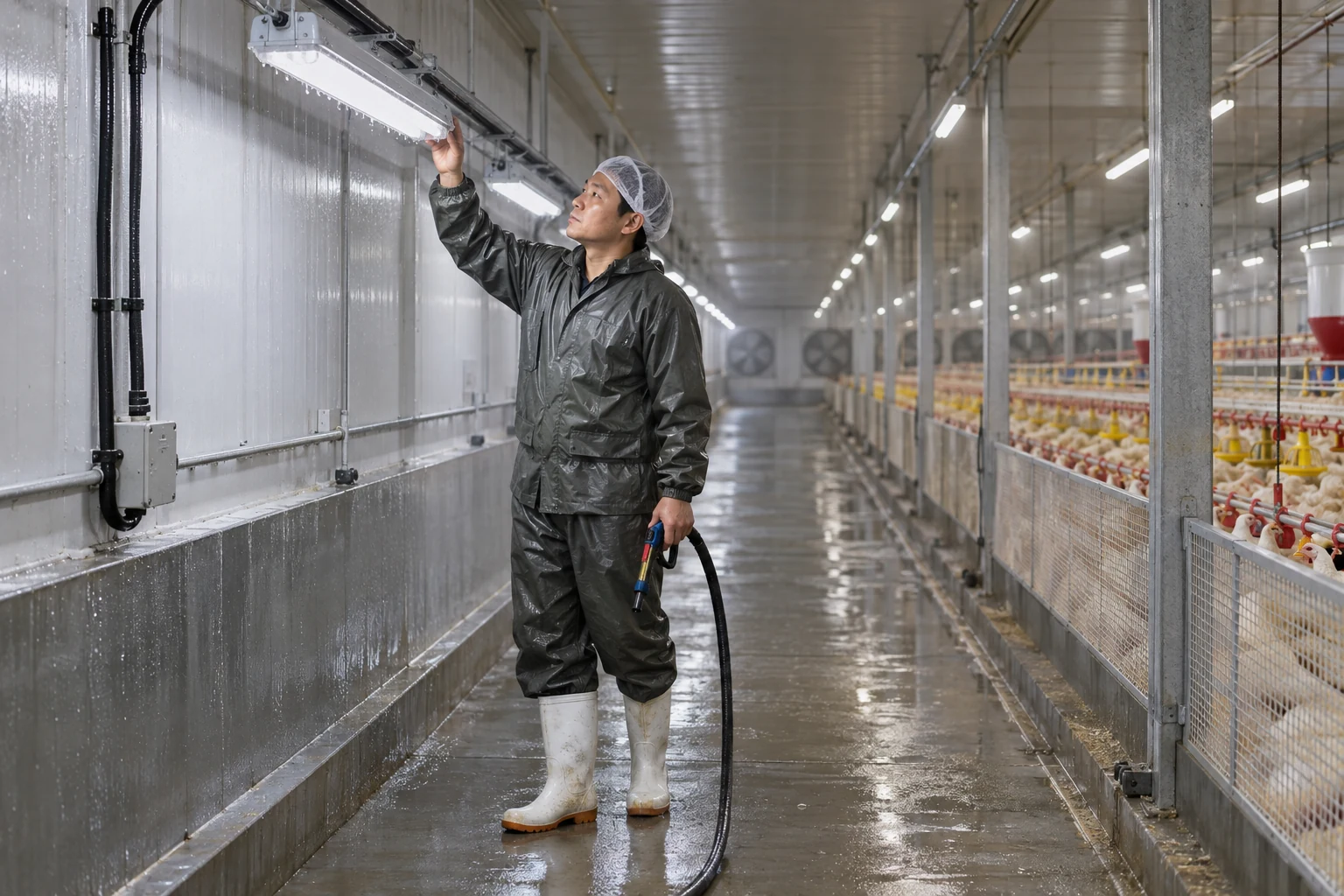
LED lighting for poultry should use fixtures, seals, cables, connectors, coatings, and thermal design suited to dust, humidity, cleaning, vibration, and corrosive contaminants found in animal housing. A residential lamp may save energy on paper yet fail early in a poultry environment. Environmental protection must cover the complete installed assembly, including joints and entry points.
Which environmental risks affect fixtures?
Inspect the whole enclosure. Cleaning water, dust, ammonia-rich air, heat, cold, and power quality can attack different components over time. Review:
- Ingress protection for the actual cleaning method
- Corrosion resistance of housing, fasteners, and connectors
- Thermal performance under dust accumulation
- Cable glands, seals, sockets, and junction boxes
What should testing and documentation cover?
Ask for evidence by model. Generic certification claims do not prove that every configuration suits a poultry house, so match reports and ratings to the exact product model and market; review the site’s certification support before defining the document package. Request:
- Applicable safety and electromagnetic compliance documents
- IP test evidence for the complete enclosure
- Thermal, aging, and electrical test records
- Cleaning instructions and excluded chemicals
| Barn exposure | Product response | Evidence to review |
|---|---|---|
| Dust and moisture | Sealed enclosure and entries | IP test report |
| Corrosive air | Suitable materials and coatings | Material declaration or test |
| Cleaning | Defined cleaning limits | Installation and cleaning guide |
Key Takeaway: Model-specific evidence helps you separate a farm-ready assembly from a lamp carrying broad marketing claims. Match each environmental risk with a design response and a document you can verify.
9. How Do You Specify LED Lighting for Poultry Projects?

LED lighting for poultry should be specified from the flock program outward: biological requirements define light settings, the barn defines layout and protection, and the electrical system defines controls and wiring. A useful request for quotation gives suppliers enough detail to propose and price the same scope. It also separates mandatory requirements from options that can be tested during sampling and prototyping. For projects sold into the European Union, compare the lighting plan with the official broiler welfare requirements and each country’s implementation.
What information should your request for quotation contain?
Make the barn visible on paper. Share drawings, dimensions, mounting points, equipment positions, supply voltage, control requirements, target market, and expected cleaning process. Include:
- Poultry type, age stages, and management program
- Target intensity, spectrum, daily light period, and transition needs
- Barn geometry, fixture height, and obstruction locations
- Environmental, certification, warranty, and documentation needs
How should samples be reviewed?
Test before you scale. Use a representative sample circuit with the intended control method, then review construction, output, dimming, temperature, cleaning resistance, and installation access; Our factory capability can support prototype-to-production discussions. Record:
- Approved sample identity and configuration
- Measured electrical and optical results
- Required corrections and revision history
- Production acceptance criteria
| request for quotation block | Required input | Supplier response |
|---|---|---|
| Biological program | Stages and target settings | Proposed output and control plan |
| Barn layout | Drawing and mounting data | Fixture layout and quantity |
| Approval | Tests and documents | Sample and validation schedule |
Key Takeaway: A detailed request for quotation and signed sample give purchasing, engineering, and production one shared reference. Use the request for quotation to expose assumptions before they become purchase-order changes.
10. How Do You Validate LED Lighting for Poultry Before Purchase?
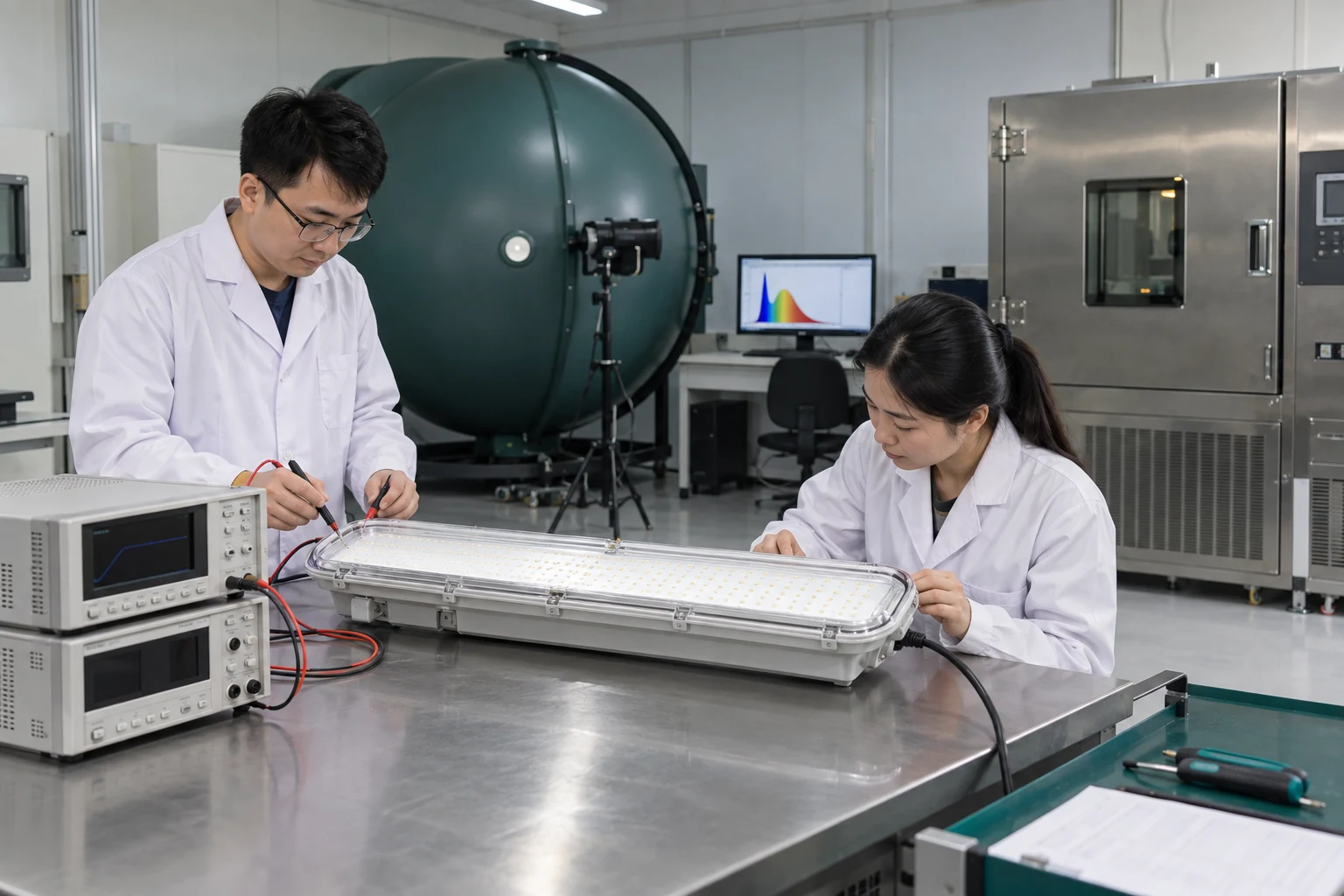
LED lighting for poultry should be validated through document review, sample testing, layout checks, control compatibility tests, and clear production acceptance criteria. Approval should cover the exact fixture, driver, dimmer, cable, connector, and enclosure combination you plan to buy. The decision is stronger when farm operations, animal management, electrical engineering, and procurement sign off on the same evidence.
Which tests belong in the approval process?
Recreate real operating conditions. Test full and low output, repeated switching, programmed transitions, thermal behavior, optical distribution, electrical safety, and relevant environmental protection. Your checklist should include:
- Input power and power-quality measurements
- Bird-level output and uniformity mapping
- Dimming stability and flicker assessment
- Aging, thermal, ingress, and cleaning checks as applicable
What should the final purchase decision record?
Freeze the approved configuration. Place the agreed specification, sample reference, documents, inspection plan, warranty, spare strategy, and change-control rules in the purchasing file. Record:
- Exact model and controlled components
- Approved drawings, samples, and test reports
- Production inspection and batch-consistency checks
- Installation, commissioning, and after-sales responsibilities
| Approval gate | Evidence | Owner |
|---|---|---|
| Technical fit | Drawing, layout, and sample results | Engineering and farm team |
| Compliance | Applicable model-specific documents | Compliance and purchasing |
| Production release | Inspection plan and approved sample | Supplier and buyer QC |
Key Takeaway: A documented approval package protects performance from sample approval through repeat orders. If one gate lacks an owner or evidence, keep the purchase decision open.
A sound poultry lighting project solves five connected problems: it gives birds a defined light program, gives farm staff usable controls, gives maintenance teams suitable hardware, gives buyers verifiable specifications, and gives management a measurable operating case. Our engineering team can review your barn drawings, target settings, electrical controls, environmental conditions, and market requirements before proposing a standard or customized LED solution.
If you are planning a retrofit or new poultry house, contact us today with your layout and operating program for an engineering review. Our position is straightforward: agricultural lighting should be specified around the animals, verified in the barn, and manufactured for repeatable performance.
Frequently Asked Questions
Can I replace poultry-house incandescent lamps with LED lamps directly?
Usually not without checking the dimmer, sockets, wiring, circuit load, beam distribution, and required low-light range. A sample circuit can reveal incompatibility before a whole-house retrofit.
What’s the best LED color for every poultry flock?
There is no single color for every flock. Bird type, strain, age, production stage, intensity, daily light period, and management goals can change the response, so use an approved program and measured spectrum.
How do I know if the light is uniform enough?
Measure it at bird level on a repeatable grid. Compare points beneath lamps, between rows, near walls, and around equipment at several dimming settings.
Can I use household LED lamps in a commercial poultry barn?
They are generally a poor choice for demanding commercial conditions. Confirm agricultural suitability, environmental protection, dimming compatibility, thermal design, warranty terms, and model-specific evidence.
How do I know if a supplier’s sample will match production?
Freeze the approved model, components, settings, drawings, and test results. Add batch inspection criteria and written change control so substitutions require review.
